
 Worksheets
Tides and moon phases
Total questions: 32
Worksheet time: 32mins
The moon phases occur because...
the sun, the earth, and the moon do a dance and create shadows
the moon grows and shrinks
the moon revolves around the earth
the moon produces its own light
The moon goes through every phase..
once a month
twice a month
once a year
the moon doesn't have phases, it has seasons
In relation to the moon, waxing means...
growing
shrinking
shining
i don't know, the karate kid does it
In relation to the moon, waning means...
growing
shrinking
crying
don't horses wane?
We always see the same side of the moon
True
False
the moon affects
the coriolis effect
global conveyor belt
the tides
how we behave
the moon is a natural satelite
true
false
The moon is twice as large as the earth
False
True
The moon is made of cheese
yep, swiss cheese
no.. pretty sure its just a rock
As the moon moves from a new moon to a full moon, you see:
the moon appearing increasingly lighter
the amount of light the moon gets staying constant
the amount of light the moon is receiving is decreasing
more light and then less light
Mrs. Smith says "the moon looks larger than the stars!" What explains this?
the moon soaks up the star's light
the moon is larger than stars
the moon is larger than earth
the moon is closer to earth than the stars are
Define gibbous
less than half of moon visible
all of moon visible
more than half of moon visible
none of moon visible

The diagram shows how Earth spins on its axis, causing day and night. Which term describes the movement shown?
tilt
orbit
rotation
revolution
How long does it take Earth to complete one orbit around the sun?
1 day
27 days
60 days
365 1/4 days
When Earth moves into the moon's shadow, a solar eclipse takes place. Which phase represents the appearance of the moon during a solar eclipse?
full moon
new moon
third quarter
waning gibbous
Which gravitational pull has the greatest effect on tides?
the sun's gravitational pull on Earth
the moon's gravitational pull on Earth
Earth's gravitational pull on the moon
the sun's gravitational pull on the moon
Which term describes the periodic rise and fall of the water level in the oceans and other large bodies of water?
current
neap
tide
wave
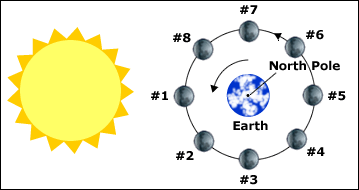
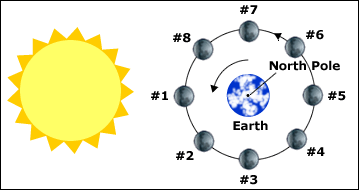
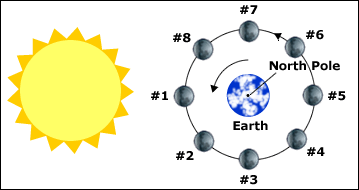
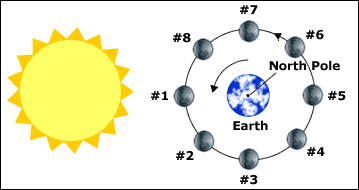
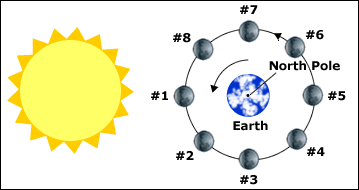


As the moon revolves around the earth, the water follows the motion and causes...
sea levels
waves and currents
moon phases
high tides and low tides
Spring tides have the largest tidal ranges because...
the earth, moon, and sun are aligned for greater gravitational force.
the moon has the strongest gravitational force.
the sun has the most gravitational force.
none of the above
During neap tides, the gravitational effects of the sun and moon ______________ together.
do not add
are added
increase
don't change
High tides and low tides each happen _____ times per day.
4
2
1
24

