wayground logo

Free Printable Worksheets

Font size

S
M
L
XL
Worksheets

water cycle, ground water, porosity and permeability

Total questions: 47

Worksheet time: 30mins

Name
Class
Date
1.
An underground layer of permeable rock that holds groundwater which can be extracted by drilling a well.
a)
water table
b)
aquifer
c)
watershed
d)
river
2.
Porosity refers to...
a)
the shape of the particles
b)
The sorting of the particles
c)
% of pore space in a material
d)
% of cement in a material
3.
If porosity is low then permeability is ______________.
a)
low
b)
high
4.
Poorly sorted soil...
a)
has low porosity
b)
has high porosity
c)
has high pore space
d)
means water will move through quickly
5.
Well sorted soil...
a)
has low porosity
b)
has low pore space
c)
has high porosity
d)
means water will move through slowly
6.
The measure of how easily water can flow through an aquifer. 
a)
porosity
b)
permeability
c)
gradient
d)
divide
7.
Base your answer to the following question on the diagram, which represents samples of soil and bedrock at Earth’s surface.  The arrows represent possible infiltration of rainwater   Which sample probably has the greatest porosity?
a)
Granite bedrock
b)
Pebble-and-sand soil
c)
Pebble soil
d)
Conglomerate bedrock
8.
Rain soaks into the ground
a)
Infiltration
b)
Condensation
c)
Throughflow
d)
Surface runoff
9.

Water changing from liquid to vapor (gas), usually due to the Sun's heat.

a)

Evaporation

b)

Condensation

c)

Precipitation

d)

Transpiration

10.

Water flowing downhill, through gravity, over the Earth's surface, collecting into streams and rivers.

a)

Runoff

b)

Precipitation

c)

Groundwater

d)

Evaporation

11.

A porous layer of rock underground that can store water is a:

a)

Aquifer

b)

Aquitard

c)

Aquaman

d)

Wet rock

12.
What is the process during which water cools and turns from a gas to a liquid?
a)
Codensation
b)
Runoff
c)
Precipitation
d)
Evaporation
13.

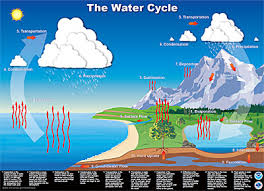
What process is happening in number 6?

a)

transpiration

b)

evaporation

c)

condensation

d)

accumulation

14.
During which stage do clouds form?
a)
condensation
b)
evaporation
c)
precipitation
15.
Which best explains why runoff is important?
a)
It returns water to other locations on Earth
b)
It increases the chance of flooding
c)
It makes evaporation occur faster
d)
It increases condensation
16.
97% of the water on earth is _________, making it undrinkable for humans.
a)
fresh water
b)
ground water
c)
salt water
d)
surface water
17.
What is it called when plants give off water vapor as a waste product?
a)
condensation
b)
evaporation
c)
sublimation
d)
transpiration
18.
What is the hydrosphere?
a)
Water on the earth's surface
b)
Oceans of the Earth
c)
Rivers, oceans and lakes of the Earth
d)
None of the above
19.

What step of the hydrologic cycle is responsible for transporting pollution from farms into nearby streams, rivers and eventually to lakes?

a)

run-off

b)

infiltration

c)

evaporation

d)

condensation

20.

The ability for water to flow through rocks and sediments.

a)

porosity

b)

permeability

c)

percolation

d)

infiltration

21.

The hydrologic cycle is powered by energy from what?

a)

The Sun

b)

The Moon

c)

The Wind

d)

Human interaction

22.

The amount of water on earth grows by _______ each year.

a)

0%

b)

5%

c)

15%

d)

25%

23.

An area of land that drains to a particular river, lake, bay, or other body of water.

a)

Tributary

b)

Wetland

c)

Divide

d)

Watershed

24.
Which diagram represents the soil with the greatest permeability?
a)
Choice 1
b)
Choice 2
c)
Choice 3
d)
Choice 4
25.
Water flows through permeable materials ____________________ than impermeable materials.
a)
slower
b)
faster
26.

What is the relationship between soil type/particle size and permiability (as shown by the bar graph below)?

a)

The larger the particle size, the slower the permeability rate

b)

The smaller the particle size, the faster the permeability rate

c)

There is no relationship between particle size and permeability

d)

The larger the particle size, the faster the permeability rate

27.
Impermeable materials...
a)
have an abundance of pores.
b)
let water in.
c)
have little to no pores.
28.
The measure of how easily water can flow through an aquifer. 
a)
porosity
b)
permeability
c)
gradient
d)
divide
29.

If water can easily move between cracks of a rock, we can say that...

a)

water is permeable

b)

rock is permeable

c)

rock is impermeable

d)

water is impermeable

30.

______ is more permeable since water passes through it

a)

gravel

b)

sand

c)

clay

d)

Silt

31.

Water flows through permeable materials ____ than impermeable materials.

a)

slower

b)

faster

32.

If porosity is low then permeability is

a)

low

b)

high

33.

The amount of space between sediment is called ...

a)

permeability

b)

porosity

c)

evaporation

d)

condensation

34.

If water can easily move between cracks of a rock, we can say that...

a)

water is permeable

b)

rock is permeable

c)

rock is impermeable

d)

water is impermeable

35.

What is permeability?

a)

The amount of space between particles

b)

The ability to hold water

c)

The number of openings in your face

d)

The ability to allow water to flow through

36.

What is porosity?

a)

The amount of space between particles

b)

The number of particles in a sample

c)

The number of openings in your face

d)

The ability to allow water to flow through

37.
Porosity refers to...
a)
the shape of the particles
b)
The sorting of the particles
c)
% of pore space in a material
d)
% of cement in a material
38.
The ___________________ the grain size, the faster the water will move through the soil.
a)
more mixed
b)
smaller
c)
larger
39.
the measure of the storage space available in an aquifer.
a)
aquifer
b)
permeability
c)
porosity
d)
divide
40.
A sponge has high porosity.  A rock can have it too.  Porosity is...
a)
the inability to hold water
b)
the ability to hold water
c)
allowing water to pass through
41.
A soil sample with a large amount of space between the particles will have a
a)
High Porosity
b)
Low permeability rate
c)
High capillarity
d)
Low infiltration rate
42.

What type of sediment tends to be the most impermeable?

a)

sand

b)

clay

c)

silt

d)

rocks

43.

Define permeability

a)

Water

b)

Nothing

c)

Percent of volume of open spaces in rock or sediment

d)

Ability rock/sediment fluids pass through open spaces/pores

44.

What is porosity

a)

Rocks

b)

The percent of the volume of open spaces in rock or sediment

c)

Ability rock sediment fluids pass through open spaces/pores

d)

Nothing

45.

What affect does particle size have on permeability

a)

No effect

b)

The larger the particles the lower the permeability

c)

The larger the particles the higher the permeability

d)

The smaller the particles the higher the permeability

46.

If particle size decreases permeability

a)

decreases

b)

increases

c)

stays the same

d)

It could increase or decrease

47.

What is a measure of how well a material absorbs water? There are multiple answers.

a)

permeability

b)

occlusion

c)

porosity

d)

exclusion