wayground logo

Free Printable Worksheets

NEW

Font size

S
M
L
XL
Worksheets

Chemistry Review Quizizz

Total questions: 55

Worksheet time: 42mins

Name
Class
Date
1.
The mold and bacteria rotting the sandwich is a 
a)
physical change
b)
chemical change
c)
both
d)
neither
2.
The diagram shows the molecules of water breaking up into oxygen and hydrogen atoms in electrolysis. This is a 
a)
physical change
b)
chemical change
c)
both
d)

neither

3.
Cutting paper is a 
a)
physical change
b)
chemical change
c)
both
d)
neither
4.
Bo Jackson snapping his bat after striking out is a 
a)
chemical change
b)
physical change
c)
both
d)
neither
5.
When water boils it is a 
a)
physical change
b)
chemical change
c)
both
6.
When silver tarnishes it is a 
a)
chemical change
b)
physical change
c)
both
7.
As the cake batter baked the color change and change in smell showed that...
a)
a chemical change took place
b)
the cake just changed state. This is a physical change. It can be melted back to batter.
8.
Photosynthesis is a 
a)
chemical change
b)
physical change
c)
neither
d)
both
9.
We know photosynthesis is a chemical change because
a)
the glucose and oxygen produced are different molecules than CO2 and H2O
b)
It's not a chemical change
c)
Plants create new matter and destroy the carbon dioxide and water
10.
All of the following are chemical changes except...
a)
plastic burning
b)
combining two chemicals that begin to fizz and decrease in temp
c)
food rotting
d)
Change of state
11.
When iron is melted it is a 
a)
physical change
b)
chemical change
c)
neither
d)
both
12.
Bending metal is a 
a)
physical change
b)
chemical change
c)
both
d)
neither
13.
When iron rusts (as shown) it is a 
a)
physical change
b)
chemical change
c)
both
d)
neither
14.
Mixing different colors of food coloring to produce a new color is a 
a)
physical change
b)
chemical change
c)
both
d)
neither
15.
What is the chemical symbol for the element hydrogen
a)
H
b)
He
c)
h
d)
he
16.
What is the chemical symbol for the element oxygen
a)
O
b)
Oxy
c)
ox
d)
Oy
17.

Which element is known at the building blocks of life?

a)

hydrogen

b)

helium

c)

oxygen

d)

carbon

18.
all matter is made of what 
a)
energy 
b)
atoms 
c)
electrons 
d)
compounds 
19.

In a ___________change, a substance changes into a different substance.

a)

Physical

b)

Chemical

20.
DIFFERENT kinds of atoms chemically combined to form a substance are
a)
Mixture
b)
Element
c)
Compound
d)
Substance
21.
A substance that cannot be broken down into a simpler substance is called ______________
a)
a mixture
b)
a componud
c)
a suspension
d)
an element
22.
A substance that is made up for one type of atom is called an:
a)
atom
b)
element
c)
compound
d)
mixture
23.

State of matter

a)

Physical property

b)

Chemical property

24.

Color

a)

Physical property

b)

Chemical property

25.
He
a)
Hexon
b)
Hydrogen
c)
Radion
d)
Helium
26.
Zn
a)
Zinc
b)
Clenium
c)
Zeezee
d)
Zecasium
27.

Hydrogen Peroxide (H2O2) is an example of a(n)

a)

compound

b)

element

28.

Why is water NOT on the periodic table?

a)

It is naturally occuring

b)

It is a compound, not an element

c)

It exists as a solid, a liquid, and a gas

d)

Its chemical formula doesn't fit

29.

Which of the following is an example of a compound?

a)

copper (Cu)

b)

Iron (Fe)

c)

Carbon (C)

d)

Water (H2O)

30.

Which task in the kitchen is an example of a physical change?

a)

frying an egg

b)

baking a cake

c)

melting butter

d)

toasting bread

31.

__________________ have a shiny, metallic luster.

a)

Metals

b)

Nonmetals

c)

Metalloids

32.

Ice melting

a)

Chemical Change

b)

Physical Change

33.

Physical change

a)

create a new substance

b)

rusting

c)

change the appearance, but not the chemical composition

d)

burning

34.

properties of both metals and nonmetals

a)

Metals

b)

Metalloids

c)

Non Metals

35.
What is anything that has mass and takes up space known as?
a)
Mass
b)
Atom
c)
Molecule
d)
Matter
36.
The particles that are found in the nucleus of an atom are
a)
neutrons and electrons
b)
electrons only
c)
protons and neutrons
d)
protons and electrons
37.
Which part of an atom is POSITIVELY charged?
a)
protons
b)
neutrons
c)
electrons
d)
atoms
38.
What part of an atom is NEGATIVELY charged?
a)
protons
b)
neutrons
c)
electrons
d)
atoms
39.
Which part of an atom has no charge?
a)
protons
b)
neutrons
c)
electrons
d)
atoms
40.
What is the picture displayed?
a)
Atom
b)
Element
c)
Molecule
d)
Compound
41.
Protons are equal to:
a)
Atomic Mass
b)
Number of neutrons
c)
Atomic Number
d)
All of the subatomic particles
42.
A particle that moves around the nucleus is a(n)...
a)
Proton
b)
Neutron
c)
Electron
d)
Quark
43.
How many protons are in Beryllium?
a)
4
b)
9
c)
5
d)
2
44.
How many electrons does an Iodine atom have?
a)
53
b)
126
c)
73
d)
179
45.
What is the number highlighted?
a)
Atomic number
b)
Atomic mass
c)
Number of protons
d)
Number of electons
46.
How many neutrons are in a Gold atom?
a)
79
b)
196
c)
118
d)
275
47.
a)
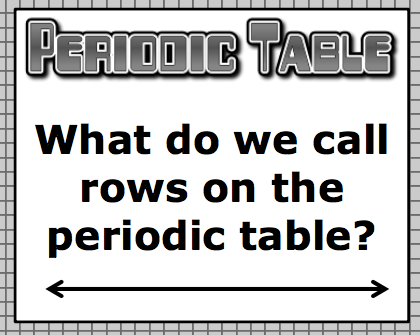
Periods
b)
Groups
48.
a)
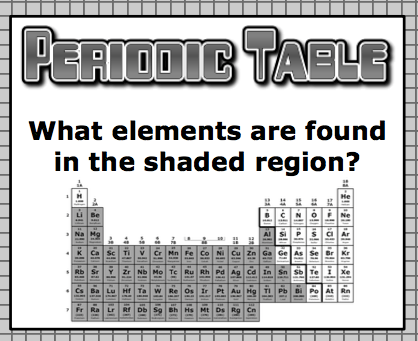
Metals
b)
Nonmetals
c)
Metalloids
49.
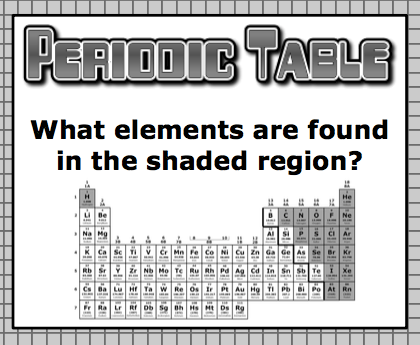
a)
Metals
b)
Nonmetals
c)
Metalloids
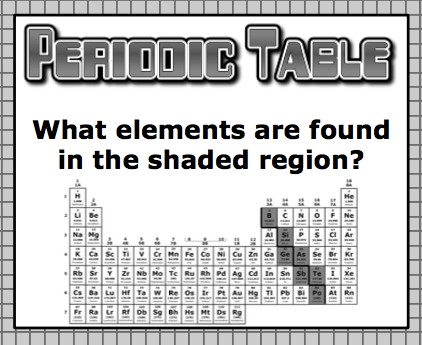
50.
a)
Metals
b)
Nonmetals
c)
Metalloids
51.
How many elements are represented in the compound?
Na2CO3
a)
1
b)
2
c)
3
d)
4
52.

In a ___________change, a substance changes into a different substance.

a)

Physical

b)

Chemical

53.
The law of conservation of mass states that....
a)
Matter can be made
b)
Matter can be destroyed
c)
Matter can neither be made or destroyed
54.

Biochemical elements are:

a)

Needed for life to exist

b)

Nonmetals

c)

Carbon, Hydrogen, Nitrogen, Oxygen, Phosphorous, and Sulfur

d)

All of the above

55.

There are ______ elements on the periodic table.

a)

100

b)

53

c)

118

d)

209