
 Worksheets
AP Physics I 2021 Final Exam Review
Total questions: 150
Worksheet time: 5hrs 49mins

What is object doing at t = 4 s to t = 6 s?
At rest
Speeding up
Slowing down
What is object doing at t = 7 s to t = 9 s?
moving backward.
speeding up
moving forward
moving forward
At what time interval does the object have the greatest speed?
t = 6 s to t = 9 s
t = 1 s to t = 4 s
t = 4 s to t = 6 s

What is the object doing between t = 5 s and t = 10 s?
moving backward
speeding up
slowing down
moving forward
What is the velocity of the object between t = 0 and t = 5 s?
0.8 m/s
0.6 m/s
0.5 m/s
0.9 m/s

What is the distance the object moved from t = 0 min. to t = 10 min.?
300 m
30 m
6 m
600 m
From t = 15 min. to t = 30 min., the object is (slowing down / speeding up) because its velocity is (+ / -) and its acceleration is (+ / -).
slowing down , +v , -a
speeding up , +v , -a
slowing down , -v , -a
slowing down , -v , +a
From t = 30 min. to t = 40 min., the object is (slowing down / speeding up) because its velocity is (+ / -) and its acceleration is (+ / -).
speeding up , -v , -a
slowing down , -v , -a
speeding up , +v , -a
slowing down , -v , +a

These three graphs describe ___ motion.
projectile
free fall
harmonic
rotational

In graph i, acceleration is ( + / - / 0 ) and the object is ____.
+ / moving with constant acceleration
- / moving with constant acceleration
+ / moving with increasing acceleration
- / moving with decreasing acceleration
In graph ii, acceleration is ( + / - / 0 ) and the object is ____.
- / moving with constant acceleration
+ / moving with constant acceleration
- / moving with increasing acceleration
+ / moving with 0 acceleration
In graph ii, acceleration is ( + / - / 0 ) and the object is ____.
- / moving with constant acceleration
+ / moving with constant acceleration
- / moving with increasing acceleration
+ / moving with 0 acceleration
In graph iii, acceleration is ( + / - / 0) and the object is ____.
0 / moving with constant velocity or at rest
+ / moving with increasing acceleration
- / moving with constant acceleration
+ / moving with constant acceleration

In graph 1, velocity is ( + / - / 0 ) and the object is ____.
+ / moving with constant velocity.
- / moving with constant velocity.
+ / moving with 0 velocity
+ / moving with increasing velocity.

What is this object doing?
Moving to the right; slowing down to a rest.
Moving to the right; speeding up.
Moving to the left; slowing down to a rest.
Moving to the right; moves with a constant speed.

What is this object doing?
Moving to the right; speeds up and stops
Moving to the right; speeds up to a constant speed.
Moving to the left; slowing down to a stop.
Moving to the right; slowing down and stops.

What is this object doing?
Moving to the right; slows down to change direction to the left; moves to the left; speeds up to where it started.
Moving to the right; speeds up to change direction to the left; moves to the left; slows down to where it started.
Moving to the left; slows down to change direction to the right; moves to the right; speeds up to where it started.
Moving to the right; slows down to change direction to the left; moves to the left; slows down to where it started.
What is this object doing?
Moving to the right; slows down to change direction to the left; moves to the left; speeds up to where it started.
Moving to the right; speeds up to change direction to the left; moves to the left; slows down to where it started.
Moving to the left; slows down to change direction to the right; moves to the right; speeds up to where it started.
Moving to the right; slows down to change direction to the left; moves to the left; slows down to where it started.

What is this object doing?
Moving up, slows to a rest; then moves down; speeding up.
Moving up, speeds up; then moves down; speeding up.
Moving up, slows to a rest; then moves down; slowing down.
Moving up at a constant speed; then moves down with a constant speed.

What is this object doing?
Moving to the right, slows to a rest to change direction, moves to the left; speeding up.
Moving to the right, speeds up and changes direction; moves to the left; speeding up.
Moving to the right, speeds up and changes direction; moves to the left; slowing down.
Moving to the right, moves with a constant speed; changes direction and moves to the left with a constant speed.

What is this object doing?
Moving to the left with increasing speed.
Moving to the left with decreasing speed.
Moving to the left with a constant speed.
Moving to the right with a constant speed.

What is this object doing?
Speeding up to the left with a constant acceleration.
Speeding up to the right with a constant acceleration.
Slowing up to the left with a constant acceleration.
Slowing up to the right with a constant acceleration.

A dolphin swims 1.50 km/hr. How far has the dolphin swam after 1.00 hr?
1.0 km
1.0 m
1.50 km
1.50 mi
Displacement is (select all that apply)
how far an object is from where it started
how far an object has traveled
a scalar
a vector
Velocity is (select all that apply)
speed with a direction
a vector
rate of change of displacement
rate of change of acceleration
A toy car is given an initial velocity of 5.0 m/s and experiences a constant acceleration of 2.0 m/s 2 . what is the final velocity after 6.0s?
10 m/s
12 m/s
16 m/s
17 m/s
A shopping cart given an initial velocity of 2.0 m/s undergoes a constant acceleration of 3.0 m/s2. What is the magnitude of the cart's displacement after the first 4.0 s of its motion?
10.0 m
55 m
32 m
80.0 m
A curious kitten pushes a ball of yarn at rest with its nose displacing the ball of yarn 15.4 cm in 3.00 s. What is the acceleration of the ball of yarn?
4.38 cm/s2
3.42 cm/s2
46.2 cm/s2
18.4 cm/s2
A sports car accelerates at a constant rate from rest to a speed of 27.8 m/s in 8.00 s. What is the displacement of the sports car I this time interval? (hint: 2 steps find a then Δx)
55.0 m
77.0 m
111 m
222 m

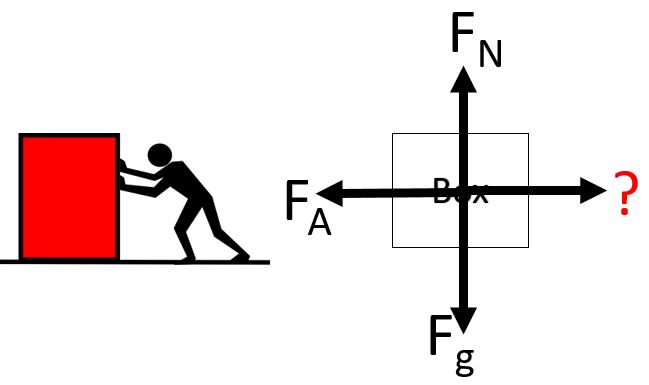
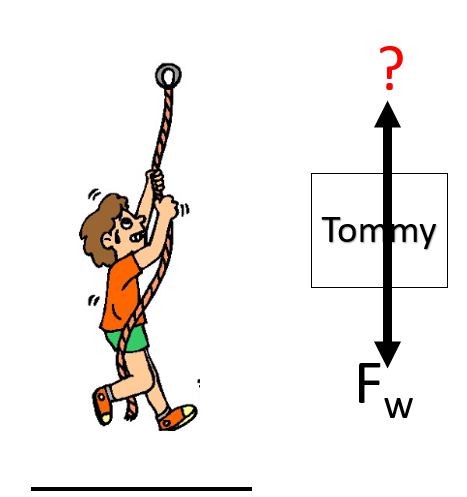
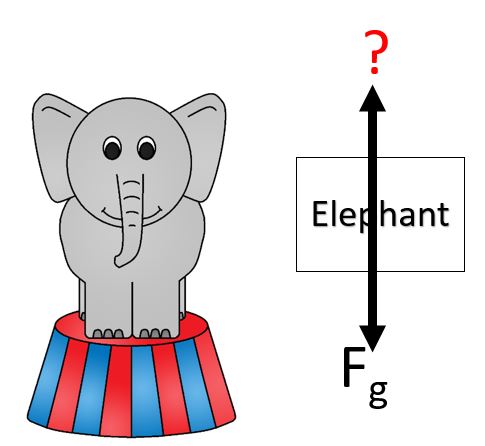

The best way to label a push or a pull on a diagram is to use


Which of the following free body diagrams correctly depict the forces acting on an object that is moving at a constant velocity?


An apple falls out of a tree and takes 1.75 seconds to strike the ground. How high was the apple from the ground?
25.00
20.00
15.00
10.00
On a scale of one to ten, how ready are you for this Test?
11
20
100
Off the charts ready
A ball is thrown straight up in the air. When the ball reaches its highest point, which of the following is true?
It is in equilibrium.
It has zero acceleration.
C It has maximum momentum.
It has maximum kinetic energy
None of the above
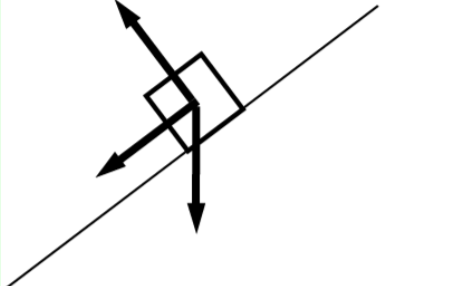
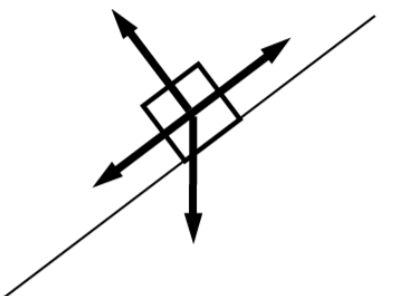
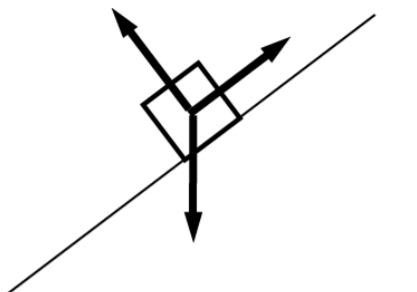
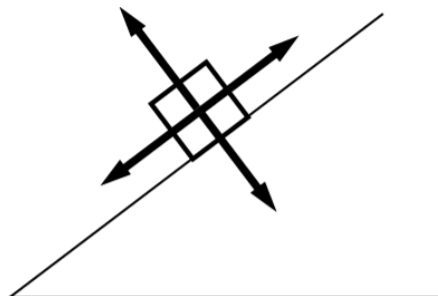
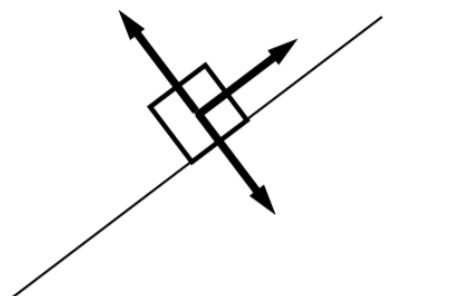
A box is given a sudden push up a ramp. Friction between the box and the ramp is not negligible. Which of the following diagrams best represents the directions of the actual forces acting on the box as it moves upward after the push?
A planet of mass m orbits a star of mass M, where m<<M. The orbit is circular, its radius is r, and
its period is T. True statements about the planet’s orbit include which of the following?
I. The orbital speed equals 2πr / T
II. The gravitational force equals GMm / r2
III. If the orbital radius r were greater, T would also be greater.
I only
II only
I and III only
II and III only
I, II, and III
While traveling in its elliptical orbit around the Sun, Mars gains speed during the part of the orbit where it is getting closer to the Sun. Which of the following can be used to explain this gain in speed?
As Mars gets closer to the Sun, the Mars–Sun system loses potential energy and Mars gains kinetic energy.
A component of the gravitational force exerted on Mars is perpendicular to the direction of motion, causing an acceleration and hence a gain in speed along that direction.
The torque exerted on Mars by the Sun during this segment of the orbit increases the Mars–Sun system’s angular momentum.
The centripetal force exerted on Mars is greater than the gravitational force during this segment of the orbit, causing Mars to gain speed as it gets closer to the Sun.

A rock of mass m is thrown horizontally off a building from a height h, as shown above. The speed of the rock as it leaves the thrower's hand at the edge of the building is v.
What is the kinetic energy of the rock just before it hits the ground?
mgh
21mv02
21mv02 +mgh
21mv02 −mgh
mgh − 21mv02
While traveling in its elliptical orbit around the Sun, Mars gains speed during the part of the orbit where it is getting closer to the Sun. Which of the following can be used to explain this gain in speed?
As Mars gets closer to the Sun, the Mars–Sun system loses potential energy and Mars gains kinetic energy.
A component of the gravitational force exerted on Mars is perpendicular to the direction of motion, causing an acceleration and hence a gain in speed along that direction.
The torque exerted on Mars by the Sun during this segment of the orbit increases the Mars–Sun system’s angular momentum.
The centripetal force exerted on Mars is greater than the gravitational force during this segment of the orbit, causing Mars to gain speed as it gets closer to the Sun.
What is the kinetic energy of a satellite of mass in that orbits the Earth, of mass M, in a circular orbit of radius R ?
zero
21 RGMm
41 RGMm
21 R2GMm
R2GMm

An object is moving in the positive x-direction while a net force directed along the x-axis is exerted on the object. The figure above shows the force as a function of position. What is the net work done on the object over the distance shown?
F0d
23F0d
2F0d
4F0d

Three objects can only move along a straight, level path. The graphs below show the position d of each of the objects plotted as a function of time t.
The sum of the forces on the object is zero in which of the cases?
II only
III only
I and II only
I and III only
I, II, and III
An object is thrown with an initial speed v near the surface of Earth. Assume that air resistance is negligible and the gravitational field is constant.
If the object is thrown vertically upward, the direction and magnitude of its acceleration while it is in the air is
upward and decreasing
upward and constant
downward and decreasing
downward and increasing
downward and constant
An object has a weight W when it is on the surface of a planet of radius R. What will be the gravitational force on the object after it has been moved to a distance of 4R from the center of the planet?
16W
4W
W
41W
161W
An object has a weight W when it is on the surface of a planet of radius R. What will be the gravitational force on the object after it has been moved to a distance of 4R from the center of the planet?
16W
4W
W
41W
161W
An object is thrown with an initial speed v near the surface of Earth. Assume that air resistance is negligible and the gravitational field is constant.
If the object is thrown vertically upward, the direction and magnitude of its acceleration while it is in the air is
upward and decreasing
upward and constant
downward and decreasing
downward and increasing
downward and constant

As the angle of the incline increases, what happens to the normal force?
The normal force increases
The normal force decreases
The normal force is not affected by the incline
The normal force is only dependent on the force due to gravity

Given the FBD, which of the following must be true?
The frictional force must be accelerating the system to the left.
The box must be accelerating to the right.
The box must be moving to the right.
The FBD is incorrectly drawn. This situation isn't possible

Camille launches has a catapult that changes the velocity of a ball (m= 2 kg) from 0 to 10 m/s in one sec. What is the average force that is exerted on the ball during launch?
20 N
5 N
8 N
0.2 N

Which of the following statements is true about the image above?
The accelerations of the blocks will vary according to their mass
The net force acting on each block is the same
The blocks will experience the same acceleration
The 3m box will eat the 2m and the m boxes

Which of the following is not true about the system?
T3 is equal to the scalar sum of the magnitudes of T2 and T1
T3 is equal in magnitude to Fg
The x- components of the T1 and T2 and equivalent but in opposite directions
The system is in equilibrium.

Sam is hover boarding down they hall at a constant velocity. Assuming there is friction, which of the following must be true?
The force applied by the board must be greater than the frictional force
The frictional force must equal the force applied by the board
The force applied must equal zero
There is not enough information

If there is no friction, then the acceleration would be equal to
mg
sin(θ)mg
g
sin(θ)g

If μk = 0.65 and μs = 0.7, acceleration would be equal to
0 m/s/s
9.8 m/s/s
3.35 m/s/s
-2.63 m/s/s

A man standing on a scale in an elevator notices that the scale reads 40 newtons greater than his normal weight. Which type of movement of the elevator could cause this greater-than-normal reading?
accelerating upward
accelerating downward
moving upward at a constant speed
moving downward at a constant speed
A man weighing 800 Newtons is standing in an elevator. If the elevator rises with an acceleration of 0.5 meters per second2, the force exerted by the elevator on the man will be
400 N
800 N
1200 N
1000 N
A car travels up a hill at constant speed. Which of the following diagrams best represents the forces acting on the car at this instant?


Three forces of equal magnitude act on the box shown. One force is upward, one downward, and one rightward. Which of the following statements must be true based on this information? Select two answers.
The box must have a rightward component of velocity.
The box has no vertical component of velocity.
The acceleration of the box is directed to the right.
The velocity of the box is changing with time.


A 2.00-kg solid, uniform ball of radius 0.100 m is released from rest at point A as shown in the figure, its center of gravity a distance of 1.50 m above the ground. The ball rolls without slipping to the bottom of an incline and back up to point B where it is launched vertically into the air. The ball rises to its maximum height hmax at point C. At point B, find the ball’s translational speed. (The ball's moment of inertia is defined by I=52MR2 .)
3.78 m/s
37.8 m/s
14.3 m/s
3.70 m/s

A 2.00-kg solid, uniform ball of radius 0.100 m is released from rest at point A as shown in the figure, its center of gravity a distance of 1.50 m above the ground. The ball rolls without slipping to the bottom of an incline and back up to point B where it is launched vertically into the air. The ball rises to its maximum height hmax at point C. At point B, find the ball’s rotational speed. (The ball's moment of inertia is defined by I=52MR2 .)
3.78 rad/s
37.8 rad/s
0.370 m/s
3.70 rad/s
A 2.00-kg solid, uniform ball of radius 0.100 m is released from rest at point A as shown in the figure, its center of gravity a distance of 1.50 m above the ground. The ball rolls without slipping to the bottom of an incline and back up to point B where it is launched vertically into the air. The ball rises to its maximum height hmax at point C. At point C, find the ball’s rotational speed. (The ball's moment of inertia is defined by I=52MR2 .)
3.78 rad/s
37.8 rad/s
0.370 m/s
0 rad/s
A 2.00-kg solid, uniform ball of radius 0.100 m is released from rest at point A as shown in the figure, its center of gravity a distance of 1.50 m above the ground. The ball rolls without slipping to the bottom of an incline and back up to point B where it is launched vertically into the air. The ball rises to its maximum height hmax at point C. Find the ball's maximum height hmax of its center of gravity. (The ball's moment of inertia is defined by I=52MR2 .)
0.756 m
0.744 m
1.43 m
1.22 m

A 0.00500-kg bullet traveling horizontally with a speed of
1.00 x 10³ m/s enters an 18.0-kg door, embedding itself 10.0 cm from the side opposite the hinges as shown. The 1.00-m-wide door is free to swing on its hinges. Before it hits the door, what is the angular momentum of the bullet?
4.50 kg·m2/s
0.500 kg·m2/s
5.00 kg·m2/s
0 kg·m2/s
A 0.00500-kg bullet traveling horizontally with a speed of
1.00 x 10³ m/s enters an 18.0-kg door, embedding itself 10.0 cm from the side opposite the hinges as shown. The 1.00-m-wide door is free to swing on its hinges. What is the kinetic energy of the bullet-door system after impact? (The moment of inertia of the door is defined by I=31ML2 , where L is the length of the door.)
1.68 J
2.50 × 10³ J
2.25 J
1.52×10³J
A spool of thread has an average radius of 1.00 cm. If the spool contains 62.8 m of thread, about how many turns of thread are on the spool? "Average radius" allows us to not need to treat the layering of threads on lower layers.
100
1000
10,000
10

The cart of mass 10 kg shown above moves without frictional loss on a level table. A 10 N force pulls on the cart horizontally to the right. At the same time, a 30 N force at an angle of 60° above the horizontal pulls on the cart to the left. Which of the following describes a manner in which this cart could be moving? Select two answers.
moving left and speeding up
moving left and slowing down
moving right and speeding up
moving right and slowing down

The parabola above is a graph of speed v as a function of time t for an object. Which of the following graphs best represents the magnitude F of the net force exerted on the object as a function of time t?


A ball is thrown and follows a parabolic path, as shown above. Air friction is negligible. Point Q is the highest point on the path. Which of the following best indicates the direction of the net force on the ball at point P?
At an angle
There is no force acting on the ball
Up
Down

A block of mass m is accelerated across a rough surface by a force of magnitude F that is exerted at an angle with the horizontal, as shown above. The frictional force on the block exerted by the surface has magnitude f. What is the acceleration of the block?
F/m
(Fcos)/m
(F–f)/m
(Fcos–f)/m
A block of mass m is accelerated across a rough surface by a force of magnitude F that is exerted at an angle with the horizontal, as shown above. The frictional force on the block exerted by the surface has magnitude f. What is the acceleration of the block?
F/m
(Fcos)/m
(F–f)/m
(Fcos–f)/m
Two point masses m and M are separated by a distance d. If the distance between the masses is increased to 3d, how does the gravitational force between them change?
The force will be 1/3 as great.
The force will be 1/9 as great.
The force will be 3 times as great.
The force will be 9 times as great.
It is impossible to determine without knowing the numerical values of m, M, and d.
When the net force that acts on a hockey puck is 10 N, the puck accelerates at a rate of 50 m/s2. Determine the mass of the puck.
0.2 kg
1.0 kg
5 kg
10 kg
50 kg
When the net force that acts on a ball is 46 N, the ball accelerates at a rate of 23 m/s2. Determine the weight of the puck.
2.0 kg
2.0 N
19.6 kg
19.6 N
9.8 N

Which section(s) of the graph corresponds to a condition of zero net force?
V only
III only
II and IV
II, III, and IV
I, III, and V

In which section(s) of the graph is the net force changing?
I and III
II and IV
III
IV
I and V


Which of the following units are used to measure velocity?
m/s
m/s/s
N
J
W
Which of the following units are used to measure acceleration?
m/s
m/s/s
N
J
W
Which of the following units are used to measure force?
m/s
m/s/s
N
J
W
Which of the following units are used to measure energy?
m/s
m/s/s
N
J
W
Which of the following units are used to measure work?
m/s
m/s/s
N
J
W
Which of the following units are used to measure power?
m/s
m/s/s
N
J
W
Which of the following units are used to measure time?
s
kg
kg*m/s
m
N
Which of the following units are used to measure mass?
s
kg
kg*m/s
m
N
Which of the following units are used to measure momentum?
s
kg
kg*m/s
m
N
Which of the following units are used to measure displacement?
s
kg
kg*m/s
m
N
Which of the following units are used to measure distance?
s
kg
kg*m/s
m
N
Which of the following units are used to measure height?
s
kg
kg*m/s
m
N
Which of the following units are used to measure weight?
s
kg
kg*m/s
m
N
Which of the following units are used to measure inertia?
s
kg
kg*m/s
m
N
Which of the following units are used to measure direction?
s
kg
kg*m/s
m
degrees
How fast are you going?
depends on what frame of reference you choose
none of your business Sir!
pretty fast
the speed of light
I have no idea but I have a question for you Dr. Session. Why is my grade so low!?
Which of the following symbols represents the speed of light?
c
g
m
m/s
m/s/s
Who was Henry Cavendish?
He calculated the value of G. The Universal Gravitational Constant
my boy
He discovered Newton's Laws.
He discovered Hooke's Law
He was the first to calculate g. The acceleration of gravity.
What is the acceleration of gravity on Earth?
9.81 m/s
9.81 m/s/s
9.81 kg
9.81 m
9.81 g
Which of the following is used to measure temperature in physics.
Kelvin
Kelvins
Celsius
Fahrenheit
Degrees
A civilization that can control all the energy it its galaxy is classified as a ______________civilization
Type 3
Type 4
Type Omega
Type 1
Type 2
Impulses cause
changes in momentum
accelerations
collisions
shopping
problems
Which of the following is not one of the 4 fundamental forces of nature
Strong Nuclear
Weak Nuclear
gravitational
electromagnetic
power
Which of the following is a formula for energy?
W = Fd
P = W/t
F = ma
v = d/t
Impulse = Ft
What time is it?
depends on your velocity and your frame of reference
around 1 pm
time for you to get a Timex
See........this...........this right here is why I hate this class.
this question cannot be answered
What do we use to model motion in physics?
vectors
graphs
models
velocity
feet
Which of the following people made the greatest contribution to the physics that we have learned about so far?
Newton
Session
Galileo
Cavendish
Watt
Tangential Velocity is measured in ____________
m/s
m/s/s
s
kg
J
Centripetal Force is measured in ____________
kg
m/s/s
N
Nm
J
Centripetal Acceleration is measured in __________.
m/s/s
N
m/s
J
J/s
A Watt is also _______________-
J/s
Nm
N/m
Js
A joule is also ___________-
Nm
kg*m/s
kg/j/s
N/m
Kinetic Energy is measured in __________
J
m/s
temperature
s
Potential Energy is measured in ____________.
J
m/s
W
N
Depends on your frame of reference

