wayground logo

Free Printable Worksheets

Font size

S
M
L
XL
Worksheets

Genetics and Inheritance

Total questions: 41

Worksheet time: 47mins

Name
Class
Date
1.

Select ALL options that describe phenotypes.

a)

AA

b)

bb

c)

homozygous

d)

blue eyes

e)

black fur

2.

Which genotype is homozygous dominant?

a)

AA

b)

aA

c)

Aa

d)

aa

3.

Long fur (L) is dominant to short fur (l) in rabbits. Which rabbits would have long fur?

a)

LL

b)

Ll

c)

ll

4.

In a certain flower, tall height (T) is dominant over short height (t). In the punnett square below, what belongs in the missing square?

a)

tt

b)

Tt

c)

Bb

d)

TT

5.

In bears, brown fur (B) is dominant over white fur (b).

In the punnett square, what is the probability for white fur?

a)

0%

b)

25%

c)

50%

d)

75%

e)

100%

6.
An organism’s genetic makeup or allele combination.
a)
Genotype
b)
Phenotype
c)
Beanotype
d)
Notype
7.
An organism’s physical appearance, or visible traits. 
a)
Genotype
b)
Phenotype
c)
Beanotype
d)
Notype
8.

What is called when a organism has two different alleles for a trait. Example - Tt or Rr

a)

Heterozygous

b)

Homozygous

c)

Domozygous

d)

Thermozygous

9.

What is called when a organism has two identical alleles for a trait. Example - TT or tt.

a)

Heterozygous

b)

Homozygous

c)

Domozygous

d)

Thermozygous

10.
In a certain species of plant, the color purple (P) is dominant to the color white (p).
According to the Punnett Square, what is the probability of an offspring being purple?
a)
25%
b)
0%
c)
100%
d)
50%
11.
What allele combination should go in the missing box?
a)
AA
b)
Aa
c)
aa
d)
none of these
12.

Select all options that show a heterozygous genotype.

a)

AA

b)

Tt

c)

pp

d)

Dd

13.

For a given trait, you get ________ allele from you mom and ________ allele from your dad.

a)

1;1

b)

2;2

c)

it depends on the trait

14.

model that shows genetic traits that were inherited by members of a family

a)

pedigree

b)

mutation

c)

multiple alleles

d)

genetics

15.

any permanent change in the sequence of DNA in a gene or a chromosome of a cell

a)

mutation

b)

pedigree

c)

genetic engineering

d)

hybrids

16.

modification of an organism's genetic material by inserting DNA from another organism

a)

mutation

b)

genetic engineering

c)

hybrid

d)

inheretiance

17.

coiled strands of DNA

a)

allele

b)

chromosomes

c)

gene

d)

DNA

18.

genetic factor that blocks another genetic factor

a)

dominant

b)

recessive

c)

gene

d)

strong

19.

a segment of DNA on a chromosome that codes for a specific trait

a)

allele

b)

gene

c)

mutation

d)

chromosome

20.

study of how traits pass from parents to offspring

a)

heredity

b)

genes

c)

genetics

d)

genetic engineering

21.

having two different alleles for a trait

a)

heterozygous

b)

homozygous

22.

having two identical alleles for a trait

a)

homozygous

b)

heterozygous

23.

a distinguishing characteristic of an organism

a)

trait

b)

gene

c)

chromosome

d)

genetics

24.

How many genes for each trait does a child inherit?

a)

2

b)

3

c)

4

d)

1

25.

How many pairs of chromosomes does a child receive from each parent?

a)

46

b)

23

c)

44

d)

21

26.

Which of the following is true about a mutation?

a)

It is always damaging to a person.

b)

It never harms the next generation.

c)

It may harm the next generation.

d)

It never passes down diseases.

27.
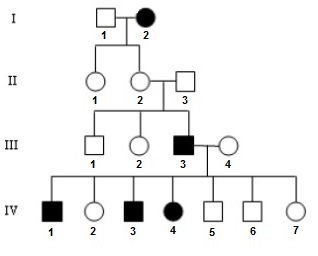
How many generations are shown in this pedigree?
a)
1
b)
2
c)
3
d)
4
28.
What does a filled in square represent?
a)
Not affected Female
b)
Not affected Male
c)
Affected Male
d)
Affected Female
29.
How many kids did the mother and father from the first generation have?
a)
2
b)
4
c)
5
d)
6
30.
This pedigree represents the inheritance of hemophilia in this family. How many of the females have the hemophilia trait?
a)
8
b)
5
c)
2
d)
3
31.
What do half colored symbols represent?
a)
The individual is a carrier (heterozygous).
b)
The individual expresses the trait.
c)
The individual has both recessive alleles.
d)
The individual has both dominant alleles.
32.
What does an open circle represent?
a)
Not Affected Male
b)
Not Affected Female
c)
Affected Male
d)
Affected Female
33.
Is this trait (the shaded individuals) dominant or recessive?
a)
dominant
b)
recessive
34.
In the second generation-how many people are carriers of the trait?
a)
2
b)
3
c)
5
d)
6
35.
How many people in this whole pedigree have the trait/disease?
a)
2
b)
3
c)
4
d)
6
36.
How many females are in this pedigree?
a)
3
b)
4
c)
6
d)
7
37.
What is this?
a)
Pedigree
b)
Karyotype
c)
Venn diagram
d)
Punnett Square
38.
Which individual in the first generation is a carrier?
a)
The male
b)
The female
c)
individual 1
d)
None of the above
39.
How many individuals are there in the 3rd generation?
a)
2
b)
3
c)
4
d)
6
40.
Which gender can be carriers of colorblindness and not have it?
a)
Just males
b)
Just females
c)
Both genders
41.
How many people in the pedigree are carriers for the disorder? 
a)
b)
8
c)
2
d)
9