wayground logo

Free Printable Worksheets

Font size

S
M
L
XL
Worksheets

Chemistry Final Exam Review

Total questions: 185

Worksheet time: 46hrs 15mins

Name
Class
Date
1.
When is it OK to eat or drink in the lab?
a)
Always
b)
Never
2.
What should you do if you break glass in the lab?
a)
Tell the teacher.
b)
Sweep up the glass.
c)
Pick up the glass with your hands.
d)
Ignore it; the teacher will clean it up when she sees it later.
3.

Horseplay, jokes, and pranks is ok in the science classroom at any time.

a)

True

b)

False

4.

Flammable materials, like alcohol, should never be dispensed or used near

a)

an open door

b)

an open flame

c)

another student

d)

a sink

5.

Approved eye protection devices (such as goggles) are worn in the laboratory

a)

to avoid eye strain

b)

to improve your vision

c)

only if you don't have corrective glasses

d)

any time chemicals, heat, or glassware is used

6.

If you do not understand a direction or part of a lab procedure, you should

a)

figure it out as you do the lab

b)

try several methods until something works

c)

ask the instructor before proceeding

d)

skip it and go on to the next part

7.

The study of matter and its changes is called

a)

Biology

b)

Chemistry

c)

Physics

d)

None of the above

8.

The smallest unit of an element that retains the properties of that element is called a(n)

a)

Element

b)

Compound

c)

Atom

d)

Molecule

9.

Which of the following is NOT a pure substance?

a)

Element

b)

Compound

c)

Mixture

d)

Molecule

10.

Which property of a substance is not affected by a physical change?

a)

Reactivity

b)

Size

c)

Position

d)

Shape

11.

Which of the following is NOT a potential sign of chemical change?

a)

Change in odor

b)

Boiling

c)

Fizzing

d)

Change in color

12.

Which of the following causes a chemical change?

a)

Moving

b)

Melting

c)

Burning

d)

Shattering

13.

Which of the following is an element?

a)

Steel

b)

Brass

c)

Bronze

d)

Iron

14.

Unlike a mixture, a pure substance has

a)

Atoms

b)

Molecules

c)

A specific size

d)

A fixed composition

15.

Which of the following is a heterogeneous mixture?

a)

Ammonia

b)

A dog

c)

Bronze

d)

Carbon dioxide

16.

_____ is the study of the composition, structure, and properties of matter.

a)

Science

b)

Chemistry

c)

Biology

d)

Knowledge

17.

_____ is the knowledge obtained by observing natural events and conditions in order to discover facts and formulate laws.

a)

Science

b)

Chemistry

c)

Biology

d)

Learning

18.

Which branch of chemistry involves the study of non-organic substances?

a)

Organic chemistry

b)

Inorganic chemistry

c)

Biochemistry

d)

Analytical chemistry

19.

An _____ is a pure substance that cannot be broken down into simpler, stable substances and is made of one type of atom.

a)

Atom

b)

Element

c)

Matter

d)

Particle

20.

A _____ is a substance that can be broken down into simple stable, substances.

a)

Atom

b)

Particle

c)

Compound

d)

Element

21.

Water has a constant boiling point of 100oC. Boiling points are examples of _____ which do not depend on the amount of matter in a sample.

a)

Extensive properties

b)

Intensive properties

c)

Chemical properties

d)

physical properties

22.

A friend asks you to you help lift a box. He points you over to the large box with 100 kg printed on the side. You know that that is a HEAVY box. The mass of this box is an example of _____ which depends on the amount of matter.

a)

Extensive properties

b)

Intensive properties

c)

Chemical properties

d)

Physical properties

23.

A student is observing a new substance. He notices that the substance is a white crystal with a mass of about 2 grams. What type of properties did you observe?

a)

Extensive property

b)

Intensive property

c)

Physical property

d)

Chemical property

24.

A student observes that a white crystal substance will start bubbling with added to acetic acid. This reaction is an example of what type of property?

a)

Extensive property

b)

Intensive property

c)

Physical property

d)

Chemical property

25.

A chemical is observed to melt at 0oC and boil at 100oC. These phase changes are a type of _____.

a)

Physical change

b)

Chemical change

c)

Chemical reaction

d)

Physical reaction

26.

Any type of chemical reaction will result in the creation of a new substance. For example, if you add sodium metal to water, you create sodium hydroxide and hydrogen gas. Based on the equation below, which is the products?

Na + H2O --> NaOH + H2

a)

Na + H2O

b)

NaOH + H2

c)

Na + H2

d)

H2O + NaOH

27.

A mixture is a blend of 2 or more kinds of matter which can be physically separated. If the 2 types of matter are not evenly distributed, the mixture is said to be _____.

a)

heterogeneous

b)

homogeneous

28.

Part of your lab instructions might be to add a salt to a sample of water. The salt dissolves in the water, but you would still taste it. What type of mixture did you make?

a)

a homogeneous solution

b)

a heterogeneous sol

c)

a heterogeneous suspension

d)

a homogeneous gel

29.

A balloon filled with only helium gas, He. The balloon contains a _____.

a)

Homogeneous mixture

b)

Heterogeneous mixture

c)

Pure substance

d)

Solution

30.

What subatomic particle has a negative charge and is found outside of the nucleus?

a)

Electron

b)

Proton

c)

Nucleus

d)

Neutron

31.

Which subatomic particle has a positive charge and is found inside the nucleus?

a)

Electron

b)

Proton

c)

Neutron

d)

Nucleus

32.

What is the smallest unit of matter that still has the properties of an element?

a)

Atom

b)

Proton

c)

Neutron

d)

Electron

33.

Which subatomic particle has a neutral charge and is found inside the nucleus?

a)

Electrons

b)

Protons

c)

Neutrons

d)

Nucleus

34.
Measure mainly of the nuclear particles: protons + neutrons
a)
Subatomic Particles
b)
Atomic Number
c)
Atomic Mass
d)
Gluons
35.
Value representing the number of protons in an element
a)
Atomic Mass
b)
Mass Number
c)
Valence Electrons
d)
Atomic Number
36.
Arrangement of elements organized by atomic number
a)
Electron Cloud 
b)
Periodic Table 
c)
Electron Configuration
d)
None of these
37.

How many protons does Helium (He) have?

a)

1

b)

2

c)

3

d)

4

38.

JJ Thomson discovered what subatomic particle

a)

nucleus

b)

neutron

c)

proton

d)

electron

39.

Rutherford discovered what part of the atom

a)

nucleus

b)

neutron

c)

proton

d)

electron

40.

First person to propose the concept of an atom

a)

Rutherford

b)

Democritus

c)

Dalton

d)

Bohr

41.

Who proposed the theory that atoms orbit the nucleus in specific orbits.

a)

Bohr

b)

Democritus

c)

Rutherford

d)

Chadwick

42.

Which of the following shows the correct order of Atomic Theory Timeline

a)

Rutherford, Bohr, Dalton, Democritus, Thomson

b)

Bohr, Democritus, Thomson, Rutherford, Dalton

c)

Dalton, Thomson, Rutherford, Bohr, Democritus

d)

Democritus, Dalton, Thomson, Rutherford, Bohr

43.

Thomson Experimented with ______

a)

Gold Foil

b)

alpha particles

c)

cathode rays

d)

protons

44.

Rutherford experimented with ____

a)

Gold foil and alpha particles

b)

Cathode rays and alpha particles

c)

electron and alpha particles

d)

gold foil and cathode rays

45.

what is the biggest group on the table

a)

metals

b)

nonmetals

c)

metaloids

d)

halogens

46.

what is the name of group number 1

a)

halogens

b)

noble gases

c)

alkali

d)

alkaline earth

47.

what is the name of group number 2

a)

transition metals

b)

halogens

c)

metaloids

d)

alkaline earth

48.

what is the big group of metals called found within the metals

a)

transition metals

b)

nonmetals

c)

noble gases

d)

halogens

49.

where are the metaloids found

a)

far left, vertical

b)

stair step/diagonal

c)

far right horizontal

d)

at the bottom

50.

what group number are the halogens

a)

18

b)

1

c)

2

d)

17

51.

what group number are the noble gases

a)

17

b)

18

c)

14

d)

15

52.
Ionization energy is the...
a)
energy needed to remove the outermost electron.
b)
ability of an atom to attract electrons from another atom.
53.
Electronegativity is the...
a)
energy needed to remove the outermost electron.
b)
ability of an atom to attract electrons from another atom.
54.

Which of the alkaline-earth metals has the smallest electronegativity

a)

Be

b)

Sc

c)

Ra

d)

Sr

55.

Which of the metalloids has the smallest atomic radius?

a)

Si

b)

B

c)

Sb

d)

Al

56.
The first orbital can hold a maximum of how many electrons?
a)
2
b)
3
c)
8
d)
6
57.
1.  What is the shape of an s orbital?
a)
sphere
b)
dumbbell
c)
double dumbbell
d)
TOO COMPLEX TO KNOW IT.
58.
How many electrons can each p orbital hold?
a)
6
b)
3
c)
2
d)
4
59.
Which is associated with more energy? 
a)
2p
b)
2s
c)
3p
d)
1s
60.
Waves with a large wavelength have a __________ frequency
a)
high
b)
low
61.
How many orbitals are in the f sublevel
a)
1
b)
3
c)
5
d)
7
62.
What is the correct electron configuration for Selenium
a)
1s22s22p63s23p64s24d104p4
b)
1s22s22p63s23p64s23d104p4
c)
1s22s22p63s23p64s23d104p3
d)
1s22s22p63s23p64s24d104p43
63.
Which is a particle of electromagnetic radiation with no mass that carries a quantum of energy?
a)
electron 
b)
neutron 
c)
microwave
d)
photon 
64.
Who determined that it is not possible to simultaneously determine the electron's position and velocity?
a)
Pauli
b)
Hund
c)
Heisenberg
d)
Einstein 
65.
What are patterns made when excited electrons emit light of certain wavelengths?
a)
electromagnetic spectra
b)
atomic emission spectra
c)
spectroscopes
d)
prisms
66.
Number of waves per second. Measured in Hertz (Hz)
a)
Amplitude
b)
Wavelength
c)
Frequency 
d)
Quantum
67.
Distance between one point on a wave and the nearest point just like it.
a)
amplitude 
b)
wavelength
c)
frequency
d)
quantum
68.
What is the maximum number of electrons that an orbital can have?
a)
1 electron
b)
2 electrons
c)
3 electrons
d)
4 electrons
69.
Bromine is found in which block?
a)
s
b)
p
c)
d
d)
f
70.

When naming compounds that contain a nonmetal bonded to a nonmetal, _____ must be used.

a)

parenthesis

b)

Greek prefixes

c)

ionic charges

d)

Lewis structures

71.

When writing the chemical formula of a compound that contains more than one of a particular polyatomic ion, _____ must be used.

a)

ionic charges

b)

parenthesis

c)

Greek prefixes

d)

lower case letters.

72.

What is the correct name of the compound CaCl2?

a)

Calcium dichloride

b)

Calcium dichlorine

c)

Calcium chlorine

d)

Calcium chloride

73.

All binary compounds end with_____.

a)

-ous

b)

-ate

c)

-ide

d)

-ite

74.

What is the correct formula for the compound Phosphorus tribromide?

a)

P3Br

b)

PBr

c)

PBr3

d)

Br3P

75.

What is the correct name for the compound LiF?

a)

Lithium fluoride

b)

Lithium fluorine

c)

monolithium monofluoride

d)

lithium monofluoride

76.

What is the correct name for the compound LiF?

a)

Lithium fluoride

b)

Lithium fluorine

c)

monolithium monofluoride

d)

lithium monofluoride

77.

What is the correct formula for Ammonium phosphate?

a)

NH4PO4

b)

NH43PO4

c)

(NH4)3PO4

d)

NH4(PO4)3

78.

What is the correct name of the compound Mg(NO3)2?

a)

Magnesium nitride

b)

Magnesium dinitrate

c)

Monomagnesium dinitrate

d)

Magnesium nitrate

79.

What is the correct formula for aluminum sulfide?

a)

Al3S2

b)

Al2S

c)

AlS2

d)

Al2S3

80.

What is the correct formula for the compound calcium carbide?

a)

CaC

b)

Ca2C

c)

CaC2

d)

Ca2C4

81.

What is the correct chemical formula for strontium acetate?

a)

SrC2H3O2

b)

Sr2C2H3O2

c)

Sr(C2H3O2)2

d)

Sr(C2H3O2)3

82.

How many atoms of oxygen are in a molecule of Ca3(PO4)2

a)

1

b)

2

c)

4

d)

8

83.

What is the correct chemical formula for magnesium iodide?

a)

MgI2

b)

Mg2I

c)

MgI

d)

Mg2I2

84.

What is the name of the compound NH4OH?

a)

Nitrogen oxygen hydride

b)

Nitrogen hydroxide

c)

Ammonium oxygen hydride

d)

Ammonium hydroxide

85.

_______ is an ion that contains more than one atom.

a)

monatomic ion

b)

complex ion

c)

polyatomic ion

d)

diatomic ion

86.

What is the correct formula of the potassium oxide?

a)

KO

b)

K2O

c)

KO2

d)

K2O2

87.
In a ___________change, a substance changes into a different substance.
a)
Physical
b)
Chemical
88.
Which of these is NOT a sign that a chemical change has occurred? 
a)
A loss of transparency 
b)
An unexpected color change
c)
A temperature change
d)
The formation of a precipitate
89.
The Law of Conservation of Mass states
a)
that matter exists in all states and reacts the same
b)
that matter can only be changed into new substances by introducing a catalyst
c)
that matter exists in the same state throughout any chemical change
d)
that matter cannot be created or destroyed and that the mass of the products must equal the mass of the reactants
90.

The reaction XY ⟶ X + Y is an example of _____.

a)

synthesis

b)

decomposition

c)

single replacement

d)

double replacement

91.

The reaction A + B ⟶ AB is classified as a _____ reaction.

a)

synthesis

b)

decomposition

c)

single replacment

d)

double replacement

92.

The reaction AB + X ⟶ XB + A is classified as a _____ reaction.

a)

synthesis

b)

decomposition

c)

single replacement

d)

double replacement

93.

What class of reaction best describes the equation below?

2HI ⟶ H2 + I2

a)

synthesis

b)

decomposition

c)

single replacement

d)

double replacement

94.

What class of reaction best describes the equation below?

FeS + HCl ⟶ H2S + FeCl2

a)

synthesis

b)

combustion

c)

single replacement

d)

double replacement

95.

What class of reaction best describes the reaction

Mg + HCl ⟶ MgCl2 + H2

a)

combustion

b)

synthesis

c)

decomposition

d)

single replacement

96.

Which of the following chemical equations is an example of a combustion reaction?

a)

2Al2O3 ⟶ 4Al + 3O2

b)

2C5H10 + 15O2 ⟶ 10CO2 + 10H2O

c)

2MgCl2 + Na2CO3 ⟶ 2 NaCl + MgCO3

d)

K2O + H2O ⟶ 2 KOH

97.
_P4+_O  _P2O3
a)
3 P4+1 O→ 2 P2O3
b)
1 P4+1 O→ 2 P2O3
c)
1 P4+ 3 O→ 2 P2O3
d)
1 P4+ 2 O→ 3 P2O3
98.
_AgNO3 + _Cu _Cu(NO3)2 + _Ag
a)
2 AgNO3 + 2 Cu → 3 Cu(NO3)2 + 1 Ag
b)
2 AgNO3 + 1 Cu → 1 Cu(NO3)2 + 2 Ag
c)
1 AgNO3 + 2 Cu → 2 Cu(NO3)2 + 1 Ag
d)
3 AgNO3 + 2 Cu → 3 Cu(NO3)2 + 2 Ag
99.
_BaS + _PtF2  _BaF2 + _PtS
a)
1 BaS + 1 PtF2 → 1 BaF2 + 1 PtS
b)
4 BaS + 2 PtF2 → 1 BaF2 +  1 PtS
c)
1 BaS + 2 PtF2→ 2 BaF2 +  2 PtS
d)
1 BaS + 3 PtF2 →1 BaF2 +  2 PtS
100.
The large number in front of a chemical formula or compound is the ___________. 
a)
coefficient
b)
product
c)
physical
d)
chemical
101.

Which of the following statements regarding the mole is INCORRECT?

a)

A mole is a unit of quantity equal to 6.02 x 10²³ particles.

b)

The number of particles in a mole is known as Avogadro’s number.

c)

A mole of particles of an element is numerically equal to the atomic mass of the element.

d)

none of the above

102.

What is the molar mass of PbSO4?

a)

303.27 g/mol

b)

255.27 g/mol

c)

163.87 g/mol

d)

372.27 g/mol

103.

The mass of one mole of an element is equal to

a)

its atomic number from the periodic table, but in amus.

b)

its atomic mass from the periodic table, but in amus.

c)

its atomic mass from the periodic table, but in grams.

d)

its atomic number from the periodic table, but in grams.

104.

How many formula units are in 2.5 moles of NaCl?

a)

1.5 x1024 formula units

b)

1.5 formula units

c)

4.2 formula units

d)

4.2 x10⁻²⁴ molecules

105.
How many molecules are there in 31.8 moles of water?
a)
5.28 x 10⁻²³ molecules
b)
1.91 x 1025 molecules
c)
5.28x 10⁻²⁵
d)
1.91 x 10²²
106.

What is the mass of 1.2 x 1024 atoms of C?

a)

2.0 grams

b)

24 grams

c)

0.17 grams

d)

1.4 x 1025 grams

107.
What is the percent by mass of oxygen in MgO?
a)
20%
b)
40%
c)
50%
d)
60%
108.
What is the percent by mass of sodium in NaCl?
a)
39%
b)
61%
c)
35%
d)
65%
109.
A compound consists of 72.2% magnesium(Mg) and 27.8% nitrogen(N) by mass. What is the empirical formula?
a)
Mg4N3
b)
MgN2
c)
Mg3N
d)
MgN
110.
Which of the following is considered an empirical formula?
a)
CH3COOH
b)
C6H12O6
c)
H2O
111.
Which pair has the same empirical formula?
a)
NaCrO4 and Na2Cr2O7
b)
C2H4O2 and C6H12O6
c)
C3H6Oand C2H6O2
d)
CH4 and C2H6
112.
Glycerol has a molar mass of 92.09g/mol. Its percent composition is: 39.12% C, 8.75% H, and 51.12% O. What is the molecular formula for glycerol?
a)
C2H3O2
b)
CH2O
c)
C2H4O2
d)
C3H8O3
113.
2H2  +   O2  →  2H2O
How many moles of oxygen are consumed if 8 moles H2 are used?
a)
2
b)
4
c)
6
d)
8
114.
For the Balanced Reaction: 3 Mg + 1 Fe2O3 → 3 MgO + 2 Fe; What is the Ratio of moles of MgO to moles Fe?
a)
3mol Mg / 2 mol Fe
b)
2 mol Mg/ 3 mol Fe
c)
1 mol Fe/ 2 mol Fe
d)
3 mol MgO / 2 mol Fe
115.
2Na + 2H2O → 2NaOH+ H2
How many grams of hydrogen are produced if 120 g of Na are available?
a)
5.2 g
b)
2.6 g
c)
690 g
d)
45 g
116.
What does Boyle's law relate to?
a)
Temperature and Volume
b)
Volume and Pressure
c)
Temperature and Pressure
117.
What is the formula for Boyle's Law?
a)
P1V1=P2V2
b)
P1V1/P2V2
c)
P1V2=P2V1
d)
P1/V1=P2/V2
118.
What type of relationship to pressure and volume have?
a)
direct
b)
inverse
c)
no relationship
d)
I don't know
119.
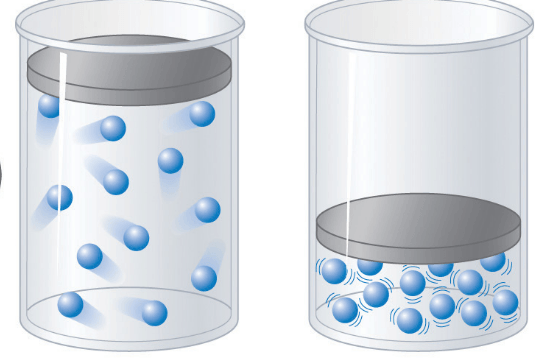
Which container will have a lower pressure?
a)
left
b)
right
c)
they both have the same pressure
d)
I don't know
120.
What is the formula Charles' Law?
a)
V = T
b)
VT = VT
c)
T1 / V1 = T2 / V2
d)
V1 / T1 = V2 / T2
121.
TRUE/ FALSE: Science is a continually ongoing process.
a)
True
b)
False
122.
A series of steps used by scientists to solve a problem or answer a question
a)
scientific method
b)
recipe
c)
data collection
d)
metric system
123.
A gas that has a pressure of 2 atm and a volume of 10 L.  What would be the new volume if the pressure was changed to 1 atm?
a)
P1/T1 = P2/T2
b)
P1V1 = P2V2
c)
V1/n1 = V2/n2
d)
PV = nRT
124.
A sample of a gas has a volume of 852 mL at 298 K. What temperature is necessary for the gas to have a volume of 945 mL?
a)
Pt = P1 + P2 + P3 + ...
b)
P1V1 = P2V2
c)
V1/T1 = V2/T2
d)
P1V1/T1 = P2V2/T2
125.
A 1.25 L volume of gas contains 4.5 moles.  How many moles will be in 0.75 L?
a)
PV = nRT
b)
P1V1 = P2V2
c)
P1V1/T1 = P2V2/T2
d)
V1/n1 = V2/n2
126.

Surface tension of the water is the cohesive force between water molecule on the surface of water.

a)

True

b)

False

127.

Cohesive force between water molecules and adhesive force between water molecules and other molecules enable this phenomenon __________________ occur.

a)

surface tension

b)

capillary action

c)

float on water

d)

photosynthesis

128.
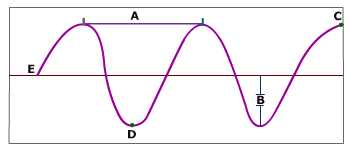
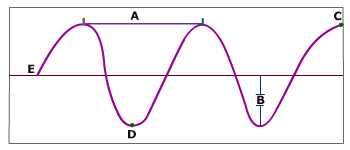
Which letter represents wavelength?
a)
A
b)
B
c)
C
d)
D
129.
Which letter represents amplitude?
a)
A
b)
B
c)
C
d)
D
130.
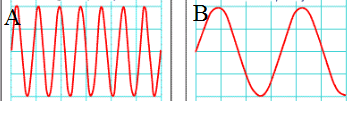
Which wave has a greater frequency?
a)
A
b)
B
131.
Large bodies of water do not quickly fluctuate in temperature. Why?
a)
Water is a solvent.
b)
Water has a high heat capacity.
c)
Water acts as a buffer.
d)
Water is non-polar.
132.
Water is a universal solvent because it...
a)
It can be found anywhere
b)
It freezes when it gets cold
c)
floats when frozen
d)
Dissolves most substances
133.
The fact that ice floats on liquid water is due to the fact that water's solid is ___________ than it's liquid form
a)
less polar
b)
more polar
c)
less dense
d)
more dense
134.
The tightness across the surface of water that enables paper clips to float is ____________.
a)
adhesion
b)
capillary action
c)
surface tension
d)
polarity
135.
Contains the maximum amount of dissolved solute
a)
unsaturated solution
b)
supersaturated solution
c)
saturated solution
136.
What is a substance that is dissolved in another substance? 
a)
solution
b)
solute
c)
solvent
d)
compound
137.
What is a solvent?
a)
The substance that does the dissolving in a solution.
b)
The substance that is being dissolved in a solution.
c)
The mixing of different substances.
d)
The process in which neutral molecules lose or gain electrons
138.
salt water is a 
a)
compound
b)
element
c)
heterogeneous mixture
d)
solution
139.

A substance is found to have the following characteristics:


Very bitter taste

Feels slippery to the touch

Produces OH- ions when dissolved in water


In what category would the substance be classified?

a)

acid

b)

base

c)

enzyme

d)

fatty acid

140.
Releases hydrogen in an aqueous solution.
a)
base
b)
strong base
c)
acid
d)
weak base
141.
Which of the following statements is correct?
a)
Blue litmus paper turns red when placed in a base.
b)
Red litmus paper turns blue when placed in a base.
c)
Blue litmus paper stays blue when placed in an acid.
d)
Red litmus paper stays red when placed in a base.
142.
What is the pOH of a solution that has a pH of 2?
a)
10
b)
12
c)
14
d)
1
143.

The pH value of an acid represents its __________ of positive ions in the solution

a)

amount

b)

concentration

c)

color

d)

charge

144.

Which of the following is a property of a base?

a)

bitter taste

b)

reacts with metals

c)

salty

d)

sour taste

145.

Do acids and bases conduct electricity?

a)

Only acids conduct electricity

b)

Only bases conduct electricity

c)

Bases and acids conduct electricity

d)

Neither conduct electricity

146.

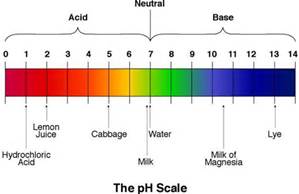
According to the pH range given in the image,which substance is more acidic than lemon juice?

a)

Hydrochloric acid

b)

Cabbage

c)

Milk

d)

Milk Of Magnesia

147.

What is mass?

a)

How much gravity pulls on an object

b)

The amount of matter in an object

c)

A measurement done on a scale

d)

The number of protons in an object

148.
In order to be accepted, a scientific theory must be
a)
 widely tested and supported by extensive data
b)
 based on the results of a single experiment
c)
 controversial and cause debate
d)
 in line with all previous historical ideas
149.
A testable explanation to a problem that has not yet been tested. 
a)
data
b)
theory
c)
hypothesis
d)
fact
150.

The leaf is 5 mm wide.

a)

qualitative

b)

quantitative

151.

These kind of observation use your senses to observe results.

a)

qualitative

b)

quantitative

152.
When experimenting with the growth of a plant, a scientist uses three (of the same type of) plants, two different fertilizers, equal light, and equal water. What type of variable is the fertilizer?
a)
Dependent
b)
Independent
c)
Control
d)
Compound
153.
Research question: does the distance a person kicks a soccer ball effect how well they will do on their math test.  What is the dependent variable?
a)
How far they kick the soccer ball
b)
who the person is
c)
how well they do on the math test
d)
Type of soccer ball.
154.

A control is important in an experiment because

a)

it shows what you are interested in

b)

it shows what you are changing

c)

it doesn't change

d)

it allows for comparison

155.
The substances listed on the left side of a chemical equation are the
a)
Products
b)
Coefficients
c)
Precipitates
d)
Reactants
156.
Name the part in red:

H2 + O2 -> H2O
a)
Coefficient
b)
Product
c)
Yield
d)
Subscript
157.
Name the part in red:

_2_H+ _1_O2 -> _2_H2O
a)
Coefficient
b)
Product
c)
Yield
d)
Subscript
158.
 Balance this equation:

__ Al + __ HCl → __ H
2 + __ AlCl3
a)
2, 6, 3, 2
b)
it is already balanced
c)
4, 12, 3, 4
d)
2, 1, 4, 5
159.
Which of the following equations are correctly balanced?
a)
12CO2 +H2O --> C6H12O6 + O2
b)
CO2 + 9H2O --> C6H12O6 + O2
c)
CO2 + H2O --> 3C6H12O6 + O2
d)
6CO2 + 6H2O --> C6H12O6 + 6O2
160.
What is the molar mass of Carbon?
a)
6
b)
12
c)
20
d)
40
161.
What are the units for molar mass?
a)
grams
b)
amu
c)
grams/mole
d)
liters
162.
How many Mn atoms are found in the following compound?
3Cr(MnO4)6
a)
3
b)
4
c)
6
d)
18
163.
What is the first thing you must do to solve a stoichiometry problem?
a)
Write a Balanced Equation
b)
Panic
c)
Write an Unbalanced Equation
d)
Ask for help
164.

1 N­2 + 3 H2 --> 2 NH3


How many moles of NH3 will be produced from 10.2 x 10^25 molecules of H2?


(6.02 x 10^23 molecules H2= 1 mol H2)

a)

113 mol NH3

b)

254 mol NH3

c)

169 mol NH3

d)

508 mol NH3

165.

Bornite, Cu3FeS3, is a copper ore used in the production of copper. When heated, the following reaction occurs:

2 Cu3FeS3(s) + 7 O2(g) --> 6 Cu(s) + 2 FeO(s) + 6 SO2(g)

If 450 moles of bornite are reacted, determine the number of moles of copper produced.

a)

750 mol bornite

b)

1350 mol bornite

c)

1525 mol bornite

d)

150 mol bornite

166.
CH4  +  2O2  →  CO2  +  2H2O
24 grams of CH4 was added to the above reaction. Calculate the theoretical yield of CO2.
a)
66 grams
b)
132 grams
c)
33 grams
d)
8.72
167.
The ______________ yield is the maximum amount of product possible in a reaction. This determines the amount of product that should be produced in a perfect setting
a)
Percent
b)
actual
c)
stoichiometry
d)
theoretical
168.

When reacting Na with Cl2, we calculated that the theoretical yield should be 13 grams. Our actual yield was 12.5 grams. What is the percent yield?

a)

90.4%

b)

104%

c)

96.15%

d)

1.04%

169.
You need 2 pieces of bread, 1 tablespoon of peanut butter and 2 tablespoons of jelly to make a sandwich.  If you have 10 pieces of bread, 4 tablespoons of peanut butter and 20 tablespoons of jelly, what is the limiting reactant?
a)
bread
b)
jelly
c)
peanut butter
d)
sandwich
170.
Identify the limiting reagent when 6.00 moles HCl combines with 5.00 moles Mg to form MgCl2.
 
1 Mg +  2 HCl --> 1 MgCl2  +  1 H2   
 
a)
Mg
b)
H2
c)
MgCl2
d)
HCl
171.
The limiting reactant . . .
a)
slows the reaction down.
b)
is used up first.
c)
is the reactant that is left over.
d)
controls the speed of the reaction.
172.
When does a chemical reaction stop?
a)
When the lab is finished.
b)
When the excess reactant is used. up
c)
When the limiting reactant is used up.
d)
Chemical reactions never stop.
173.
1 Cheese + 2 Bread --> 1 Grilled cheese
How many grilled cheeses can you make with 26 slices of bread and 14 pieces of cheese?
a)
14
b)
13
c)
26
d)
7
174.
James Chadwick discovered the ________.
a)
proton
b)
neutron
c)
electron
d)
nucleus
175.

He claimed that matter was made of small, hard particles that he called “atomos.”

a)

Democritis

b)

Dalton

c)

Moseley

d)

Einstein

176.

John Dalton stated:

a)

Atoms are tiny, invisible particles.

b)

Atoms of one element are all the same.

c)

Atoms of different elements are different.

d)

Compounds form by combining atoms.

e)

All of the statements listed.

177.
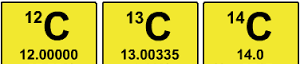
What do these isotopes of carbon all have in common?
a)
neutrons & mass number
b)
atomic number and neutrons
c)
atomic number and electrons
d)
protons, atomic number, and mass number
178.
How many neutrons does the isotope of lithium have?
a)
8
b)
3
c)
4
d)
5
179.
In a correctly written symbol what would be located in the "A" position?
a)
number of neutrons
b)
atomic number
c)
number of electrons 
d)
mass number
180.
What quantities vary between isotopes of an element?
a)
protons, electrons, and atomic mass
b)
protons, electrons, and atomic number
c)
neutrons and electrons
d)
neutrons and atomic mass
181.
Four isotopes of lead include lead-204, lead-206, lead-207, and lead-208.  The average atomic mass of lead is 207.2.  Which isotope of lead is likely to be the most abundant.
a)
204
b)
206
c)
207
d)
208
182.
24.1% of all the isotopes of a an element have a mass of 75.23 amu, 48.7% have a mass of 74.61 amu, and 27.2% have a mass of 75.20 amu.
What is the average mass of this element?
a)
74.92 amu
b)
24.97 amu
c)
75.01 amu
d)
74.51 amu
183.

Calculate the average atomic mass of the element iron (Fe) using the following data:

[Isotope / % abundance]

[Iron 54 / 6% ] [Iron 56 / 92% ] [ Iron 57 / 2% ]

a)

53.7 amu

b)

54.9 amu

c)

5592.0 amu

d)

55.9 amu

184.
An isotope has three forms.  30% have a mass of 4 amu, 20% have a mass of 5 amu and 50% have a mass of 3 amu.  Average atomic mass will be closest to
a)
2 amu
b)
3 amu
c)
4 amu
d)
5 amu
185.
If an atom contains exactly three protons, then it's an atom of _____
a)
lithium
b)
gold
c)
nitrogen
d)
carbon