wayground logo

Free Printable Worksheets

Font size

S
M
L
XL
Worksheets

IPC SPRING FINAL EXAM

Total questions: 50

Worksheet time: 30mins

Name
Class
Date
1.

A solid is a state of matter that has...

a)

indefinite volume and an indefinite shape

b)

definite volume and a definite shape

c)

definite volume and an indefinite shape

d)

indefinite volume and a definite shape

2.

In which state of matter are particles packed tightly together in a fixed position?

a)

gas

b)

solid

c)

liquid

d)

compound

3.

Particles of a liquid...

a)

are tightly packed together and stay in a fixed position

b)

have no viscosity

c)

decrease in volume with increasing temperature

d)

are free to move in a container but remain in close contact with one another

4.

In which state of matter do the particles spread apart and fill all space available to them?

a)

crystal

b)

liquid

c)

gas

d)

solid

5.

The changing from a liquid to a solid, or the reverse of melting, is called

a)

condensation

b)

boiling

c)

sublimation

d)

freezing

6.

What is vaporization?

a)

a gas becoming a liquid

b)

a liquid becoming a solid

c)

a gas becoming a solid

d)

a liquid becoming a gas

7.

Which state of matter undergoes changes in volume most easily?

a)

solid

b)

liquid

c)

gas

d)

frozen

8.

During the process of sublimation...

a)

a solid turns directly into a gas

b)

a solid turns into a liquid

c)

a gas turns directly into a solid

d)

a liquid turns into a gas

9.

A change in size or shape is a physical change.

a)

true

b)

false

10.

When ice cream melts, a chemical change has occurred.

a)

true

b)

false

11.

What subatomic particles are found in the nucleus of an atom?

a)

protons and electrons

b)

electrons and neutrons

c)

protons and neutrons

12.

How many protons does Krypton have?

a)

18

b)

36

c)

40

d)

84

13.

The electrons of an atom that are in the outermost shell are known as ________ electrons.

a)

positive

b)

valence

c)

wild

d)

neutral

14.

What is the negatively charged subatomic particle of an atom known as?

a)

proton

b)

neutron

c)

electron

d)

nucleus

15.

How many neutrons are in a typical Fluorine atom?

a)

10

b)

9

c)

18.9

d)

17

16.

Identify the element that has 19 protons and 22 neutrons.

a)

Titanium

b)

Niobium

c)

Potassium

d)

Krypton

17.

What are the first two elements in period 4?

a)

Be & Mg

b)

K & Ca

c)

C & Si

d)

Ti & Zr

18.

What do we call the elements that border the stair-step line?

a)

transition metals

b)

metals

c)

non-metals

d)

metalloids

19.

The second energy level of an atom can hold a maximum of _____ electrons.

a)

18

b)

8

c)

2

d)

4

20.

Which of the following are properties of Metals? (select all that apply)

a)

luster

b)

brittle

c)

malleable

d)

poor conductor

e)

ductile

21.

Which side of the equation are the reactants found?

a)

left side of the yield sign

b)

right side of the yield sign

22.

Which of the following is a compound?

a)

Cl

b)

Fe

c)

CO

d)

Br

23.

How many atoms are there in TOTAL in the following chemical compound.

a)

2

b)

8

c)

10

d)

16

24.

How many Oxygen (O) atoms are there in the above compound?

a)

6

b)

10

c)

4

d)

24

25.

The small numbers in the chemical equation above represent _______________________.

a)

subscripts

b)

reactants

c)

coefficients

d)

none of the above

26.

What does the law of conservation of mass states?

a)

Matter can only be gained in a chemical reaction

b)

Matter can only be lost in a chemical reaction

c)

Matter cannot be gained or lost in a chemical reaction

d)

Matter can only be gained or lost in a chemical reaction

27.

How many elements are found in the compound above?

a)

13

b)

11

c)

4

d)

3

28.

Which of the above is an example of an UNBALANCED equation.

a)

A

b)

B

c)

C

d)

D

29.

When balancing an equation, a _______________________ can be placed to the left of a formula for a substance to make the equations balanced.

a)

Charge

b)

Subscript

c)

Coefficient

d)

Random Number

30.

A sealed test tube containing 6 grams of Iron filings and 9 grams of Sulfur is heated until the material in the test tubes is bright red. What is the mass of the PRODUCTS?

a)

Mass is less than 15g

b)

Mass is greater than 15g

c)

Mass is equal to 15g

d)

Mass cannot be measured

31.
What two elements make up water?
a)
Helium and oxygen
b)
Hydrogen and oxygen
c)
helium and carbon
d)
oxygen and carbon
32.
Water is a universal solvent because it...
a)
It can be found anywhere
b)
It freezes when it gets cold
c)
floats when frozen
d)
Dissolves most substances
33.
Which statement explains why water molecules stick together?
a)
both sides are negative
b)
one side has a positive charge and the other side has a negative charge
c)
one side has a negative charge adn the other side has a neutral charge
d)
both sides are positive
34.
Why does ice float?
a)
As water freezes, it expands and its density decreases.
b)
As water freezes, it takes up more hydrogen from the atmosphere, causing it to have a greater buoyancy.
c)
As water freezes, air becomes trapped between the hydrogen bonds of water molecules.
d)
As water freezes, it takes up more oxygen from the atmosphere, causing it to have a greater buoyancy.
35.
Which of the following is LEAST likely to dissolve in water?
a)
nonpolar fats and oils
b)
polar sugar molecules
c)
salt made of a positive sodium ion and a negative chloride ion
d)
all of the substances will dissolve easily in water
36.
 Small insects can walk across the surface of calm water. Their feet push the surface of the water down slightly, somewhat like a person walking across a trampoline, but they do not break the surface. What is the best explanation for why this happens?
a)
The insects are light enough so that they do not break the hydrogen bonds holding the water molecules together
b)
The insects actually use their wings to hover slightly above the water's surface and they only skim it with their feet
c)
The insects' feet are non-polar, so they are repelled by the polar water molecules and are pushed away from the water's surface
d)
The insects are small enough to see the individual water molecules, so they are able to step carefully from one molecule to the next
37.
What is the only substance with a neutral pH of 7?
a)
Milk
b)
Orange Juice
c)
Water
d)
Blood
38.
When water molecules stick easily to other water molecules, this is called what?
a)
cohesion
b)
adhesion
c)
solution
d)
polar molecule
39.
What word describes when water is attracted to other substances?
a)
cohesion
b)
adhesion
c)
capillary action
d)
surface tension
40.
Large bodies of water do not quickly fluctuate in temperature. Why?
a)
Water is a solvent.
b)
Water has a high heat capacity.
c)
Water acts as a buffer.
d)
Water is non-polar.
41.
Which process involves the joining of small nuclei?
a)
Beta decay
b)
Alpha decay
c)
Nuclear fission
d)
Nuclear fusion
42.
Which process involves the splitting of large nuclei?
a)
Beta decay
b)
Alpha decay
c)
Nuclear fission
d)
Nuclear fusion
43.
The time taken for half of an amount of radioactive atoms to decay.
a)
Nuclear fusion
b)
Full-life
c)
Dead time
d)
Half-life
44.
Scientist involved with discovery of radioactivity.
a)
Albert Einstein
b)
Ernest Rutherford
c)
Marie Curie
d)
Isaac Newton
45.
The nuclear process occurring at a nuclear power plant.
a)
Nuclear fusion
b)
Nuclear fission
c)
Combustion
d)
Multiplication
46.
Complete the sentence: As time passes the level of radiation produced by a radioactive material...
a)
Decreases
b)
Increases
c)
Remains constant
47.
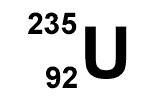
How many neutrons are in this isotope of Uranium?
a)
235
b)
92
c)
327
d)
143
48.

What did the meltdown at Chernobyl release into the air?

a)

Radioactive dust

b)

Bees!

c)

The Hounds

d)

The Kracken

49.

What is Pripyat like today?

a)

It is a thriving, vibrant city and the center of trade in Russia

b)

It was wiped off the map by a tactical nuclear strike launched by the United States in 1991

c)

It is still radioactive and not safe to live in today

d)

It was absorbed by the expanding Ottoman Empire in 1498

50.

Where was the Chernobyl power plant located?

a)

In the United States

b)

In the Soviet Union (Ukraine)

c)

In England

d)

In France