
Font size
 Worksheets
Topic 17 Vietnam War TEST - US History Spring 2021
Total questions: 64
Worksheet time: 45mins
On April 17, 1961, the Bay of Pigs invasion began, under what president?
Johnson
Kennedy
Nixon
Eisenhower
The goal of the Bay of Pigs invasion was to get rid of which communist leader?
Guevara
Batista
Chavez
Castro
What U.S. agency was behind the Bay of Pigs Invasion?
FBI
CIA
NSA
Police
The United States used Cuban exiles for the Bay of Pigs invasion
True
False
Which country became a close friend of the Cuban government after the Bay of Pigs?
Germany
United States
Soviet Union
Canada
The Soviet leader at the time of the Bay of Pigs was..
Joseph Stalin
Mikhail Gorbachev
Leonid Brezhnev
Nikita Khrushchev
Why was the Berlin Wall built?
To separate East and West Berlin
To keep people from leaving East Berlin
Both
Why did the USSR want to put missiles on Cuba?
To have more missiles because they couldn't match the nuclear power of the US
To counter the Warsaw Pact countries that were overthrowing communism
To counter the US missiles in Italy and Turkey
To counter the power of NATO
Why didn't Kennedy want to attack Cuba once the missiles were discovered?
fear of war
fear of communism in the US
fear of putting European allies in danger
fear of losing re-election
What was the resolution of the Cuban Missile Crisis?
The ambassadors from both countries came to an agreement to remove missiles from the countries each were concerned about
The President and Soviet Premier decided that they would both agree to disagree without fighting
Kennedy lifted the blockade but Cuba still had missiles on it
Khrushchev decided to remove missiles from Cuba to get the blockade lifted without talking to the US first, as an act of good faith
What was the lesson of the Cuban Missile Crisis?
Politics should only be left to the people to vote on each issue as it comes up
Governments should never get involved with other governments, unless there is a war going on
Politics are fragile and need to be handled diplomatically to prevent future problems
All nuclear weapons should be banned and never used in the world by any country
The failed US attempt to overthrow the communist Cuban government in 1961 was called the:
Bay of Pigs Invasion
Cuban Missile Crisis
Project to Eliminate Cuban Communism (PECC)
Inchon Invasion
Anti-Totalitarian Takeover (ATT)
A competition between superpowers to develop new, more deadly nuclear and controversial weapons.
Arms Race
Domino Theory
Glasnost
Warsaw Pact
Why were Cubans unhappy with the USA? Select all the right answers.
The USA had too many troops in Cuba.
The USA owned too much of Cuba's land.
The USA supported the dictator of Cuba.
The Cubans remained poor while profits went to American companies.
Who took over Batista as leader of Cuba?
Kennedy
Stalin
Khrushchev
Castro
What did the USA agree to do to end the Crisis? Select all the right answers.
Pay compensation to Cuba and the USSR.
Remove its missiles from Turkey.
Leave Cuba alone.
Apologise to Cuba for their actions.
What were the effects of the Crisis on the USA? Select all the right answers.
The USA looked weak for losing.
The President looked brave for handling the Crisis.
The USA became more aggressive.
The USA had to accept having a communist neighbour.
What were the effects of the Crisis on the USSR? Select all the right answers.
The USSR had to remove its missiles from Cuba.
The USSR became more aggressive towards the USA.
The USSR looked strong for handling the Crisis.
The leader lost the respect of other communist countries.
Which year did the Cuban Missile Crisis happen?
1945
1953
1962
1965
Which country had all of Southeast Asia as colonies prior to the Vietnam War?
the US
the USSR
France
Great Britain
The leader of North Vietnam was
Lyndon Johnson
Premier Ngo Dihn Diem
Ho Chi Minh
The John F Kennedy

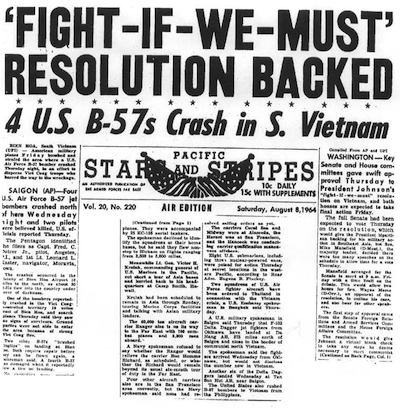
How many Americans were killed in the Gulf of Tonkin Incident?
2
5
10
None of the above
What ship did the Vietnamese attack on the 2nd of August?
USA Maddox
US Maddox
USS Maddox
According to the history of the Tonkin Gulf incident by the U.S. Naval Institute, high government officials...
misled the American public about the naval clash that took place?
had a clear understanding of what occurred off the coast of North Vietnam on August 4, 1964
ordered naval commanders to make every attempt to avoid provoking the North Vietnamese
had forbidden covert intelligence-gathering missions against communist North Vietnam
Which of the following statements is true about the Bay of Pigs?
Castro was alert and prepared for a rebel attack because the first rebel soldiers had missed their target.
Soviet ships carrying medical supplies and food were refused entrance to the Bay of Pigs and had to turn back.
Castro made an alliance with Gorbachev, who placed missiles in Cuba which were directed at the US.
A US spy plane observed the Cubans placing Soviet submarines in the Bay of Pigs, which prompted the US to attack Cuba.
The Bay of Pigs is a small farming community that was being used to disguise the Soviet missiles being set up on the coast of Cuba.
Which of the following justifies Kennedy's Navy block around Cuba?
Khrushchev removed all Soviet missiles from Cuba.
An American spy plane caught the Soviet Union placing nuclear weapons in Cuba.
Fidel Castro becomes dictator of Cuba and launches his new line of army fatigues with matching beards.
Khrushchev led a conference in Yalta but the US was not invited.
Castro threatened to launch four missiles at the US if Kennedy refused to take down the US missiles in Turkey.

Which of the following statements expresses the message in this political cartoon?
Castro reluctantly agreed to give Khrushchev 54 of his submarines in exchange for the Soviet missiles.
Castro had a terrible toothache and asked Khrushchev if he would pay his dental bill.
In 1968 Khrushchev demanded that Castro remove 22 missiles in Turkey, which were pointed at the Soviet Union.
Khrushchev determined he couldn't trust Castro and made the decision to remove the 100 missiles he had left behind in Cuba.
Castro mockingly told Khrushchev he would rather lose all his teeth than to lose all the missiles pointed at the United States.
"Within the past week, unmistakable evidence has established the fact that a series of offensive missile sites is now in preparation on that imprisoned island."
Which 1962 leader said this?
Nikita Khrushchev
John F. Kennedy
Harry Truman
Wang Chung
Hideki Tojo
The Gulf of Tonkin Incident claimed that 2 US Ships were attacked and this gave President ______________ the authority to send troops to Vietnam.
Kennedy
Johnson
Eisenhower
Truman
To burn the jungle areas and find the enemy, the US Government used a jellied gasoline that burned everything in site. This was called _____________.
Bombs
Napalm
Grenades
Carpet Bombing
The Democratic leader of South Vietnam that the US supported was Premier ______________.
Minh
Johnson
Diem
Truman
What was the name of the two bombing campaign's on North Vietnam?
Operation rolling lightening
Operation steel tiger
Operation Rolling thunder
Operation Tonkin
....was used to kill trees and plants in effort to expose communist guerrilla fighters
Napalm
Agent Orange
Kerosene
inflammable gel
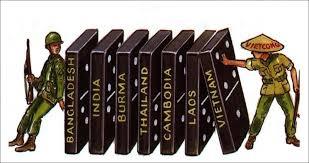
The idea that if South Vietnam fell to communism, other nations would soon follow...
Vietnamization
Communism
Domino Theory
Imperialism
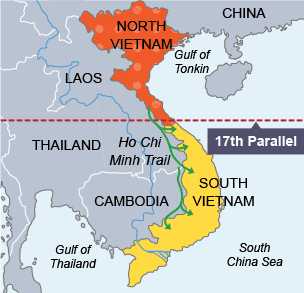

Who was the leader of North Vietnam during the war?
Ho Chi Minh
Ngo Dinh Diem
William C. Westmoreland
Bien Denh Phu
What countries helped North Vietnam during the war?
US and Russia
Canada and the Soviet union
China and Spain
Chinese and the Soviet Union
Style of warfare that the North Vietnamese fought with
Chemical warfare
Guerilla warfare
Nuclear warfare
Hand to hand combat


What is the capital of Vietnam?
Ha Noi
Ho Chi Minh
Both
None of them
Protests against the USA involvement in Vietnam grew in the late 1960's and early 1970's mainly because many Americans
Believed war was unjust
objected to college students getting drafted
feared nuclear war
opposed participation in conflicts involving the United Nations
The domino theory was used bu the USA as a justification for
China '79
Vietnam War '65-'73
Iran Hostage Crisis '79-'80
Iraq War '90-'91
What was one domestic result of the United States involvement in the Vietnam War?
improved relations between youth and the older generation
increased faith in militarism as a foreign policy
increased attention to social programs
greater public distrust of the governmental policies
One way in which the Korean War, the Vietnam War, and the Persian Gulf War are similar is that in all three wars
the goal was to defeat the Soviet Union
the USA was primarily interested in protecting oil supplies
The United States was fighting with out allies
no formal declaration of war was made by Congress
In 1968, the number of American who felt that United States troops should withdraw from Vietnam increased significantly. Which of the following events was most important in causing this shift in public opinion?
The gulf of Tonkin incident
The Tet Offensive
The fall of dien Bien Phu
The siege of Khe Sanh

