
 Worksheets
Semester I : Test III: Module 4: Waves and Oscillations
Total questions: 100
Worksheet time: 1hrs 15mins
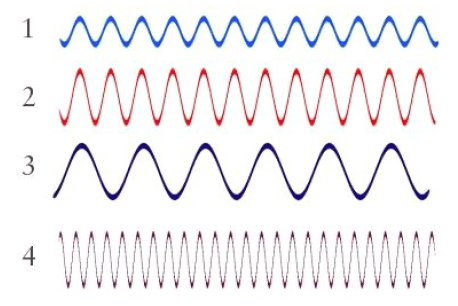
Which wave in the diagram has the greatest wavelength?
1
2
3
4

An object attached to one end of a spring makes 20 complete vibrations in 10s. Its period is:
0.50 s
2 s
0.5 Hz
2 Hz
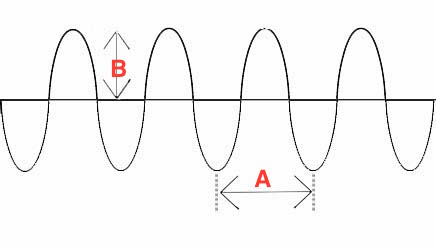
What property of the wave is represented by the letter "B"?
amplitude
crest
trough
wavelength
The number of wavelengths that pass a point each per second is:
frequency
period
longitudinal
transverse wave
What is common with all electromagnetic and mechanical waves?
They travel at the same speed
They transfer energy
They are all longitudinal waves
They are all transverse waves
Sound is an example of a
transverse wave
longitudinal wave
focal wave
electromagnetic wave
Maximum displacement from equilibrium position is called
trough
crest
amplitude
equilibrium
What fact is FALSE about standing waves?
They are created through wave interference
They occur both on strings and in tubes
They only apply to sound waves
They only occur at certain frequencies
When is the pendulum at maximum velocity
At its lowest point
At its highest point
It moves at a constant velocity
It is at rest
When does the mass move at maximum velocity in a mass-spring system?
At equilibrium
At the farthest point from the equilibrium
At its hightest point
At its lowest point
What are the two requirements for a simple harmonic oscillator?
The object vibrates about the equilibrium point and the restoring force is proportional to the displacement
The object moves left to right and the restoring force is proportional to the displacement
The object vibrates about the equilibrium and the restoring force is greater than the displacement
The object moves left to right and the restoring force is greater than the displacement
When is the pendulum at 0 velocity
At its lowest point
At its highest point
It moves at a constant velocity
It is at rest
When does the mass move at 0 velocity in a mass-spring system?
At equilibrium
At the farthest point from the equilibrium
At its hightest point
At its lowest point
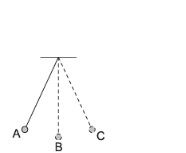
A pendulum oscillates as shown. At which of the following positions is the kinetic energy equal to the total energy?
A
B
C
Not enough information given.
The frequency of a body moving with simple harmonic motion is doubled. If the amplitude remains the same, which one of the following is also doubled?
the time period
the total energy
the maximum velocity
the maximum acceleration
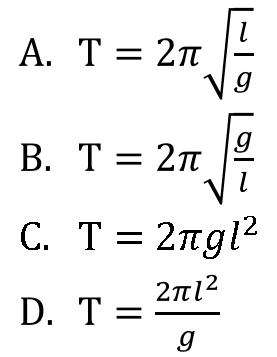
Based on your findings, which equation could best describe the pendulum’s period?
A
B
C
D

The maximum velocity occurs where the ____.
potential energy is a maximum
kinetic energy is a minimum
displacement from equilibrium is equal to
the amplitude of 0.4 𝑚
displacement from equilibrium is equal to
zero
An object of mass 𝑚 is attached to a horizontal spring, stretched to a displacement 𝐴 from equilibrium and released, undergoing harmonic oscillations on a frictionless surface with period 𝑇 . The experiment is then repeated with a mass of 4𝑚. What’s the new period of oscillation?
2T
T
4T
T√2
When is a pendulum in simple harmonic motion?
Never
All the time
only at large angles
only at small angles
What is the definition of SHM?
periodic motion without loss of energy in which the acceleration of a body is directly proportional to its displacement and is directed towards the equilibrium position but in opposite direction of the displacement.
periodic motion without loss of energy in which the acceleration is directly proportional to its velocity and is directed towards the equilibrium position but in opposite direction of the velocity.
periodic motion without loss of energy in which the acceleration of a body is inversely proportional to its displacement
periodic motion without loss of energy in which the angular frequency is directly proportional to its displacement and is directed towards the equilibrium position but in opposite direction of the displacement.
Position at which the body would come to rest if it were to lose all of its energy refers to
equilibrium position
maximum displacement / amplitude
periodic position
good position
The acceleration of a particle in SHM is:
always zero
always constant
maximum at amplitude
maximum at the equilibrium position
The amplitude and period in a SHM is 0.5 m and 0.4 s respectively. The equation of SHM will be:
x=0.5 sin 5πt
x=0.5 sin 4πt
x=0.5 sin 2.5πt
x=0.5 sin 0.8πt
Which of the following equation represent the displacement of SHM:
x= A tan ωt
x= A sin ωt
x= A sin ωt cos kx
x= A sin (ωt ± kx)

What is the number of complete waves passing a fixed point in a given amount of time?
Amplitude
Intensity
Wavelength
Frequency

What is frequency measured in?
Milliseconds
Miles
Hertz
Kilograms

Period of a wave refers to...
how long it takes for the event to repeat.
how strong a wave is.
how long a wave is.
how much energy a wave has.

Which type of waves have the longest wavelength?
Visible light
Radio waves
X-rays
Gamma-Rays
The distance between repetitions in a wave is the ---.
frequency
wave speed
amplitude
wavelength

What is the amplitude of the wave?
3 m
27 m
8 m
4 m

What is the wavelength of the wave?
3 m
27 m
35 m
13 m

What type of wave is this?
Transverse
Longitudinal
Rayleigh
electromagnetic

What type of wave is this?
Transverse
Longitudinal
Rayleigh
electromagnetic


The diagram shows the standing wave pattern of a vibrating string which is fixed at ends X and Y.
Which one of these statements is true?
P to R is one wavelength.
At R the string will move up.
The lowest frequency for this string is one third of its current value.
Point Q represents a node
A disturbance that transfers energy from one place to another without transferring matter:
wave
trough
pitch
period

Sound waves move faster in what temperature?
higher temperature
lower temperature
it makes no difference
both

The movement of a swing is known as ............
transitional motion
wave motion
oscillatory motion
(a) and (b)
All of the following are examples of oscillatory motion except .....................
motion of string
motion of tuning fork
motion of car
motion of simple pendulum

Which motion of the following represents a complete oscillation for the given simple pendulum?
C ---> B ---> A ---> B
A ---> B ---> C ---> B ---> A
A ---> B ---> C ---> B
B ---> C ---> B ---> A
The maximum displacement made by oscillating body away from its rest position is ...................
amplitude
frequency
periodic time
complete oscillation
The frequency is measured by a unit called .....................
Hertz
watt / m
decibel
m /sec
If the frequency of an oscillating body is 6 HZ, the periodic time is .................... sec.
3
61
6
The result of multiplying the frequency of an oscillating body by its periodic time equals .........................
31
1
41
.................... is (are) mechanical waves.
water waves only
sound waves only
microwaves only
both (b) and (c)
Wave is the disturbance that propagates and transfers energy ....................
in the direction of propagation.
in the direction opposite to that of propagation.
in the direction perpendicular to that of propagation.
no correct answer

Standing waves are created by
Two identical waves reflecting off each other
Two identical waves being diffracted together
Two identical waves move through each other in opposite directions
Two identical waves are diffracted from two identical sources

In the diagram which letters represent the nodes
A B C
A C E
B D
B D E
A C D
Which one of these statements is true?
Standing wave patterns produced in a medium are constrained to integer or half-integer multiples of resonant wavelengths. If a rope is fixed at both ends 1 m apart, which wavelength below could not possibly produce a standing wave?
2 m
1/3 m
1/4 m
3 m

Standing waves created in strings, pipes and closed pipes have specific wavelengths that fit into the length of those instruments
True
False

A pipe, opened at both ends (40 cm long) makes a tone travelling at 330 m/s. Calculate the frequency of the fundamental wave.
4.125 Hz
264 Hz
26400 Hz
412.5 Hz
Even numbered harmonics (multiples of fundamental frequency) do not form in a closed pipe because
the pipe “fits” only an odd number of quarter wavelengths
the pipe “fits” only an even number of quarter wavelengths
the pipe cannot put an anti-node at the open end
the pipe cannot get enough air to vibrate in the pipe at these lengths

The pipe length of A is 0.18 m. Sound travels at 343 ms-1 Calculate the frequency of the sound produced.
686 Hz
1905.56 Hz
343 Hz
1429.17 Hz
The pipe length of B is 0.25 m. What is the wavelength of the sound produced?
0.25 m
0.5 m
0.75 m
1 m
The pipe length of C is 0.25 m. What is the wavelength of the sound produced?
0.25 m
0.5 m
0.75 m
1 m
The pipe length of D is 0.65 m. The frequency of the sound produced is 1200 Hz. Calculate the wave velocity.
120 m/s
600 m/s
343 m/s
780 m/s
The pipe length of D is 0.65 m. The frequency of the sound produced is 1200 Hz. Calculate the wave velocity.
120 m/s
600 m/s
343 m/s
780 m/s

The figure represents a string of length L, fixed at both ends, vibrating in several harmonics. Which string shows the 4th harmonic?
A
B
C
D
E

The figure represents a string of length L, fixed at both ends, vibrating in several harmonics. Which string shows the 3rd harmonic?
A
B
C
D
E

The figure shows several modes of vibration of a string fixed at both ends. The mode of vibration that represents the fifth harmonic is
1
2
3
4
None of these is correct.

The figure shows a standing wave in a pipe that is closed at one end. The frequency associated with this wave pattern is called the
first harmonic.
second harmonic.
third harmonic.
fourth harmonic.
fifth harmonic.

The air in a closed organ pipe vibrates as shown. The length of the pipe is 3.0 m. The frequency of vibration is 80 Hz. The speed of sound in the pipe is approximately
80 m/s
0.16 km/s
0.24 km/s
0.32 km/s
0.96 km/s
Standing waves are created by
Two identical waves reflecting off each other
Two identical waves being diffracted together
Two identical waves move through each other in opposite directions
Two identical waves are diffracted from two identical sources
Do standing waves carry energy from one area to another?
Yes
No
Which statement is correct about the half wave A B C
All particles in this half wave are in phase with each other as they all move in the same direction
The particles A B C are in phase with the next half wave C D E because they all move in the same direction
All particles in this part of the wave are out of phase with each other as they all move in different directions
All particles in A B C have carried energy from one area to another
Standing waves created in strings, pipes and closed pipes have specific wavelengths that fit into the length of those instruments
True
False
Even numbered harmonics do not form in a closed pipe because
the pipe “fits” only an odd number of quarter wavelengths
the pipe “fits” only an even number of quarter wavelengths
the pipe cannot put an anti-node at the open end
the pipe cannot get enough air to vibrate in the pipe at these lengths
What number harmonic is shown in C
1
2
3
4
What number harmonic is shown in A
1
2
3
4
What number harmonic is shown in D
1
2
3
4
What number harmonic is shown in B
1
2
3
4

If a sound wavelength gets smaller what do you hear?
A louder sound
A quieter sound
A higher pitch sound
A lower pitch sound
If a sound Amplitude gets smaller what do you hear?
A louder sound
A quieter sound
A higher pitch sound
A lower pitch sound

A wave with a wavelength of 5m is traveling with a velocity of 2.5 m/s. Calculate its frequency.
12.5 Hz
0.5 Hz
2 Hz
15 Hz
In the diagram which letters represent where a sound wave will be at its loudest?
A B C
A C 3
B D
B D E
A C D
If you walk along the line of the standing wave what will you hear?
The sound loudness stays the same from A to E
The pitch of the sound changes as you move from A to B to C
The loudness of the wave changes from no sound / quietest at B to loudest at C
The loudness of the wave changes from no sound / quietest at C to loudest at D
The pipe length of C is 0.25 m. What is the wavelength of the sound produced?
0.25 m
0.5 m
0.75 m
1 m
The pipe length of B is 0.25 m. What is the wavelength of the sound produced?
0.25 m
0.5 m
0.75 m
1 m
The pipe length of A is 0.18 m. Sound travels at 343 ms-1 Calculate the frequency of the sound produced.
686 Hz
1905.56 Hz
343 Hz
1429.17 Hz
The pipe length of D is 0.65 m. The frequency of the sound produced is 1200 Hz. Calculate the wave velocity.
120 m/s
600 m/s
343 m/s
780 m/s
The pipe length of D is 0.65 m. The frequency of the sound produced is 1200 Hz. Calculate the wave velocity.
120 m/s
600 m/s
343 m/s
780 m/s

