

Wayground logo

Free Printable Worksheets

Font size

S
M
L
XL
Worksheets

CFE Honors Practice Test 24

Total questions: 53

Worksheet time: 1hrs 18mins

Name
Class
Date
1.

Visible light emitted from a star or galaxy can be separated into a band of colors, called a (a)   .
2.

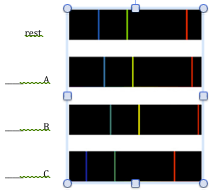
Are any of the galaxies moving towards Earth?  Explain. (a)  

Choose from the below words
A.  It is redshifted
B. It is redshifted.
C. It is blue shifted.
A. It is blueshifted.
3.
What is Cosmic Background radiation?
a)
Evidence of a large explosion in the universe leaving radiation behind
b)
It is the life force that supports the universe
c)
Evidence of blackholes actually existing
d)
Evidence of that the universe is heating
4.

Which term describes the apparent shift of light wavelengths toward the red end of the electromagnetic spectrum when a luminous object is moving away from Earth? (a)  

Choose from the below words
blueshift
infrared shift
redshift
ultraviolet shift
5.

What type of telescope is used to measure cosmic microwave background radiation? (a)  

Choose from the below words
Gamma radiation telescope
UV radiation telescope
Microwave radiation telescope
IR radiation telescope
6.

All stars begin their life in a (a)  

Choose from the below words
Main Sequence
Nebula
Protostar
Black Dwarf
7.

What are the final two stages of a low mass star? (a)  

Choose from the below words
white dwarf - black dwarf
neutron star - black hole
supernova - neutron star
pulsar - neutron star
8.

A gigantic explosion that causes the death of a large star is called (a)  

Choose from the below words
pulsar
red giant 
supernova
black hole
9.

A Red Giant burns through it Hydrogen and then uses Helium as fuel. What is the byproduct of this process? (a)  

Choose from the below words
Magnesium
Iron
Silicon
Carbon
10.

In the diagram given, what happens as we move to the left? (a)  

Choose from the below words
Stars Get Larger
Stars get Colder
Stars get older
11.

A force that drags a plate into the mantle. (a)  

Choose from the below words
convection
convergent plate
divergent plate
slab pull
12.

What are the deepest places on Earth formed by pushing oceanic crust under continental crust? (a)  

Choose from the below words
mid-ocean ridges
rift valleys
trenches
mountain ranges
13.

What forms when denser oceanic crust is pushed under less dense oceanic crust? (a)  

Choose from the below words
mountains
volcanic islands
rift valleys
mid-ocean ridges
14.

What is associated with transform boundaries? (a)  

Choose from the below words
mountains
volcanoes
faults
islands
15.

Surface currents bring warm water from the equator towards Earth's (a)  

Choose from the below words
Southern Hemisphere
Continents
Equator
Poles
16.

The Gulf stream (starting near the Equator) carries _____________ water from the east coast of The United States to the West coast of Europe.

a)

Cold

b)

Warm

c)

Freezing

d)

Fresh

17.

Deep Ocean currents caused by (a)  

Choose from the below words
Global Wind Patterns
Earth's Rotation
Differences in density
All of the above
18.

What do we call the constantly moving system of deep-ocean circulation driven by differences in temperature and salinity? (a)  

Choose from the below words
California Current
Global Conveyor Belt
Surface Currents
Gulf Stream
19.

Water availability impacts plant growth and animals who depend on plants for food are interactions between the (a)  

Choose from the below words
Geosphere and Hydrosphere
Cryosphere and atmosphere
Biosphere and geosphere
Hydrosphere and biosphere
20.

Evaporation from the ocean moves the water from (a)  
Choose from the below words
atmosphere to geosphere
geosphere to hydrosphere
hydrosphere to atmosphere
atmosphere to hydrosphere
21.

When living things breathe, they interact with which of Earth's spheres?  (a)  

Choose from the below words
Geosphere 
Hydrosphere 
Atmosphere 
Biosphere 
22.
When I cold front is approaching, what happens?
a)
warm air is pushing under cold air causing humid weather and lower temperatures
b)
warm air is pushing under cold air causing humid weather and higher temperatures
c)
warm air rises, cools, and causes rain and thunderstorms
d)
cold air is pushed over warm air causing rain and thunderstorms
23.

What type of front is over Texas? (a)  

Choose from the below words
warm front
cold front
stationary front
occluded front
24.

Which of the following best describes the surface wind circulation around the center of a High pressure system (as seen from above)?

a)

counterclockwise and spiraling outward

b)

counterclockwise and spiraling inward

c)

clockwise and spiraling outward

d)

clockwise and spiraling inward

25.

Most clouds form by the cooling of air. Air, if sufficiently cooled, will become saturated with water vapor. Continued cooling will result in condensation, cloud formation, and possible precipitation. The vertical motion in a __________ often leads to cloud formation.

a)

low

b)

high

26.

Surface winds on Earth are primarily caused by differences in

a)

distances from the Sun during the year

b)

ocean wave heights during the tidal cycle

c)

rotational speeds of Earth’s surface at various latitudes

d)

air density due to unequal heating of Earth’s surface

27.
Which statement correctly defines wind?
a)
Wind is the movement of air from areas of low pressure to areas of high pressure
b)
Wind is the movement of air to a colder area in the atmosphere.
c)
Wind is the movement of air from areas of high pressure to areas of low pressure.
d)
Wind is the movement of air pushed around and bouncing off Earth's surface.
28.

On which day was there the least difference between the low temperature and high temperature? (a)  

Choose from the below words
Monday
Tuesday
Thursday
Friday
29.

Students observe plant and animal cells under the microscope and use a Venn diagram to compare what they observe. (a)  

Choose from the below words
Descriptive only
Descriptive and Comparative
Experimental
30.

Which type of investigation does not have a control group? (a)  

Choose from the below words
Comparative
Experimental
31.

In the paper airplane experiment, changing the size of the airplane would be which variable? (a)  

Choose from the below words
Dependent
Independent
Control
Conclusion
32.

These kind of observations are made using instruments such as rulers, balances and thermometers. (a)  
Choose from the below words
Qualitative
Quantitative
Scientific
33.
Mr. S normally uses praise as a reward to train his dog. He wants to know the best way to train his dog, so he sets up an experiment to find out if there is a better way to get his dog to respond to commands. What is his dependent variable?
a)
Type of reward
b)
Praise
c)
Type of dog
d)
Amount of time the dog follows commands
34.
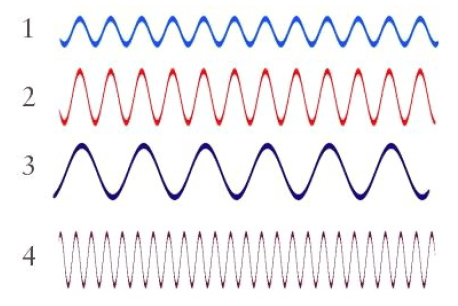
Which wave in the diagram has the greatest frequency?
35.

A wave with a large wavelength will have a (a)   frequency and (b)   energy

Choose from the below words
high, low
high, high
low, high
low, low
36.

Which of the following electromagnetic waves is given off as heat?  (a)  

Choose from the below words
ultraviolet light
x-rays
gamma rays
infrared rays
37.

Which of the following has the least amount of energy? (a)  

Choose from the below words
UV rays
The color yellow
Radio waves
Gamma rays
38.

As frequency increases on the electromagnetic spectrum, what happens to the wavelength? (a)  

Choose from the below words
It stays the same
It decreases
It increases
It doubles
39.
Heat transfer occurs:
a)
in many directions
b)
both from warm objects to colder ones and from cold objects to warmer ones
c)
only from warm objects to colder ones
d)
only from cold objects to warmer ones
40.

A measure of how much thermal energy an object has (a)  

Choose from the below words
thermal energy
conduction
convection
temperature
41.

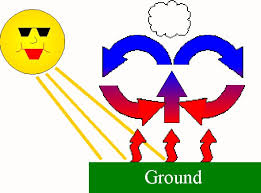
A group of friends gather around a fire to stay warm. (a)  
Choose from the below words
conduction
convection
radiation
42.

Warm air rises and the cool air sinks. (a)  
Choose from the below words
conduction
convection
radiation
43.
At higher temperatures
a)
particles in an object have less energy
b)
particles in an object move faster
c)
a gas contracts
44.
Chemical weathering is defined as...
a)
Wear and tear on rocks primarily by forces.
b)
Wear and tear on rocks primarily by weather.
c)
Wear and tear on rocks primarily by reactions with water.
d)
All of the above.
45.

Layers of sediment forming at the bottom of the ocean (a)  

Choose from the below words
weathering
erosion
deposition
46.

When the land surface above collapses or sinks into the cavities or when surface material is carried downward into the voids; drought, along with resulting high groundwater withdrawals, can make conditions favorable for this to form (a)  

Choose from the below words
deltas
mountains
caves
sinkholes
47.

This canyon is a result of (a)  

Choose from the below words
water erosion
glaciers
wind
48.

How do animals get carbon?

a)

By eating plants and or other animals.

b)

They absorb it from the atmosphere.

c)

From the ground

d)

They do not get carbon from anywhere.

49.

What organisms in the ocean absorb the most carbon dioxide?

a)

Algae and marine plants

b)

Ocean mammals, like whales and dolphins

c)

Fish

d)

Coral

50.

During the process of condensation, describe the process of the movement of energy. (a)  

Choose from the below words
Energy is absorbed
Energy is released
There is no energy movement
The process is at equilibrium
51.

If greenhouse gases increase and build up in our atmosphere, what happens?

a)

They trap more heat and global temperatures rise.

b)

They trap more heat and global temperatures decrease.

c)

They trap less heat and global temperatures rise.

d)

They trap less heat and global temperatures decrease.

52.

Heat is radiated back to space from earth as (a)  

Choose from the below words
visible light
ultraviolet radiation
gamma radiation
infrared radiation
53.

According to the diagram, what can happen when solar energy hits clouds in Earth's atmosphere?

a)

it can be reflected or absorbed

b)

it can only be absorbed

c)

it can only be reflected

d)

it is neither reflected nor absorbed
