
 Worksheets
Piano Class End of the Year Final Test
Total questions: 76
Worksheet time: 2hrs 11mins
When was the piano invented?
Around 1700
Around 1800
Around 1900
Around 1600

Who invented the piano?
Christopher Columbus
Bartolomeo Cristofori
Christopher Robin
Ms. Capani

How was the new pianoforte better than the harpsichord?
It was easier to play.
It was cheaper to buy.
It could play dynamics; loud and soft.


What is the name of this key?
A
Eb
G#
F#

What is the name of this key?
Db
Bb
Cb
Fb


What note is this?
A
F
E
B

What note is this?
E
A
F
G

What is the rhythmic value in a 44 time signature?
1/2 beat
1 beat
2 beats
3 beats
4 beats


What does the bottom number of the time signature tell you?
How many beats per measure
How many seconds per measure
Which note is worth one beat
The denominator

How many beats does this note get?
1
4
3
2

How many beats does this note get?
one beat
two beats
three beats
four beats

Name this rest.
Quarter Rest
Half Rest
Whole Rest
Eighth Rest
Dotted Half Rest

How many beats do these notes get TOGETHER?
2
1
4
3
1/2


What is the name of this music symbol?
sharp
natural
flat
staccato

What is the name of this music symbol?
hashtag
sharp
flat
natural

What is the name of this music symbol?
Sign
Repeat
Crescendo
Key signature
What symbol means to skip to the coda?


name this symbol.
fortissimo: play as loud as you can
femata: shorten the note
fermata: hold the note longer than normal
formelitia: a short formula

In music, what does a tie do?
shortens two notes.
combines two or more notes of the same pitch.
makes you look good in a suit.
combines two or more notes that are different pitches.

D.S. stands for Da Segno.
True.
false.

What is a coda?
Italian for end of the song
Italian for the beginning of the song.
Italian for the middle of the song.
What does D.C. al Coda mean?
District of Columbia
Detective Comics
Dal Capo: Italian for go to the beginning of the song and then go to the end.
Deceptive Cadence


What is tempo?
how fast or slow the music should be played
how slow the music is played
how fast the music is played
moderate pace
What is allegro?
slow
moderate
fast
gradually getting faster
Ritardando = gradually slowing down
true
false
This term means the tempo speeds up.
agitato
accelerando
ritardando
calando
Tempo markings we have studied are in what language?
Italian
Latin
Olde English
German
What do Dynamics tell you?
How fast to play the music
How loud or soft to play the music
Andante
Adagio
Forte means?
loud
soft
medium loud
medium soft
Largo is a _______ marking and means ______?
Dynamic; slow
Tempo; slow
Dynamic; fast
Tempo; fast
Mezzo Piano (mp) is a ________ marking and means _______?
Tempo; slow
Dynamic; soft
Tempo; medium soft
Dynamic; medium soft
Allegro is a ________ marking and means ______?
Dynamic; fast
Tempo; fast
Dynamic; soft
Tempo; loud

pianissimo
piano
piano piano
pianito

piano
pizzicato
pizza
plain style

Forceful
Flauta
Fast
Forte

Forte Forte
Fortelando
Fortissimo
Fast Fast
Gradually Louder. Choose THREE
Descrescendo
Crescendo


Gradually Softer. Choose THREE.
Dimiunendo
Decrescendo
Ritardando


Why is Florence Price important in music history?
She was married to a famous composer.
She sang at Lincoln Center.
She was the first African American woman to have her composition performed by a major symphony orchestra.
She was the first African American woman to perform piano at the White House.
FLORENCE PRICE:
When the Chicago Symphony Orchestra performed Price's Symphony No. 1 in E minor in 1933, why was it groundbreaking? Choose 2 answers.
It was the first time a major symphony orchestra had performed a piece by an African American woman.
It was the first time a major symphony orchestra performed in Chicago.
An all male, all white orchestra performed the work of an African American woman.
Florence Price performed a solo with them.
Florence Price was taught piano by
her father
her mother
her school
a private piano teacher

AMY BEACH:
Where was Amy Beach born?
Henniker, New Hampshire
New York City, New York
Los Angeles, California
New Orleans, Louisiana
Many woman composers achieved successful status in American before Amy Beach.
True
False
True or false: Amy Beach's husband was supportive of her composing career.
true
false

CLARA SCHUMANN:
Where was Clara Schumann born?
Leipzig, Germany
Frankfurt, Germany
Berlin, Germany
Munich, Germany
In what musical period did Clara Schumann write?
Romantic
Medieval
Classic
Baroque
Who did Clara marry?
Robert Schumann
Felix Mendelssohn
Johannes Brahms
Franz Liszt
Check off all the terms that are elements of music. There are THREE.
beat
melody
harmony
staff
rhythm
Which of the following is NOT an element of music?
Pitch/Melody
Duration/Rhythm
Allegro
Texture
What is FORM?
How fast the music is to be played.
The way music is organized.
How high or low the pitches are.
The progression of chords.
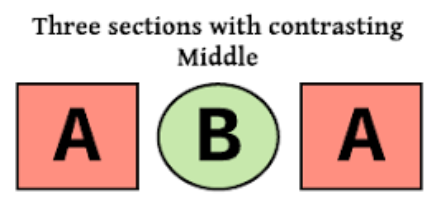
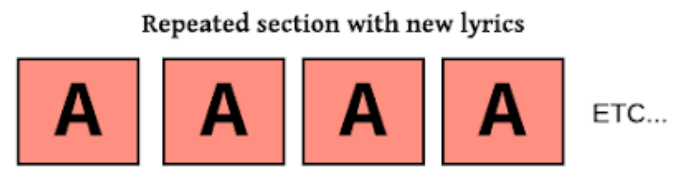
Name the form
Binary
Strophic
Theme and Variation
Ternary

What form does this picture represent?
Binary
Strophic
Ternary
Song Form
What does texture refer to?
How loud or soft a song is
The number of individual musical lines and the relationships these lines have to one another
The number of dynamics that are used within the song
How many Italian terms can be found within the music
Which of the following lists types of texture?
Monophonic, homophonic, and polyphonic
Binary, ternary, strophic, and through-composed
Forte, piano, crescendo, and decrescendo
Soprano, alto, baritone, tenor, and bass

Medieval Gregorian Chant is a single melody with Latin words. What's the texture?
polyphonic
homophonic
monophonic
What element of music refers to the speed of the underlying beat?
Timbre
Tone
Tempo
Texture
What two words can be used to describe duration?
Long or short
Smooth or detached
High or low
Thick or thin
What is timbre?
The range of an instrument or voice.
The unique tone quality of an instrument or voice.
A percussion instrument.
The main musical line.

The different sounds of these instruments are described as _________________.
melody
form
dynamics
timbre
What is melody?
The supporting chords.
How loud or soft the music is played.
The main musical line that moves in a contour of conjunct and disjunct patterns. .
The value of notes and rests.
What can used to describe conjunct melody?
jumping around
vertical harmony
decrescendo
stepwise motion

The right hand of this piano music shows melody that is mostly _____________________.
conjunct
disjunct
the term pianissimo is an example of which element of music?
Rhythm
Dynamics
Pitch
Texture

