
 Worksheets
CSEC POB - Section 5 - Production
Total questions: 118
Worksheet time: 3590secs
Which of the following is a primary need?
money
transport
land
food
Which of the following is not a factor of production?
food
land
labour
capital
In a subsistence economy the main source of production is:
exports
manufacturing
agriculture
mining
Which of the following is a diseconomy of scale?
extensive advertising is practicable
labour-saving machinery can be used
more capital is available
lines of communication can become complex
Fixed capital includes:
buildings
stocks
bank balance
stationery
The Law of Diminishing Returns states that with additions to labour:
marginal output rises
average output rises
marginal output falls
total output increases
The labour force of a country is:
all people below retirement age
all persons who are employed or are available for work
the total population
all persons over the school leaving age
Automation in industry can result in:
increased need for tertiary services
employment of a larger workforce
a more skilled workforce
increased production costs
WHAT ARE THE 4 FACTORS OF PRODUCTION?
Land, Capital, Needs & Wants
Land, Labour, Capital, Entrepreneurship
Water, Air, Food & Shelter
Land, Capital, Good & Service
WHAT IS LABOUR?
work people do for pay to produce good and services
actions people do for other people
any physical object
The money people get for inheritance
_______________ IS KNOWN AS FACTOR THAT GIVES THE NATURAL RESOURCES USED TO PRODUCE GOODS AND SERVICES
Entrepreneurs
Capital
Labour
Land
_______________ IS KNOWN AS THE MANMADE RESOURCES USED TO PRODUCE GOODS AND SERVICES.
Entrepreneurs
Capital
Labor
Land

Which of the factors of production is this?
capital
entrepreneur
land
labour
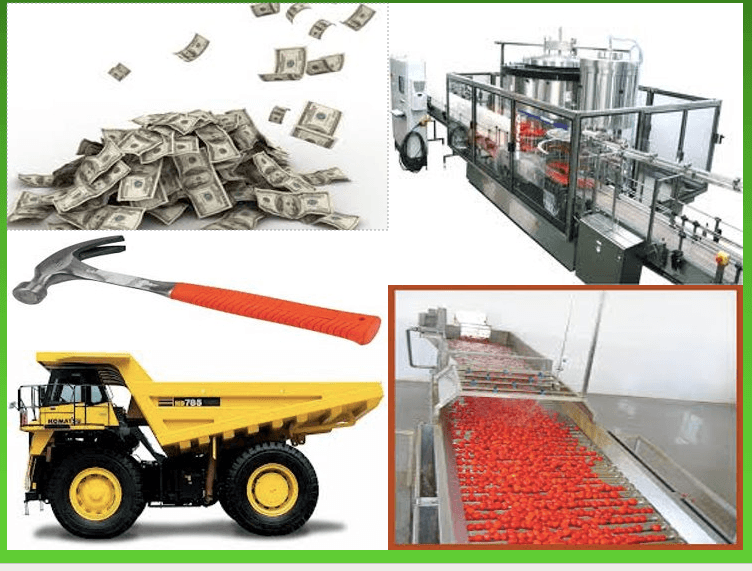
Which one of the factors of production is this?
capital
entrepreneur
land
labour
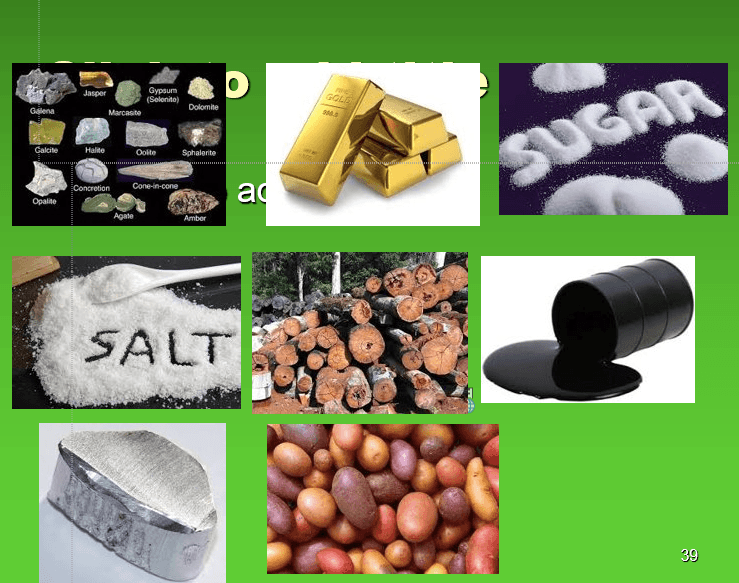
Which factor of production do these represent?
capital
entrepreneur
land
labour
This factor involves money, equipment, and tools and any items to produce goods and services?
capital
entrepreneur
land
labour

Land includes...
The "gifts of nature" or natural resources not created by human effort.
the tools, equipment, and factories used in production of goods and services
people with all their efforts and abilities
individuals who start a new business or bring a product to market.
Capital refers to...
The "gifts of nature" or natural resources not created by human effort.
people with all their efforts and abilities
the tools, equipment, and factories used in production of goods and services
individuals who start a new business or bring a product to market.
Labour refers to...
people with all their efforts and abilities
individuals who start a new business or bring a product to market.
the tools, equipment, and factories used in production of goods and services.
The "gifts of nature" or natural resources not created by human effort.
Production refers to the creation of goods and services.
True
False
Wants are referred to as primary needs.
True
False
Any activity connected with money earning and money-spending is called an economic activity.
True
False
Maybe
Physical goods is also known as INTANGIBLE GOODS.
True
False
Maybe
Services are activities provided by other people, who include doctors, lawn care workers, dentists, barbers, waiters, or online servers, a book, a digital video game or a digital movie
True
False
Maybe
There are four main methods of production.
True
False
Maybe
Domestic Level
At this level, goods are produced locally and not exchange or exported. Enough is produced to provide for the local market.
True
False
Maybe
Enough goods are produced with the intention of exporting to other country. This is called subsistence level.
True
False
Maybe
There are 5 methods of Production.
True
False
Maybe
....................... is a process of combining various material inputs and immaterial inputs (plans, know-how) in order to make something for consumption (output).
Production.
Labour.
Land.
Product.
Making a large quantity of identical products
Job
Batch
Flow
Making individual products that are bespoke (fit each customer's needs)
Job
Batch
Flow
Making different varieties of identical products. The production process is broken into stages
Job
Batch
Flow
During production process inputs are converted into ______________.
store
machines
raw materials
outputs

Stones are examples of ____________
Finished products
Goods
Parts
Raw materials
Which of the following is NOT true with production process
firms adding value to a product
transforming raw materials into finished goods
provision of a product or service
providing only a product, not service
Which of these is a service?
beverage factory
plumbing
readymade dresses
birthday cakes baked by a supermarket
Which of the following is true for productivity?
productivity is how products are made
productivity is a measure of how many workers a business has
productivity measures efficiency
productivity measures effectiveness
Which of these isn't a method of improving productivity?
employing more staff
providing pay incentives
investing in up-to-date machinery
training staff
Which of the following statements is correct?
the level of production is the total number of goods produced per worker
productivity is the same as output in a given time period
increasing production leads to increased productivity
reducing productivity per worker will increase the number of workers
One of the benefits of increasing productivity is:
more workers will be employed
total production will increase with the same number of workers
average costs will stay the same
fewer raw materials will be needed to produce the same level of output
Which of the following is the best definition of 'an increase in efficiency'?
higher output levels than last year
lower total costs of production
fewer workers employed but output level remains the same
10% more workers employed and output also rises by 10%
The inputs into production of goods and services that are provided by nature, such as land, rivers, and mineral deposits are called
physical capital.
natural resources.
human capital.
technological knowledge.
The possible disadvantage of growing a business may be
Keeping control over decision making
Larger potential profits
Benefit from bulk buying discounts
Security for the future of the business
A merger is
Two business agreeing to becoming one new business
One business buying shares in another business
One business taking over control of another business
Two businesses co operating with each other.
Advantages of a Merger might be...
(select THREE applicable answers)
Better deals because of increased order size, bulk-buying discounts etc.
Increased revenue and market share. Increased size of the combined company increases market power and ability to set higher prices
To gain resources. If one company has resources (e.g. technology) that another one wants then a merger may be the most cost effective way to get access to those resources
Slow growth so can be easily managed
Disadvantages of Mergers could be..............
(Select THREE applicable answers)
Clash of Cultures. All businesses have a slightly different culture and they may not work well together
Mergers lead to bigger more efficient business
Possible communication problems. As the business gets bigger, or if there are now too many employees
Unreliable partners. A good merger will depend on trust between the businesses
Which option best describes the term takeover?
When two firms agree to join together to make one new business
When a business finds a new market in another country
When one business purchases another business
When a business brings something new to the market
Which best describes growth by expanding overseas? When a business:
Finds new customers to buy its products in its domestic market
Purchases another business in its home country
Finds a new market in another country
Invests heavily in research and development
Nike buying a materials producer would be a form of...
Vertical Forward Integration
Horizontal Integration
Vertical Backward Integration
Diversification

Horizontal integration is...
When 2 companies in the same industry at the same stage of production join e.g. H&M and Zara
When 2 companies in the same industry at different stages of production join e.g. H&M and a textiles factory
When 2 companies in different industries join e.g. H&M and Costa
IInternal growth is also known as ORGANIC growth. External growth is also called INORGANIC growth
A benefit of organic growth is
It is quick
The business can benefit from economies of scale (lower unit costs)
Its more likely to fail than inorganic growth
Developing new products is an example of
market development
mergers
innovation
Why might a business want to grow?
More Profit
Give employees more time off
To improve the business image
To sell less products
Another reason why a business may want to grow is......
To gain more competition
To gain more customers
To reduce the amount of stores
Which of the following is NOT Internal/organic growth?
Opening a new location
Expanding through internet selling
Merging with a similar company
Offering franchises
Vertical integration occurs when...
firms in the same industry and at the same stage of the production process combine to form a larger business.
when a firm expands by combining with an existing business in the same industry but at a different stage of the production process.
Involves take over or merger with another firm in an unrelated industry.
BMW Motors Purchasing AUDI is an example of....
Vertical integration
Horizontal Integration
Diversification
Apple buying a company that creates microchips for phones and computers is an example of...
Vertical integration
Horizontal Integration
Diversification
McDonalds buying a cattle farm would be an example of...
Vertical integration
Horizontal integration
Diversification
The mining of minerals is called...
drilling
manufacturing
servicing
extracting

If you take your car is broken and you take ii to the mechanic, , is it the secondary production sector involved?
No, the mechanic is tertiary sector.
Yes, it is secondary sector

Name the activity and the prodcution sector
Agriculture, secondary
Fish Farming, secondary
Agriculture, primary
Fishing, primary

Name the activity and the production sector
Construction, primary
Mining, secondary
Extracting, tertiary
Mining, primary

Name the activity and production sector
Farming, secondary
Agriculture, primary
Manufacturing, secondary
Agriculture, secondary

Name the activity and sector
Sewing, primary
Textile, primary
Seamstress, primary
Textile, secondary

Name the activity and the production sector
Construction, seconday
Metallurgy, tertiary
Metallurgy, primary
Manufacturing, secondary
Primary industry is also known as extractive industries
True
False
Secondary industry is also known as _____________ industry
manufacturing
extractive
mining
Making soaps, carpets, sugar, etc is an example of _________ industry
primary / extractive
secondary / manufacturing
tertiary
Banking is an example of ____________ industry
Primary / Extractive
Secondary / Manufacturing
Tertiary
The industry that provides goods and not services is called tertiary industry
True
False
The industry that includes the process of making goods from raw materials is called ____________
Primary / extractive
Secondary / manufacturing
tertiary
Mining comes under ___________ industry
Primary / extractive
Secondary / manufacturing
tertiary
What are levels of production?
Primary Production
Producing at the secondary level
The amount of goods produced
Producing only enough to meet the basic needs of the family is called?
Domestic Production
Subsistence Production
Surplus Production
This level of production allows a country to earn foreign exchange from the selling of its products.
Subsistence Production
Domestic Production
Surplus/Export Production
Selling goods at your local market is which level of production?
Domestic Production
Export/Surplus Production
Subsistence Production
If Jamaica is able to produce enough goods to satisfy the needs of persons in the country, Jamaica is practicing which level of production?
Domestic Production
Export Production
Subsistence Production
When China sells its products to other countries, this is which level of production?
Subsistence Level of Production
Domestic Level of Production
Surplus/Export Level of Production
Which of the following is not a suitable method for measuring the size of a firms?
The number of employees
the size of the profit
the amount of capital employed
the size of turnover
Which of the following is not an advantage of a small firm?
Better communication
flexibility
economies of scale
a personal service can be offered
Which of the following is a disadvantage of small firms?
economies of scale
lack of finance
too bureaucratic
poor worker motivation
which of the following is not an advantage of a large firm?
market domination
economies of scale
better communication
can undertake large scale contracts
which of the following is an advantage of a small firms?
can benefit from economies of scale
ability to offer a personal service
can access a greater range of finance options
can attract the most qualified and experience staff
Which of the following is not a disadvantage of a small firm?
struggle to raise finance
difficult to attract highly qualified and experienced staff
can adapt more quickly to change
cannot exploit economies of scale
Which of the following factors encourage firms to grow?
poor access to sources of finance
desire to spread risk
government regulation monitoring levels of competition in a market
global economic instability
Which of the following is not an advantage of a large firm
can win large scale highly profitable contracts
lower average costs due to size
personal contact may be lacking impacting on employee motivation
can dominate a market and have a high public profile which they can exploit
A small business or manufacturing activity is called a cottage industry?
True
False
A business or manufacturing activity carried out in people's homes is called...
A Small Business
A Medium Enterprise Business
A Cottage Industry
A Limited Company
Which of the following is not one one of the key features of a cottage industry?
Carried out in persons homes
Typically use traditional or small scales technology
Often use local raw material
Usually hire employees from the community
Which of the following is NOT a disadvantage of operating a cottage industry?
Operators may lack marketing skills
Raw materials may be hard to obtain
Cottage industry usually offers low and attractive prices
Long hours of work usually required
Which of the following falls under cottage industry
The Village Corner Store operated by Tanty Pam on the busy junction.
The local barbershop operated in the community mall
The large supermarket at the mall
The carpenter operating at his home
Which is NOT a characteristic of cottage industry?
Based at home
Labour- intensive production
Use of readily available resources
Highly trained employees
Which of the following businesses may be BEST categorized as a cottage industry?
Linda's Hear Dressing Salon
Otis Mini Mart
Vicky's Handicraft
Eva Brewery Ltd.
All of the following can be considered disadvantages of cottage industries EXCEPT:
Flexibility in working hours
High cost of production
Lack of standardisation in output
Dependence upon local raw materials
A cottage industry can BEST be described as
A business with one person responsible for all aspects
A business that builds homes
A business carrying out production at home
A business catering to the needs of the local community
A cottage industry business, most likely has ____________
Unlimited Liability
Limited Liability
Large Labour Force
Lots of Sophisticated Capital Equipment
Linkage Industries are ______
closely connected to each other
part of the public sector
capital intensive
engaged in mass production
Which of the following is a forward linkage?
A farmer providing manure for other farmers
A farmer buying fertiliser from garden store
Oil manufacturer buying bottles from bottle manufacturer
Bottle manufacturer buying petroleum from crude oil industry
Forward linkage is where_______
one industry provides raw materials for another
one industry depends on another for their raw materials
one industry sells their product to the public
one industry buys their materials from a manufacturer
An advantage of the linkage industry is _______
It provides a guaranteed market for your product
It provides a guaranteed source for your raw materials
It is cheap and easy to set up
It makes use of local resources
An advantage of the linkage industry is _______
It provides a guaranteed market for your product
It provides a guaranteed source for your raw materials
It is cheap and easy to set up
It makes use of local resources
Linkage industries benefit the economy by all EXCEPT_____
providing employment
allowing money to remain in the country
passing down traditions from one generation to the next
Which of the following is best suited as a forward linkage industry for Tamarind Balls?
Tamarind from a farmer
Tamarind tree from a garden store
Tamarind sauce from a chef
Local Produce Store at a hotel

Jamaica has large amounts of bauxite. What can be produced from bauxite?
aluminum
chips
The Caribbean Islands once had many tropical forests, but few timber resources are available today. What is timber?
wood used for building
water used for farming
Bauxite is found in abundance in both Jamaica and __________.
Guyana
Trinidad and Tobago
Barbados
Grenada

