
 Worksheets
IGCSE Transport in animals
Total questions: 77
Worksheet time: 2hrs 39mins
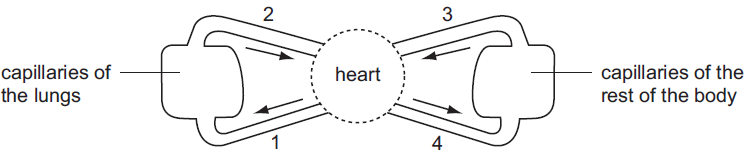
The diagram shows a double circulatory system. Which vessels carry oxygenated blood?
1 and 2
1 and 4
2 and 3
2 and 4

The plan shows the blood system of a mammal.
What does the part labelled X represent?
A heart
B kidneys
C liver
D lungs
Circulatory system consists of the heart, blood vessels and
White blood cell
Plasma
Blood
platelets
Which vessel transports blood at low pressure?
Artery
Aorta
Capillary
Vein
Which vessels transport blood at high pressure?
Artery
Capillary
Vein
Which of the following carries blood away from heart?
Vein
Artery
Capillary
Valve
Oxygen travels in red blood cells in a liquid called __________, through tubes called __________ __________, pushed by a pump called __________, in a closed circulatory system.
plasma - vascular bundles - heart
blood - blood vessels - heart
blood - vascular bundles - lung
plasma - blood vessels - heart
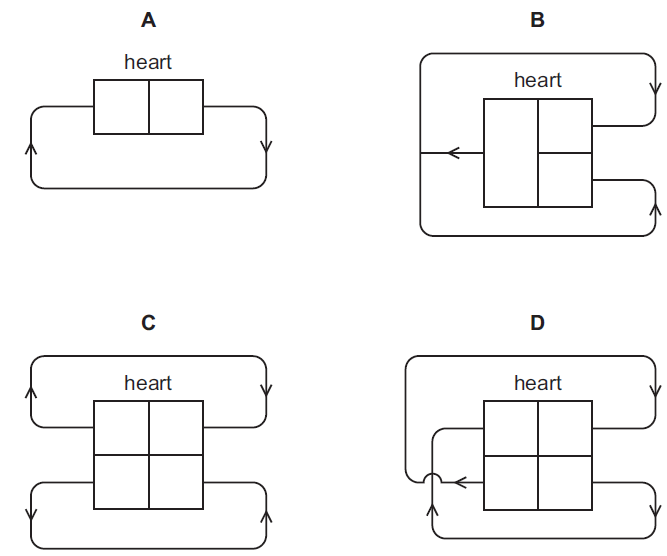
Which diagram shows the human double circulatory system?
A
B
C
D
How often must a blood cell in the renal artery pass through the heart before it again reaches the renal artery?
once
twice
three times
four times

The diagram shows some parts from the blood of a mammal.
Which one would contain the engulfed and broeken down products of a pathogen like bacteria?
A
B
C
D
The diagram shows some parts from the blood of a mammal.
Which cell would contain the antibodies against a pathogen?
A
B
C
D

Which describe the structure and function of a red blood cell?
structure: cell contents are dead
function: transport of water
structure: has a nucleus
function: produces antibodies
structure: has cilia (hair-like structures)
function: moves particles in the respiratory tract
structure: has no nucleus, biconcave shape
function: transport of oxygen attached to haemoglobin

The photograph shows human blood cells as seen under a microscope at high power.
Which letters point to red blood cells?
P and Q
Q and R
R and S
S and P
The photograph shows human blood cells as seen under a microscope at high power.
Which letter points to a phagocyte?
P and Q
Q and R
S only
P only
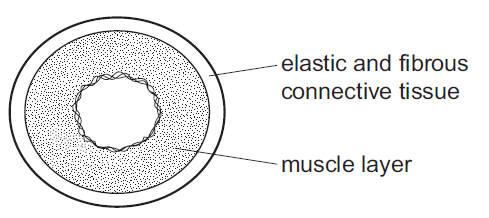
The diagram shows a cross-section through a human blood vessel.
Which type of blood vessel does the diagram show?
an artery
a capillary
a vein
a ventricle

The diagrams show some components of the blood of a mammal.
Which component causes the blood to start clotting?
A
B
C
D
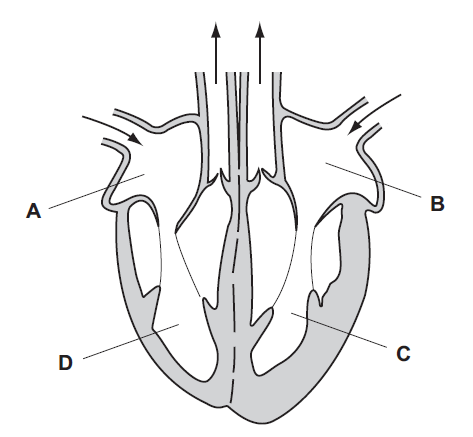
The diagram shows the directions of blood flow through a heart.
Which chamber of the heart receives blood directly from the lungs?
A
B
C
D

Which of the following is the correct equation for aerobic respiration?
glucose + water -> oxygen + carbon dioxide
glucose + oxygen -> carbon dioxide + water + energy
glucose + oxygen -> carbon dioxide + water
glucose + oxygen -> carbon dioxide + water

Which of the following statements is true?
Arteries carry blood back to the heart
The pulmonary vein is unusual because it carries blood back to the heart from the lungs
The pulmonary artery is unusual because it carries deoxygenated blood
The heart has two valves

Which of these blood vessels carries blood at the lowest pressures?
Veins
Capillaries
Arteries
Arterioles
Which type of blood vessel has valves to prevent backflow of blood?
Veins
Arteries
Capillaries
Which part of the blood carries oxygen?
Plasma
Red blood cells
White blood cells
Platelets
8.6 Which part of the blood are involved in the immune response?
Plasma
Red blood cells
White blood cells
Platelets
8.6 Red blood cells are also known as?
Erythrocytes
Lymphocytes
Phagocytes
Platelets
8.6 Which part of the blood is involved in clotting?
Erythrocytes
Lymphocytes
Phagocytes
Platelets
8.6 Which part of the erythrocyte is missing to allow more space for haemoglobin?
Cell membrane
Nucleus
Ribosomes
Mitochondria
8.6 Which type of white blood cell produces antibodies?
Lymphocyte
Phagocyte
Erythrocyte
Platelet
8.7 Which type of blood vessel has a thick elastic wall?
Veins
Arteries
Capillaries
8.7 Which type of blood vessel has walls only one cell thick?
Veins
Arteries
Capillaries
8.7 Which type of blood vessel has walls only one cell thick?
Veins
Arteries
Capillaries

What is the role X ?
decrease the size of the lumen of the vein
prevent the back flow of blood
increase the blood pressure in the vein
speed up the flow of blood in the vein
Which of the following substance transport oxygen?
haemolymph
haemoglobin
fibrinogen
plasma
What sort of circulatory system is the human circulatory system?
An open circulatory system
A single circulatory system
A double circulatory system
A colloidal osmotic circulation index
A fish has _____ heart chambers.
1
2
3
4
Oxygen-rich blood in a fish flows from
heart to body to gills
gills to heart to body
gills to body to heart
The blood circulation in a fish can be described as a
single loop
double loop
triple loop
inverted loop
I have a large lumen, I have thin muscular walls.
Artery
Vein
Capillary
Arteriole
Vessels with narrow lumens
arteries
capillaries
veins
Vessels with endothelium
arteries
capillaries
veins
Which type of cell is found in the greatest numbers in blood?
Red blood cell
White blood cell
Platelets
Why is the left wall of the heart have a thicker layer of muscle than the right side?
To stop the blood flowing backwards
To push the blood with more force at high pressure so it goes to all body cells.
To push the blood at high pressure to the lungs.
What is the name of the liquid part of the blood?
Platelets
Plasma
Red blood cells
What do platelets do?
They stick together and make fibres that make scabs (blood clots) that stop pathogens entering the blood or stop you bleeding to death.
They form your immune system and destroy pathogens.
They carry oxygen around the body attached to haemoglobin.
What other names are given to red blood cells and also white blood cells?
Lymphocytes (red blood cells) and phagocytes and erythrocytes (white blood cells).
Erythrocytes (red blood cells) and phagocytes and lymphocytes (white blood cells).
Phagocyctes (red blood cells) and lymphocytes and erythrocytes (white blood cells).
What do phagocytes do?
Engulf (surround) microbes and digest them.
Produce antibodies.
Release a toxin that kills pathogens.
Why do arteries have a thick muscle layer?
To provide energy for the blood vessel.
To prevent the blood flowing backwards.
To help withstand the high pressure blood, also to contract to control blood flow.
List the structures in the circulatory system the blood travels through from vena cava to aorta.
Vena cava, lungs, pulmonary vein, left atrium, left ventricle, aorta, right atrium, right ventricle, pulmonary artery,
Vena cava, left atrium, right ventricle, pulmonary vein lungs, pulmonary artery, right atrium, left ventricle, aorta
Vena cava, right atrium, right ventricle, pulmonary artery, lungs, pulmonary vein, left atrium, left ventricle, aorta
What type of blood vessel surround alveoli and other tissues in the body?
Capillaries
Arteries
Veins
Why is energy required by the body?
For creating glucose and oxygen
For respiration
For movement (muscle contraction) and keeping warm.

The fish heart has ... cavities and is pierced ...
two... only by venous blood.
four ... by venous and arterial blood alternately.
two ... by venous and arterial blood, alternately.

The circulatory systems are...
open
closed
intermediate

Which type of blood vessel has a thick elastic wall?
Veins
Arteries
Capillaries

The animal in which the exchanges illustrated in the figure occur has a circulatory system ..... , which allows a greater ..... of blood.
(a)

Through which chamber does oxygenated blood enter after leaving the lungs?
Left ventricle
Right ventricle
Left atrium

Choose the options that reflect the advantages of double circulation.
Blood travels through the heart twice for each complete circuit of the body.
Does not require complex organs.
Can incrase pressure of a blood flow.
Slow movement of blood.
What is the role of arteries and veins in the systemic circulatory system?
Transporting blood to all parts of the body
Transport of blood to the lungs
Transporting blood to the lungs and all parts of the body
Blood capillaries result from branching from ..... and blood circulates in them with ..... pressure.
Arteries ..... low
Veins ..... low
Veins ..... high

A transport system is complete
when there is no mixing of arterial and venous blood in the heart.
when it consists of two atria and one ventricle.
when there is mixing of arterial and venous blood in the heart.
when it consists in two atria and two ventricles.
Why is color of blood red?
myoglobin
globulin
heamoglobin
fibrinogen
What is the function of white blood cells?
transport oxygen
fight against infection
clotting
all the above
The blood vessel which carries blood to the heart
lymphatic vessel
capillaries
veins
arteries
Instrument used to measure the heart beat
Endoscope
Kaleidoscope
Microscope
Stethoscope
Pulmonary artery carries what type of blood
Oxygenated
mixed
pure blood
Deoxygenated
Human heart has -----------chambers
3
2
4
1
Aorta carries oxygenated blood to all parts of the body
True
False
No, pulmonary artery
No, pulmonary vein

