wayground logo

Free Printable Worksheets

NEW

Font size

S
M
L
XL
Worksheets

Unit 4 Final Review

Total questions: 48

Worksheet time: 1hrs 11mins

Name
Class
Date
1.
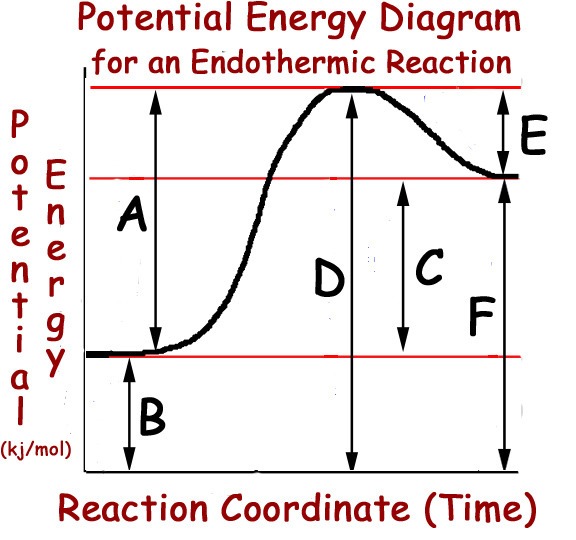
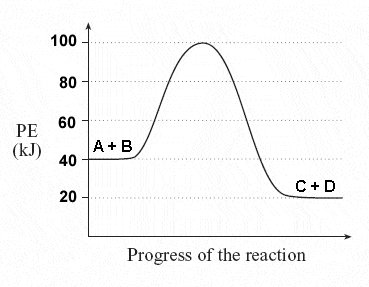
Which letter represents the activation energy?
a)
B
b)
E
c)
C
d)
D
2.
What letter represents ΔH?
a)
A
b)
B
c)
C
d)
D
3.
Is this reaction endothermic or exothermic?
a)
endothermic 
b)
exothermic
4.

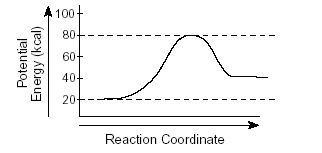
What is the ΔH of this reaction?

a)

40 kJ

b)

20 kJ

c)

80 kJ

d)

-60 kJ

5.
What letter represents the energy of the products?
a)
A
b)
B
c)
C
d)
D
6.
What is the activation energy?
a)
40 kJ
b)
20 kJ
c)
100 kJ
d)
60 kJ
7.
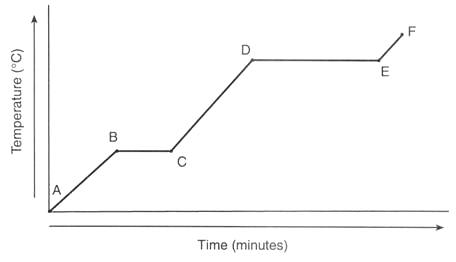
Describe the substance between letters A and B. 
a)
Solid
b)
Liquid
c)
Melting
d)
Evaporating
8.
Between which points is the temperature of the substance remaining constant?
a)
A-B only. 
b)
A-B, C-D, E-F
c)
B-C only. 
d)
B-C, D-E
9.

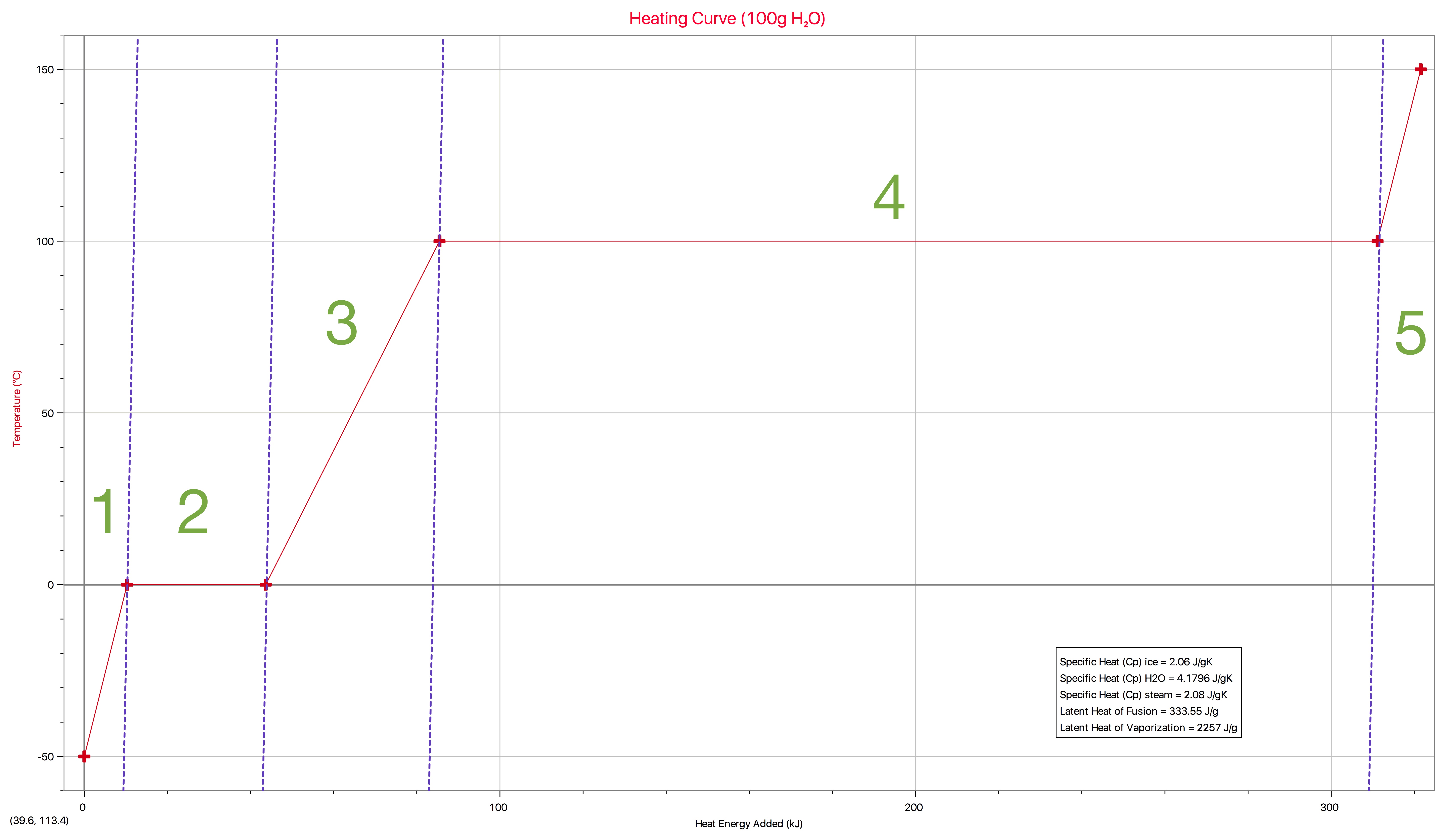
The melting point of the sample is

a)

-60 ºC

b)

-100 ºC

c)

60 ºC

d)

100 ºC

10.
In which region(s) does temperature increase?
a)
Region 1, 3, & 5
b)
Region 2 & 4
c)
Region 1 only
d)
Region 1 & 2
11.
In which region(s) of the graph does a phase change occur?
a)
Region 1, 3, & 5
b)
Region 2 & 4
c)
Region 1 only
d)
Region 1 & 2
12.
In which region(s) of the graph would the substance be a liquid only?
a)
Region 1
b)
Region 2
c)
Region 3
d)
Region 4
13.
What state of matter is X?
a)
solid 
b)
liquid
c)
gas
d)
supercritical fluid
14.
What is point A?
a)
triple point
b)
critical point
c)
equilibrium point
d)
normal melting point
15.
What change occurs from E to C?
a)
sublimation
b)
freezing
c)
melting
d)
boiling
16.
Water exists as a _____________ at 700 mmHg and 50 °C.
a)
solid
b)
liquid
c)
gas
d)
supercritical fluid
17.

What will occur when the substance transitions from B to A? (Diagram A)

a)

condensation

b)

evaporation

c)

melting

d)

freezing

18.
Which statement is true for carbon dioxide at -60 °C?
a)
All three phases are possible.
b)
It can exist as a solid or a gas, depending on pressure.
c)
It is a solid.
d)
With enough pressure it can be melted.
19.

What change occurs from E to C?

a)

sublimation

b)

freezing

c)

melting

d)

boiling

20.
Water exists as a _____________ at 700 mmHg and 50 °C.
a)
solid
b)
liquid
c)
gas
d)
supercritical fluid
21.

What line segment represents only the solid state? (Diagram F)

a)

A-B

b)

B-C

c)

C-D

d)

D-E

22.

Between which points is the temperature of the substance remaining constant? (Diagram F)

a)

A-B only.

b)

A-B, C-D, E-F

c)

B-C only.

d)

B-C, D-E

23.

Are the particles moving faster or slower as time goes on? (Diagram F)

a)

Faster

b)

Slower

24.

Which line segment demonstrates vaporization occurring? (Diagram E)

a)

B-C

b)

C-D

c)

D-E

d)

E-F

25.

What will occur when the substance transitions from B to A? (Diagram A)

a)

condensation

b)

evaporation

c)

melting

d)

freezing

26.
What is the activation energy?
a)
40 kJ
b)
20 kJ
c)
100 kJ
d)
60 kJ
27.
What is the change of the heat of the reaction (ΔH)?
a)
40 kJ
b)
20 kJ
c)
100 kJ
d)
60 kJ
28.
Is the reaction endothermic or exothermic?
a)
Endothermic
b)
Exothermic
c)
Caroussothermic
d)
Nonthermic
29.
What is the PE of the reactants?
a)
30 kJ
b)
10 kJ
c)
40 kJ
d)
20 kJ
30.
What is the PE of the products?
a)
30 kJ
b)
10 kJ
c)
40 kJ
d)
20 kJ
31.

The more energy that particles have, the ___ they move.

a)

slower

b)

faster

32.

Collisions in which particles transfer all their kinetic energy to other particles are called ___.

a)

elastic

b)

inelastic

33.

Which one of these is NOT an Ideal Gas Assumption?

a)

Gas particles are hard, round spheres.

b)

Gas particles are strongly attracted to one another.

c)

Gas particles do not take up space.

d)

Gas particles collide perfectly elastically.

34.

A hypothetical gas that perfectly fits all the assumptions of the kinetic molecular theory is known as

a)

real gas

b)

ideal gas

c)

imaginary gas

d)

perfect gas

35.
Gas pressure is caused by
a)
gas molecules colliding with surfaces
b)
gas molecules condensing to a liquid
c)
gas molecules hitting other gas molecule
d)
barometers
36.
Calculate the volume that a 0.323-mol sample of a gas will occupy at 265 K and a pressure of 0.900 atm.
a)
7.18 L 
b)
7.81 L
c)
4.63 L
d)
4.36 L
37.
Determine the Kelvin temperature required for 0.0470 mol of gas to fill a balloon to 1.20 L under .998 atm pressure. 
a)
0 K 
b)
107 K 
c)
207 K 
d)
307 K 
38.

What does R stand for

a)

Ideal gas constant

b)

Real gas constant

c)

Temperature constant

d)

Ideal gas law

39.
The ideal gas law is an equation that relates the  what  variables to a constant of R.
a)
volume, pressure, temperature
b)
volume, temperature, pressure, amount of gas particles
c)
volume, pressure
d)
volume, temperatue
40.

A student measures the pressure and volume of an empty water bottle to be 1.4 atm and 2.3 L. She then decreases the pressure to 0.65 atm. What is the new volume?

a)

2.1 L

b)

5.0 L

c)

8.2 L

d)

3.9 L

41.

A scientist needs to store 28.0 moles of xenon gas at STP in the lab. What size gas tank will he need?

a)

628 L

b)

473 L

c)

219 L

d)

376 L

42.

What is the pressure of a car tire that had an initial pressure of 1.8 atm but was heated from 38°C to 123°C?

a)

0.9 atm

b)

2.1 atm

c)

1.6 atm

d)

3.4 atm

43.

If I have 5.6 liters of gas in a piston at a pressure of 1.5 atm and compress the gas until its volume is 4.8 L, what will the new pressure inside the piston be?

a)

1.8 atm

b)

3.27 atm

c)

1.8 L

d)

3.27 atm

44.
If 3.25 mol of Ar occupies 100. L at a particular temp and pressure, what volume does 14.15 mol of Ar occupy under same condition?
a)
435 L
b)
225 L
c)
100 L
d)
522 L
45.
Three gases, Ar, N2 and H2 are mixed in a 500L container. Ar has a pressure of 255 torr, N2 has a pressure of 228torr and H2 has pressure of 752torr. What is the total pressure in the container?
a)
483torr
b)
270torr
c)
1235torr
46.

A container holds a mixture of two different gases. The oxygen in a container exerts 80 mmHg of pressure on the inside of the container. The total pressure inside the container is 120 mmHg. What is the pressure of the other gas in the container?

a)

200 mmHg

b)

80 mmHg

c)

40 mmHg

d)

120 mmHg

47.

The total pressure of a mixture of oxygen and nitrogen gas is 400.0 kPa. What is the partial pressure of nitrogen if the pressure of oxygen is 150.0 kPa?

a)

400.0 kPa

b)

550.0 kPa

c)

250.0 kPa

d)

101.3 kPa

48.

A gas is at a pressure of 95 kPa. What is its pressure in atmospheres?

a)

1.5 atm

b)

1.09 atm

c)

0.94 atm

d)

0.82 atm