
 Worksheets
US History EOY TEST Review
Total questions: 112
Worksheet time: 2hrs 49mins


__________ is the study of the past.
History
Geography
Archaeology
Pastory
What does C.E. stand for?
Common Era
Common problem
Common history
Common idea
What does B.C.E. stand for?
before the common era
before the stone age
before electricity
before the plague
A source usually created at the time in question that provides firsthand evidence. Examples include newspaper articles, photographs, diary entries, interviews and financial records.
Primary Source
Secondary Source
Bias
Opinion
A source that was not created at the time being studied, but instead uses sources that were created at that time as evidence to draw conclusions. Scholarly books and articles are examples.
Primary Source
Secondary Source
Opinion
Source
Which of the following is a TRUE statement about European settlements in the Americas?
The major motivation for European settlements in the Americas was to learn about new places and trade with Native Americans.
The major motivation for European settlements in the Americas was to to strengthen their nation with wealth, territory, and resources.
The major motivation for European settlements in the Americas was to spread religion and diseases.
The major motivation for European settlements in the Americas was to bring African slaves for farming.
Which European nations explored and claimed land in the Americas during the 15th and 16th centuries?
The Netherlands, England, Spain, Italy
The Netherlands, France, Germany, Spain
France, England, Spain, The Netherlands
England, Ireland, Scotland, Wales
What were the expectations of English colonists in America?
They expected to be governed by the English king.
They expected the same rights as English citizens.
They expected to denounce their English citizenship.
They expected to be able to choose the leader of Parliament.
Which of the following descries the Columbian Exchange?
The exchange of people, plants, animals, diseases and ideas from Old World to New World and from New World to Old World
The sending of people, plants, animals, diseases and ideas from the Old World to New World only
The sending of people, plants, animals, diseases and ideas from the New World to Old World only
The sending of people, plants, animals, diseases and ideas from South America to North America only
What happened to the population of many indigenous Americans due to Europe's invasion and colonization of Latin America?
The population decreased significantly due to diseases and warfare
The population increased significantly due to diseases and warfare
The population didn't change much
The population increased significantly due to the new crops and animals
The Columbian Exchange had positive and negative impacts for both the New and Old World.
True
False
First permanent English settlement in North America
Georgia
Massachusetts Bay Colony
Pennsylvania
Jamestown
Which colonial region is described by this: cash crops, small farms, plantations, slavery, organized into counties?
Southern
Mid-Atlantic
New England
Mid Western
The economy of the New England colonies resolved around all of the following EXCEPT:
fishing
naval supplies
shipbuilding
cash crops
Which title best completes the list above? Rocky soil, jagged coastline, town meetings, villages and churches
The Southern Colonies
The Mid-Atlantic Colonies
The New England Colonies
The Mid-Western Colonies
Why did the Pilgrims and Puritans travel to the New World?
Seek freedom from Spain
Seek religious freedom
To grow tobacco
Establish trading alliance with Jamestown Colonist
What are the 3 regions of colonial America?
Southern Colonies
Northern Colonies
Middle Colonies
American Colonies
New England Colonies

What document ended the French & Indian War?
Treaty of Paris
Treaty of the Ohio River Valley
Adams-Onis Treaty
Treaty of France & Indians
Colonists who favored American independence were known as _______
loyalists
separatists
patriots
nationalists
What event sparked the beginning of the American Revolution?
Battle of Lexington
Battle of Bunker Hill
Boston Tea Party
Suffolk Resolves
Signed in 1776 by US revolutionaries; it declared the United States as a free state.
Common Sense
U.S. Constitution
Articles of Confederation
Declaration of Independence
Who wrote the Declaration of Independence?
Thomas Jefferson
John Adams
Benjamin Franklin
George Washington
Commander of the Continental Army during the Revolutionary War.
George Washington
Nathanael Greene
Marquis de Lafayette
Baron von Steuben
The Battles of ____________________ and __________________ sparked the Revolutionary War.
Lexington; Concord
Concord; Bunker's Hill
Lexington; Saratoga
Concord; Camden
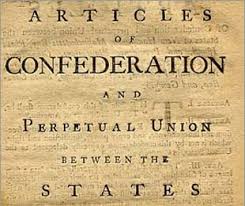
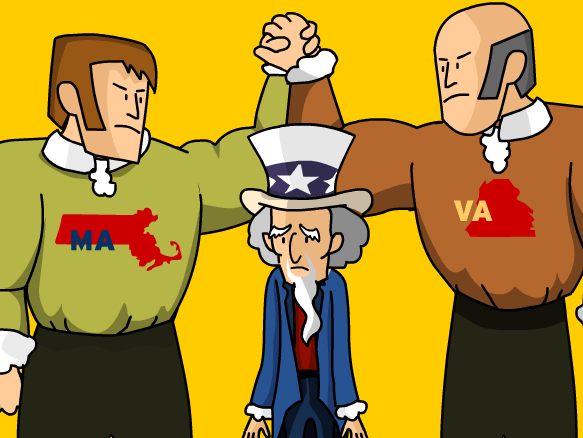
Representatives
Which party would believe this statement : "A strong central government is essential to the survival of our nation"
Federalists
Anti-Federalists
Which party would believe this statement : "A strong central government would becoming just like a king, taking away people's individual rights"
Federalists
Anti-Federalists

Lewis and Clark created the first detailed map of the
Appalachian Mountains
Gulf of Mexico
American Northwest
American Southwest
Thomas Jefferson bought the Louisiana Purchase from _____________?
Spain
France
Great Britain
Why did President Jefferson ask the U.S. Congress to pass the Embargo Act?
to stop American merchant ships from avoiding taxes
to stop Britain and France from fighting
to stop Britain and France from seizing American merchant ships
to stop trade with European countries
Besides doubling the size of the nation, what else did the Louisiana Purchase do?
Increased our Natural resources and angered-affected the Native American settlements.
Made friends with the Indians and increased trade.
Forced France to leave America forever.
Took the Mississippi River away from Spain.
Why did suffrage increase during Jackson's presidency?
Women gained the right to vote
All people were given the right to vote
White men no longer had to own property and more people felt connected to politics in order to vote
The 13th amendment was passed
What was the forced relocation of the Cherokee from Georgia to Oklahoma?
Nullification Crisis
Tail of Tears
Increased Suffrage
Goodbye Native Americans
Why did Jackson dislike the Bank of the United States?
He claimed it only benefited the wealthy
He had way to much money in the bank
He said the bank stole his money
He had lived through the Great Depression and didn't trust banks


-Mexico recognizes Texas as part of the United States.
-The Rio Grande is made the border between Mexico and the United States.
-Mexico cedes territory that is now part of 7 present day states.
Which treaty established these terms of peace to end the war?


South ____________
Many factory jobs were available in the Eastern United States, which resulted in......
An increased acceptance of immigrants in the Eastern United States
A higher level of farms production in the Eastern United States
A decrease in the level of immigrants settling in the Eastern United States
A high level of European immigrants settling in the Eastern United States
What is the main weapon a labor union can use in their struggle against factory owners?
Political Party Conventions
A lockout where workers are not allowed into factories
Violence between workers and business managers
The ability to strike and shut down production
Which system of transportation shipped raw goods to factories where they were turned to consumer goods?
Electric Streetcar
The Pony Express
Wagon Train
Transcontinental Railroad
What was the Underground Railroad?
a series of tunnels dug underground to help slaves reach freedom
a network of railroad lines that would sneak slaves to the north
a colonization movement that tried to transport slaves back to Africa
a network of people who secretly helped slaves reach freedom "station" by "station"
Why did some people want to form labor unions?
to improve working conditions
to open the workplace to more immigrants
to create more jobs
to increase productivity
Frederick Douglass and Harriet Tubman are best known as
abolitionists
authors
temperance leaders
utopian thinkers
This was part of the age of Reform
Abolishing Slavery, Women's rights, Education reform, Prison reform, and temperance (opposition to alcohol)
Banning animal cruelty, deforestation, more voting rights, and industrialization
What is an abolitionist?
A person who approved slavery.
A person who shipped slaves from Africa.
A person who worked to end slavery during the 1700s and 1800s
What does the term secede mean?
A person running away from the law
A conflict between two nations
To control
To withdraw or break away from a nation or organization
What is popular Sovereignty?
state and federal government share power
Government has limited powers
people are allowed to decide
Each branch has separate powers
Fighting that Broke out between anti-slavery and pro-slavery groups in Kansas became known as_________?
Missouri Compromise
Fugitive Slave Act
Compromise of 1850
Kansas-Nebraska Act
Which of the following cases ruled that African Americans were not citizens and were considered property.
Marbury v Marshall
Gibbons v Odgen
McCullough v Maryland
Dred Scott v Sanford
Who won the presidential election of 1860?
George Washington
Andrew Jackson
Abraham Lincoln
Thomas Jefferson
Which state was the first to secede on December 20, 1860?
Texas
Massachusetts
New York
South Carolina
Which of the following reason did the South use to justify or explain their decision to secede?
Popular Sovereignty
States' Rights
Checks and Balances
Limited Government
The first battle of the Civil War?
Battle of Fort Sumter
Battle of Yorktown
Battle of New Orleans
Battle of Gettysburg
What was the name of the new Nation for the Southern states that seceded?
The United Kingdom
Power Puffs
The Confederate States of America
Blue Angels
Who did the Confederacy chose as their new president?
Abraham Lincoln
Jefferson Davis
George Washington
Andrew Jackson
What was the Supreme Court Chief Justice Roger Taney's final ruling on the Dred Scott case?
The Constitution did not protect slavery.
The Constitution protected slavery.
States can ban slavery.
What was the main topic of the Lincoln-Douglas debate?
State's Rights
Slavery
Secession
What was John Brown's goal when he raided the arsenal at Harpers Ferry, Virginia?
Arm supporters of slavery against the U.S. government.
Arm slaves to revolt against their slaveholders.
Arm abolitionists to start the civil war.
Who was the Republican candidate for the 1860 presidential election? (Hint: he was a Republican and he won that election)
Abraham Lincoln
James Buchanan
Stephen A. Douglas
In 1863 this declared all slaves in the rebelling states were free.
Declaration of Independance
Emancipation Proclamation
Gettysburg Address
Battle of Bull Run
The Union army ...
represented the northern states and wore grey
represented the southern states and wore grey
represented the northern states and wore blue
represented the southern states and wore grey
The Confederate army...
represented the northern army and wore grey
represented the southern army and wore grey
represented the northern army and wore blue
represented the southern army and wore blue
Why was the attack on Fort Sumter significant?
It was the bloodiest day of the Civil War.
The Confederacy surrendered.
The first shots of the Civil War were fired.
General Pickett charged the Union line.

The Northern United States relied on this type of economy:
Manufacturing
Agriculture
Government Aid
Medicine

The dramatic shift from handmade to machine-made goods was known as the:
Renaissance
Industrial Revolution
Era of Reform
Manifest Destiny

What was the MOST important thing children gave up to work in factories?
Education
Family time
Social life
Playtime with toys.

Factories
North
South

Agriculture
North
South

