

wayground logo

Free Printable Worksheets

NEW

Font size

S
M
L
XL
Worksheets

[Bio] Plants Notes 2

Total questions: 19

Worksheet time: 14mins

Name
Class
Date
1.
Oak trees weigh more than acorns. Where does most of the mass come from?
a)
Air
b)
Sunlight
c)
Water
d)
Soil Nutrients
2.
Small openings called ______ are found on the underside of leaves and allow gases to enter or leave the plant cells.
a)
Phloem
b)
Chloroplasts
c)
Xylem
d)
Stomata
3.
Vascular tissue that transports water and minerals UPWARDS from a plant's roots is known as ______.
a)
Cuticle
b)
Phloem
c)
Stomata
d)
Xylem
4.
What is the TISSUE that carries food from a plant's leaves to its cells?
a)
xylem
b)
phloem
c)
photsynthesis
d)
vascular tissue
5.
What is the PROCESS by which plants make food?
a)
xylem
b)
phloem
c)
germinate
d)
photosynthesis 
6.
What two things do plants need to do the PROCESS of photosynthesis?
a)
Carbon dioxide & water
b)
Oxygen & water
c)
Sugar & water
d)
Carbon dioxide & Sugar
7.

What is the function of the waxy cuticle on leaves?

a)

To stop rain entering the leaf

b)

To prevent excess loss of water from the leaf

c)

To reflect sunlight

d)

To allow gas exchange

8.

How is the spongy mesophyll adapted for gas exchange?

a)

It is close to the palisade cells

b)

It contains chloroplasts

c)

It has air spaces and a large surface area

d)

It contains lots of small cells

9.

Where in a leaf does photosynthesis occur?

a)

In chloroplasts

b)

In palisade cells

c)

In spongy mesophyll cells

d)

All of the above

10.

Why are palisade cells arranged at the top of the leaf?

a)

So that they are far away from the stomata

b)

So that sugars made on photosynthesis can be transported to the phloem

c)

So that chloroplasts are concentrated in one place

d)

So that chloroplasts receive the maximum amount of sunlight
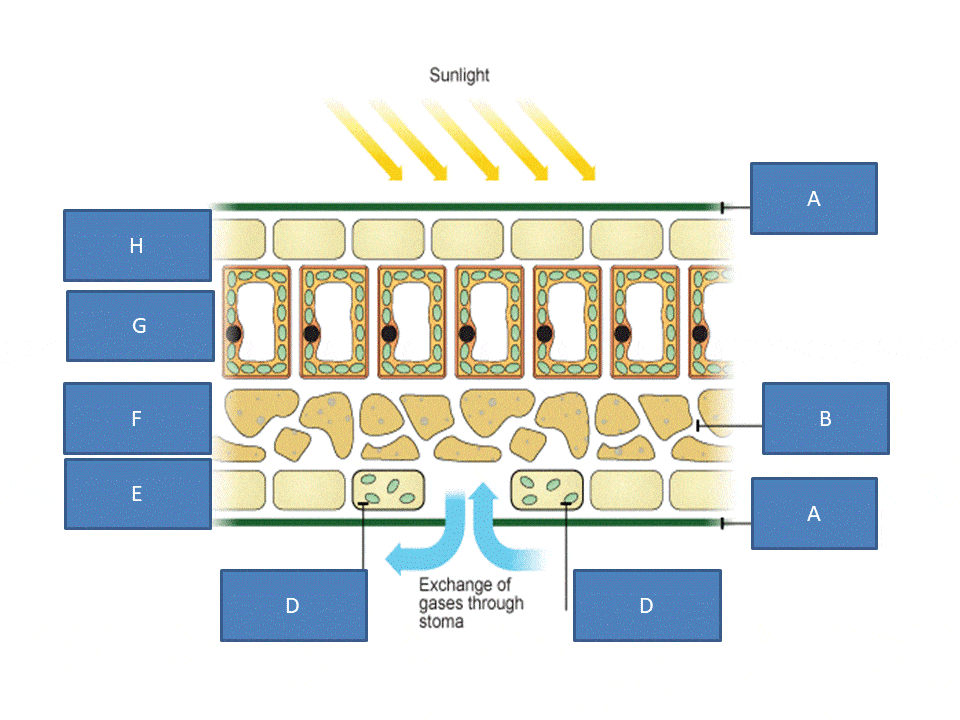
11.

What is the name of the clear layer of cells (H) on top of the leaf?

a)

Cuticle

b)

Air space

c)

Guard cell

d)

Upper epidermis

12.

What is the name of cells (part D) that surround the pores of a leaf?

a)

Palisade cells

b)

Guard cell

c)

Spongy layer

d)

Lower epidermis

13.
The role of the guard cell is to
a)
help control the temperature of the plant
b)
control how much water enters the leaf
c)
control how much glucose is stored
d)
control the movement of water vapour & gases 
14.

If guard cells are swollen with water, then they are more likely to be ...

a)

OPEN with stomata

b)

CLOSED with no stomata

c)

Cannot tell - the water amount doesn't affect it at all.

15.
Which cells of a leaf undergo the MOST photosynthesis?
a)
Guard cells
b)
Palisade cells
c)
Epidermal cells
d)
Cells in the spongy layer
16.
What is chlorophyll's main function?
a)
to make the plant a vegetable
b)
to blend into their environment
c)
to capture energy from sunlight for photosynthesis
d)
to help prevent water loss
17.
Plants need ________ as a reactant for photosynthesis.
a)
oxygen
b)
soil
c)
carbon dioxide
d)
sugar
18.
Carbon dioxide enters plant leaves through the __________.
a)
stomata
b)
chloroplasts
c)
xylem
d)
cuticle
19.

How are you feeling about your knowledge/understading of leaf structure and function?

a)

GREAT - I got all or most correct WITHOUT using my notes

b)

GOOD - I got all or most correct BUT I USED my notes

c)

NOT GOOD - I don't know this topic well yet

d)

HORRIBLE - I don't know any of this at all
