
NEW
Font size
 Worksheets
B.Sc. 1st (Chemical Kinetics)
Total questions: 15
Worksheet time: 15mins
Which of the following best describes why increasing temperature increase reaction rate?
Activation energy is reduced.
Collisions become more frequent.
Collisions become more energetic.
Collisions become more frequent and more energetic.
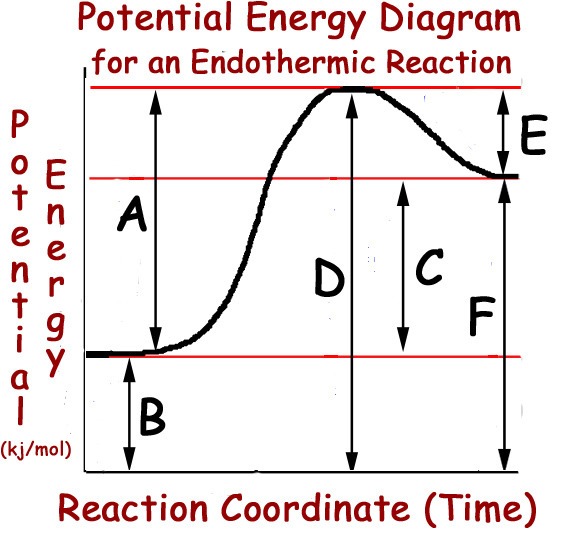
What letter represents the activation energy?
A
B
C
D
Which factors increase the rate of a reaction?
increasing temperature
increasing concentration
increasing surface area
all of the above
The catalyst alters the rate of a chemical reaction by,
providing an alternative pathway with a lower Ea
changing the products formed in the direction of the reaction
Decreases the surface on which the molecules react
increasing the frequencies of collisions between molecules
In rate law expression : Rate = k [A]p[B]q , p and q are
coefficients of reactants A and B in the chemical reaction
always constant for all the reactions
determined experimentally
can be determined by Collision theory
The rate of gaseous reaction remains unchanged when volume of the vessel is doubled. The order of the reaction is
0
1
2
3
A reaction is found to be second order with respect to carbon monoxide. If the concentration of carbon monoxide is doubled, the rate of reaction __________.
doubles
remains unchanged
increases by a factor of 4
is reduced by a factor of 2
If C is the concentration of A at any time and C0 is its concentration at time t = 0 then, for zero order reaction, rate equation can be written as:
C - C0 = 0
C = C0 - k
C/C0 = k
C = C0 - kt
Which of the following plots will show a linear relationship for a second order reaction?
[A] vs time
1/[A] vs time
ln[A] vs time
[A]2 vs time
If C0 is the initial
concentration then the half life period (t1/2) for the third order kinetics is……
t1/2 = 1/kC0
t1/2 = 3/2kC02
t1/2 = 3k/2C02
t1/2 = 3/2kC0
Which of the following is the example of pseudo first order reactions?
Decomposition of ammonium nitrite
Conversion of N-chloroacetanilide into p-chloroacetanilide
Hydrolysis of ethylacetate
Decomposition of hydrogen peroxide
Units of second order rate constant =.......
mol L-1 time-1
L mol-1 time-1
L2 mol-2 time-1
time-1
If 'a' is the initial concentration of the reactant , the half life period of the nth order reaction is proportional to
an-1
an
a1-n
an+1
Which statement is false about molecularity of a reaction?
In complex reaction, molecularity is equal to the number of molecules present in the rate law equation.
Molecularity is a theoretical concept.
Molecularity of a reaction can have integral values only.
Molecularity of a reaction can be zero.

