
 Worksheets
Chapter 4 : Chemical Bonding (Part 1)
Total questions: 16
Worksheet time: 10mins
Name
Class
Date
1.
What is the joining of atoms to form new substances?
a)
Chemical Bonding
b)
Bonding
c)
Joining Chemicals
d)
Bonding Atoms
2.
What do you call a bond that forms when electrons are transferred from one atom to another?
a)
Compound Bond
b)
Ionic Bond
c)
Crystal Bond
d)
Atom Bond
3.
This consists of two or more atoms joined together.
a)
Molecule
b)
Covalent Bond
c)
Electron-Dot Diagram
4.
Which of the following has a full valence shell?
a)
Oxygen
b)
Neon
c)
Barium
d)
Carbon
5.
An ionic bond forms when atoms ___________ electrons.
a)
gain
b)
share
c)
increase
d)
transfer
6.

How many valence electrons in this structure?
a)
6
b)
5
c)
4
d)
7
7.
What is the number of valence electrons for Oxygen?
a)
8
b)
6
c)
2
d)
1
8.
What is the correct Lewis structure for BF3?
a)
b)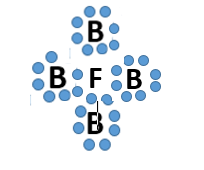
c)
d)
BF3 (The formula is the Lewis Structure)
9.

What elements generally make an ionic bond?
a)
metal and nonmetal
b)
2 or more nonmetals
c)
metal
d)
none of the above
10.
Predict the bond that will form between Be and F.
a)
Ionic
b)
Covalent
11.
What is a valence electron?
a)
an electron that is found in the outermost shell of an atom.
b)
an electron found in the innermost shell of an atom.
c)
an electron found in the middle shell.
12.
What is the number of valence electrons for Beryillum?
a)
1
b)
4
c)
2
d)
7
13.
What is the number of valence electrons for Neon?
a)
6
b)
7
c)
8
d)
9
14.
Is Hydrogen considered a metal or a non-metal?
a)
Metal
b)
Non-metal
15.
Is the following compound ionic or covalent:
AlCl3
AlCl3
a)
ionic
b)
covalent
16.
What is the formula for aluminum fluoride?
a)
AlF
b)
Al2F3
c)
AlF3
d)
Al3F2
100 %

