
 Worksheets
Biology Spring Final Review 2022
Total questions: 218
Worksheet time: 3hrs 44mins

The owl in the above food chain would be considered ______________.
Secondary consumers
Tertiary consumers
Herbivores
Decomposers
Grasses → Crickets → Field Mice → Hawks
For this food chain, which of the following changes would have the MOST severe consequences?
The hunting of predatory hawks by game hunters
The introduction of a second predator that eats field mice
A parasitic infestation that reduces the cricket population
A drastic decrease in rainfall, causing a drought

According to this logistic growth curve what is this population's carrying capacity
1200 individuals
1000 individuals
200 individuals
800 individuals

The illustrations below show vestigial pelvic bones of a baleen whale and vestigial hind limb bones of an extinct whale. The presence of these bones in the baleen whale and extinct whale provides evidence of which of the following?
Whales can travel on land when necessary.
Whales are developing into animals with four functioning limbs.
Whales have functional legs that are hidden by fat and skin.
Whales evolved from four-legged animals.

Which of the following statements best reflects the evolutionary importance of the figures above?
New genetic instructions have been disregarded in the evolution of vertebrates.
Early in development, vertebrate embryos show no evidence of common ancestry.
All adult vertebrates retain pharyngeal pouches (gills).
The evolutionary history of organisms is seen in the way embryos develop.

A pea plant has heterozygous genes for height. According to Mendel’s law of segregation, which example correctly shows the gamete formation in the plant?
A
B
C
D
Variation in human skin color is an example of
incomplete dominance
codominance
polygenic trait
multiple alleles
Which of the following pairs of alleles shows a homozygous dominant genotype?
BB
Bb
bb
The base-pairing rules state that the following are base pairs in DNA
adenine-thymine; uracil-cytosine
adenine-thymine; guanine-cytosine
adenine-guanine; thymine-cytosine
adenine-uracil; guanine-cytosine
Each nucleotide triplet in mRNA that specifies a particular amino acid is called a
mutagen
codon
anticodon
exon
What happens during the process of translation?
messenger RNA is made from DNA
the ribosome uses information from messenger RNA to produce proteins.
transfer RNA is made from messenger RNA
copies of DNA molecules are made
DNA is copied during a process called
replication
translation
transcription
transformation


Which of the following have been changed or altered due to climate change ?
droughts
flooding
melting of polar ice caps
all of the above

Any change in the sequence of DNA is a
recombination
mutation
chromatin
independent assortment


The first species to inhabit an area after a disturbance is a(n)
invasive species
pioneer species
parasites
abiotic component
Replacement of one type of community by another at a single place over time
cooperatio
symbiosis
competition
ecological succession
Which type of vesicle has powerful enzymes to help it digest old cell parts and foreign particles?
vacuoles
plasma membrane
lysosomes
chloroplasts
Some cells, such as human nerve cells and human muscle cells, contain more mitochondria than do other cells, such as skin cells.
Why do some cells have more mitochondria than others?
The cells use more energy than others.
The cells store more nutrients.
The cells break down or degrade more proteins.
The cells divide more frequently.
Which are membrane-bound containers that transport items in the cell?
ribosomes
vesicles
mitochondria
nucleolus
Smooth endoplasmic reticulum does which of the following? Check all that apply.
Makes proteins
transports proteins
Makes enzymes for calcium regulation and detoxification
Makes lipids like steroids for the cell.
All cells contain... (check all that apply)
Cell membrane
ribosomes
Endoplasmic reticulum
DNA
Protein synthesis takes place on the
ribosomes
Golgi body
chromosomes
nucleolus
Examples of organelles seen in plant cells, but NOT seen in animal cells is
chloroplasts and cytoplasm
chloroplasts and cell wall
ribosomes and cell wall
ribosomes and cytoplasm
A prokaryote is an organism that
lacks a cellular nucleus
has a cell wall
is very small
All three-lacks a cellular nucleus, has a cell wall, and is very small.
Cells of animals, plants, fungi, and protists are all?
nucleoid
prokaryote
archaea
eukaryotes
What does not require energy? Choose all that apply.
Diffusion
Facilitated Diffusion
Osmosis
Exocytosis

What organ is represent by letter A?
(a)
What organ is represent by letter C?
(a)
What organ is represent by letter G?
(a)
What organ is represent by letter B?
(a)
What organ is represent by letter D?
(a)
What organ is represent by letter E?
(a)
What organ is represent by letter F?
testis
ovaries
kidney
esophagus

Which feature moistens and protects the eye?
Chromatophore
tympanum
nictitating membrane
nares

What is structure C?
the stomach
the oviduct
the small intestine
the large intestine

What is the function of structure B?
Structure B take in oxygen and gets rid of carbon dioxide
Structure B causes air to enter the lungs when it contracts
Structure B pumps blood to the lungs and body
Structure B rids the body of waste

What is structure B?
the esophagus
the voice box
the trachea
the lungs

What body system does structure A belong to?
reproductive system
digestive system
Respiratory system
circulatory system
What organ is structure C?
Eggs
liver
lungs
heart
What organ is structure B?
Eggs
liver
lungs
heart
What organ is structure A?
Eggs
liver
lungs
heart
What body system does structure C belong to?
reproductive system
digestive system
Respiratory system
circulatory system


How many lobes does a frog liver have?
1
2
3
4

Which digestive structure is this?
Brain
Lungs
Heart
Large Intestine

Name the structure indicated by the RED line.
Large Intestine
Maxillary Teeth
Kidney
Stomach
The synthesis of a new double strand of DNA begins when the two strands of the original DNA...
are separated by the breaking of hydrogen bonds between nitrogen bases
acts as a template
attracts a nitrogen base
destroys the entire genetic code
After DNA replication, the two DNA molecules that are made...
are opposite
are identical
leave the nucleus
cannot replicate again
cytosine and thymine are...
phosphates
nucleic acids
purines
pyrimidines
The two strands of a DNA double helix molecule are...
purines
pyrimidines
complementary
identical
A nucleotide consists of which of the following:
nitrogen base
5 carbon sugar
phosphate group
polymerase
New mRNA is made through the process of:
transcription
duplication
translation
crystallography
Each combination of three nitrogen bases on messenger RNA forms a:
anticodon
codon
enzyme
nucleic acid
In messenger RNA, each codon specifies a particular:
nucleotide
purine
amino acid
pyrimidine
Which does not carry out its function and is not present in the ribosomes?
mRNA
tRNA
rRNA
DNA
The genetic code of an organism is determined by:
The number of amino acids in its cell
The speed at which polypeptides are produced
The sequence and number of nitrogen bases in its DNA
The shape of ribosomes in its cell
Which of the following 3' strands is complementary to this 5' strand?
5' ACCAGTTGCGCA 3'
3' TGGTCAACGCGT 5'
3' ACCAGTTGCGCA 5'
3' TGGTCATGCGCA 5'
3' ACCAGTACGCGT 5'
Which of these is not one of the nitrogenous bases in DNA nucleotides?
thymine
uracil
adenine
cytosine
What is semiconservative replication?
a method of DNA replication in which parental strands separate, act as templates and produce molecules of DNA with one parental DNA strand and one new DNA strand
a method of RNA replication in which parental strands separate, act as templates and produce molecules of RNA with one parental RNA strand and one new RNA strand
the method by with RNA is synthesized from a DNA template
the method by which a strand of mRNA is translated into a peptide
If a molecule of DNA contains 40% guanine, then how much thymine will it have?
80%
40%
20%
10%
The deliberate exposure of the body to an antigen to build future immunity is called __.
cellular defense
passive immunity
phagocytosis
immunization
What is a common example of passive immunity?
vaccination results in memory cells
lysozyme kills pathogens
mother's antibodies given to fetus through breast milk
skin keeps bacteria from entering body
What role do cytotoxic T cells play in immune response?
destroy pathogens and release cytokines
binds to processed antigens and B cells
prevents immunization from occurring
produces lysozymes to break down cell walls
Which of the following is a factor in natural selection?
Individuals of species compete with one another to survive
All species are genetically diverse
Individuals better able to adapt to changes leave more offspring.
All of the above.
The fossil record provides evidence that
Fossils cannot be dated.
All species were formed during Earth’s formation and have changed little since then.
The fossilized species have no connection to today’s species.
Older species gave rise to more-recent species.
The process in which organisms with traits well suited to an environment are more
likely to survive and to produce offspring is
Natural selection.
Origin of species.
Genetic principles.
Trait mechanism.
The hypothesis that evolution of a species occurs gradually over time as a slow and constant process is known as
Speciation
Punctuated equilibrium
Gradualism
Microevolution
An inherited trait or behavior that has become common in a population because it
allows you to survive (like different bird beaks for different food types) is an example of
Natural selection
Gradualism
Adaptation
Population
Darwin and Lamarck agreed that changes in species are linked to
Environmental conditions
Genetics
Use or Disuse of physical features
Acquired characteristics
Structures that share a common ancestry or are similar because they are modified versions of structures from a common ancestor that contain the same basic bone structure (so the same radius, ulna, and humerus bones) are
Not homologous
Homologous
Not related
Vestigal
Structures with no function (like dewclaws) that are remnants of an organism’s evolutionary past are
Homologous
Analagous
Vestigal
Not visible in organisms
Natural selection causes the frequency of favorable alleles (which can cause favorable traits) to
Vary widely in a population
Decrease in a population
Remain constant in a population
Increase in a population
The hypothesis that evolution of a species occurs in periods of rapid change separated by periods of little or no change is called
Divergence
Punctuated equilibrium
Isolation
Gradualism
Starting in 1954, commercial fishers in the northwest Pacific were paid by weight, rather
than by the individual fish, for pink salmon. The fishers increased the use of a type of net that
selectively catches larger fish so that way they would only hunt and kill large body size salmon.
Which of the following effects did this change in fishing technique most likely have on the
salmon population over the next 20 years?
The average body size of the males in the salmon population increased, and the females stayed
the same
The average body size of the salmon population decreased significantly.
The average body size of the salmon population increased significantly.
None of these three things
Some willow trees alter the chemical composition of their leaves when attacked by
caterpillars. Compared to normal leaves, the chemically altered leaves are less nutritious and more difficult for caterpillars to digest.
Which of the following is a likely effect of this ability to alter leaf composition?
Willow trees with this ability will attract more caterpillars than other willow trees.
More butterflies will lay their eggs on willow trees with this ability than other willow
trees
Willow trees with this ability have a survival advantage over other willow trees.
None of these choices
Which directly controls a person’s decision to use the bicep muscles (a skeletal muscle part of the PNS/peripheral nervous system) to lift weights?
parasympathetic nervous system (part of PNS)
somatic nervous system (part of PNS)
autonomic nervous system (part of PNS)
Central nervous system/CNS
The spinal cord is part of a major division of the nervous system called the
Central Nervous System (CNS)
Peripheral Nervous System (PNS)
Autonomic Nervous System
Somatic Nervous System

What is the name of the blue structure
axon terminal
dendrite
schwann cell
axon

what might be a job of a motor neuron?
carry impulses from spinal cord and brain to muscles and glands
sending messages from motor neurons to sensory neurons
sending a message toward your brain from the spinal cord
carry impulses from the sensory organs to the spinal cord and brain
The PNS (peripheral nervous system)
contains the brain and spinal cord
contains all the nerves of the body
is divided into the somatic and autonomic systems
is divided into the sympathetic and parasympathetic divisions

The pink structure is the.....
frontal lobe
occipital lobe
parietal lobe
temporal lobe
The two major parts of the nervous system are the
brain and spinal cord
central and somatic nervous systems
sympathetic and parasympathetic systems.
peripheral and central nervous systems

What part of the neuron is number 4 pointing at?
Dendrite
Axon Terminal
Axon
Myelin Sheath

This part of the neuron receives chemical messages from the neurotransmitters of other neurons. It is labeled A in the diagram.
Dendrite
Axon
Axon Terminal
Cell Body

The long, fiber like part of a neuron which the cell sends information to receiving neurons. Labelled D in diagram.
Synapse
Axon
Axon Terminal
Dendrite
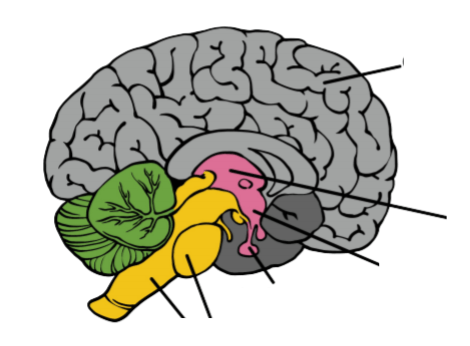
What structure is grey in this picture. It controls conscious thought and memory?
Cerebrum
Cerebellum
Brain Stem
__________ carry messages between sensory neurons and motor neurons.
Active Neurons
Interneurons
Refraction Neurons
Flower Neurons

An electrical transmission across neurons is called...
Electrical signal
Nerve impulse
Neurotransmitter
Axon terminal
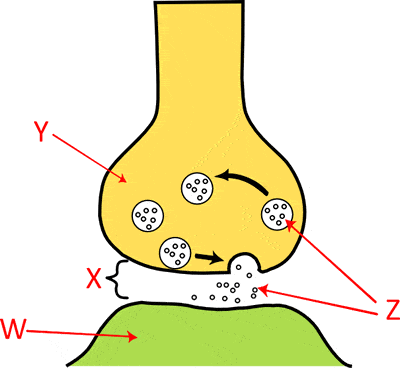
What is letter X called? It is the specialized connection between the neurons during neuron communication.
Axon Terminal Button
Neurotransmitters
Dendrite
Synapse

