

wayground logo

Free Printable Worksheets

NEW

Font size

S
M
L
XL
Worksheets

Test Review for Friday May 28th

Total questions: 42

Worksheet time: 41mins

Name
Class
Date
1.

The particle in an atom that has a positive charge and determines the atomic number of an element is...

a)

the proton.

b)

the neutron.

c)

the electron.

d)

the nucleus

2.
What does the Law of Conservation of Mass state?
a)
Matter cannot be gained or lost in a chemical reaction.
b)
Matter can only be lost in a chemical reaction.
c)
Matter can only be gained in a chemical reaction.
d)
Matter can be gained and lost in a chemical reaction. 
3.
What is the left part of a chemical equation called?
2H2 + O2 --> 2H2O
a)
Reactants
b)
Products 
c)
Yields 
d)
Chemical Equation 
4.
What is the right part of a chemical equation called...
2H2 + O2 --> 2H2O
a)
Reactants
b)
Products 
c)
Yields 
d)
Chemical Equation 
5.
What is the total number of atoms present in 5Na3PO4
a)
5
b)
40
c)
55
d)
8
6.
Is the following equation balanced?...
Al + O2 --> 2Al2O3
a)
Yes!
b)
No!
7.
Element or compound?
H2O
a)
Element
b)
Compound
8.
What is the number before a chemical formula called?
Ex: 2H2 + O2 --> 2H2O
a)
Coefficient
b)
Subscript
c)
Atom
d)
Equation
9.
Is the following equation balanced?
2C2H2 + 5O2 --> 4CO2 + 2H2O
a)
yes
b)
no
10.
Is the following equation balanced?
4Fe + 3O2 --> 2Fe2O3
a)
yes
b)
no
11.
Is the following equation balanced?
4Fe + 3O2 --> 2Fe2O3
a)
yes
b)
no
12.

Every time a chemical reaction occurs, a _______________ is created.

a)

bubble or fizz

b)

smoke

c)

temp change

d)

a new substance

13.

This is a correct dot diagram for nitrogen (N)

a)

true

b)

false

14.

What is a cation's charge?

a)

positive

b)

negative

c)

neutral

d)

depends on the element

15.

What is an anion's charge?

a)

positive

b)

negative

c)

neutral

d)

depends on the element's charge

16.

Which of the following accurately describes the chemical formula of the molecule shown above?

a)

3CH8O

b)

C3H7O

c)

C4H8O2

d)

C3H8O

17.

Which of the following molecules has the formula CH2O?

a)
b)
c)
d)
18.
How many atoms of carbon (C) are in C6H12O6?
a)
3
b)
6
c)
12
d)
24
19.
Which of the following is a compound?
a)
Co
b)
O2
c)
C
d)
CO2
20.
How many HCl molecules do you need to balance this equation? 
Mg +  __HCl --->  MgCl2 + H2
a)
1
b)
2
c)
3
d)
4
21.
What coefficient should be used to make the following equation balanced?
N2+O2--> _NO 
a)
1
b)
2
c)
3
d)
4
22.
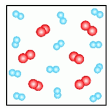
This picture represents which of the following?
a)
element
b)
compound
c)
mixture
23.

The image above shows a...

a)

molecules

b)

compounds

c)

pure substance

d)

mixture of atoms

24.

In this diagram, X represents...

a)

A compound

b)

A mixture

c)

An atom

d)

An element

25.
What is the SI unit for mass?
a)
meter
b)
liter
c)
gram
d)
kelvin
26.
The equation for density is...
a)
mass / volume
b)
mass x volume
c)
length x width x height
d)
π x rx height
27.
The part of the experiment that is changed by the experimenter is called the
a)
dependent variable
b)
independent variable
c)
control
d)
responding variable
28.
A tool used by scientists to help interpret data by revealing unexpected patterns is a
a)
theory
b)
graph
c)
law
d)
variable
29.
In science, a hypothesis must be 
a)
correct
b)
testable
c)
controlled
d)
manipulated
30.
Observations that deal with descriptions that CANNOT be expressed in numbers are called... 
a)
qualitative observations
b)
quantitative observations
31.
Observations that are expressed by using numbers are called... 
a)
quantitative observations
b)
qualitative observations
32.
What is the mass of the unknown object?
a)
273 g
b)
272 g
c)
272.5 g
d)
2270 g
33.
When the particles of a substance are heated their motion...  
a)
increases.
b)
decreases.
c)
remains the same.
34.
How many Hydrogen (H) atoms are in NH3O5
a)
3
b)
4
c)
5
d)
1
35.

What are the blue numbers called?

a)

oxidation numbers

b)

subscripts

c)

group numbers

d)

product numbers

36.
The blue atoms are called 
a)
metals
b)
nonmetals
c)
metalloids
d)
noble gases
37.
Ba +3 and  Cl-
a)
Ba3Cl
b)
Ba3Cl3
c)
BaCl3
d)
BaCl
38.

A crystal is a solid with...

a)

random arrangement of it's particles.

b)

regular and repeating patterns of it's particles.
39.

An amorphous solid is a solid with...

a)

random arrangement of it's particles.

b)

regular and repeating patterns of it's particles.

40.
This diagram represents a _____.
a)
pure substance that is a compound
b)
mixture of elements
c)
pure substance that is an element
d)
mixture of compounds
41.
What gives an atom mass?
a)
Protons & electrons in the nucleus
b)
electrons in the cloud
c)
protons & neutrons in the nucleus
d)
Protons & electrons in the cloud
42.
How many protons are in this element?
a)
79
b)
196
c)
117
d)
Cannot be determined
