
 Worksheets
G6 Q3 Science Practice Assessment
Total questions: 32
Worksheet time: 47mins
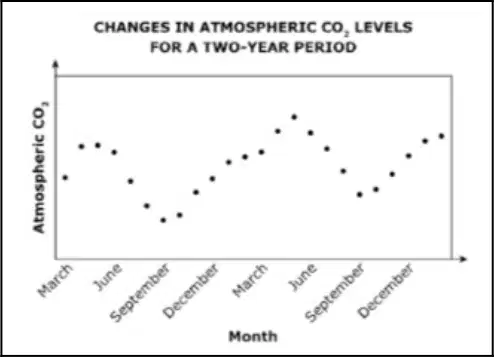
Many interactions occur between the biosphere and the atmosphere. One of these reactions results in atmospheric carbon dioxide (CO₂) levels. The graph below shows these changes over a two-year period. Which of the following changes in the biosphere most likely caused these changes in the atmospheric CO₂ levels? (6.E.7.4)
Streams froze in the winter and melted in the spring.
Plants grew leaves in the spring and lost leaves in the fall.
Offspring were born in the summer and matured in the fall.
Soil dried out in the summer and absorbed moisture in the winter.
Describes how the atmosphere best protects living organisms? (6.E.7.9)
by providing enough carbon dioxide in the ocean to support sea animals
by changing oxygen to nitrogen, which can be used as a nutrient for animals
by refracting visible light, allowing certain animals to see and capture their prey
by trapping electromagnetic radiation, keeping temperatures within a range best suited for animal life
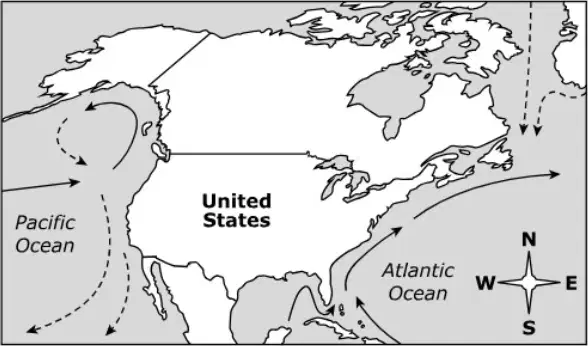
Based on the ocean currents shown, which statement best explains the difference in humidity?
The air mass in the Atlantic Ocean is warmer than the air mass in the Pacific Ocean is, and a warmer air mass holds more water vapor than a colder air mass does.
The air mass in the Pacific Ocean is colder than the air mass in the Atlantic Ocean is, and a colder air mass causes more evaporation than a warmer air mass causes.
The cold ocean current in the Pacific Ocean causes stronger winds than the warm ocean current in the Atlantic Ocean causes, and moisture evaporates from the Pacific ocean air mass.
The warm ocean current in the Atlantic Ocean produces denser air masses than the cold ocean current in the Pacific Ocean produces, and the dense air mass in the Atlantic Ocean cannot release precipitation.
Which process is the main source of evaporation of water from the oceans at the equator? (6.E.7.4)
evaporation of water from the oceans at the equator
release of fresh water into ocean water as icebergs melt
decomposition of organic matter at the bottom of oceans
release of large amounts of salt from icebergs into the ocean
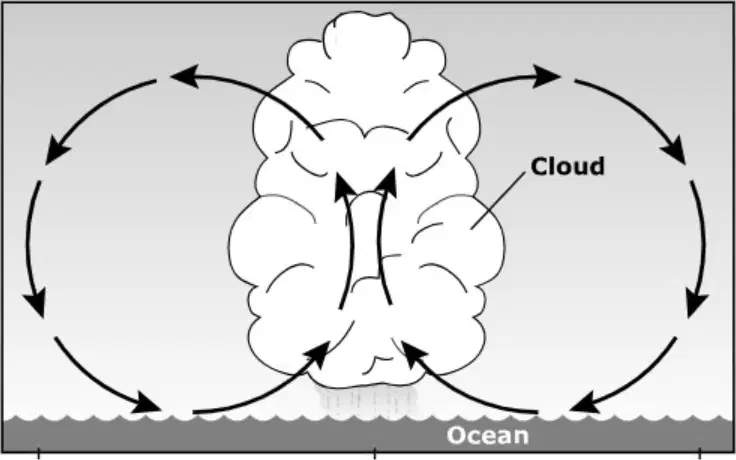
Which process is the main source of this movement? (6.E.7.2)
movement of ocean currents
decrease in relative humidity
heating by energy from the Sun
warming in the upper atmosphere
When nitrogen is returned to the soil when dead plants decompose, the interaction is between which two spheres? (6.E.7.4)
Atmosphere and Geosphere
Biosphere and Atmosphere
Biosphere and Geosphere
Hydrosphere and Atmosphere
Which of the following is the best explanation for sea breezes and land breezes along Florida’s coasts? (6.E.7.5)
The Gulf Stream current in the Atlantic Ocean.
Convection currents of rising, less-dense warm air and falling, denser cool air caused by differences in how quickly water and land absorb or lose the Sun’s heat.
Conduction currents of rising cool air and falling warm air.
Continental polar air masses moving in from the north.
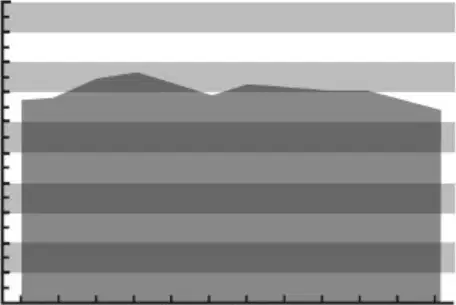
Which of the following statements refers to Miami's climate rather than Miami's weather? (6.E.7.6)
June is the least sunny month of the year.
Sunshine is steady throughout the year.
The sun shines nearly every day of the year.
There are more hours of sunshine during the summer.
Which of the following best describes how conduction causes magma to heat the surrounding rock inside Earth? (6.E.7.1)
The warm magma flows towards Earth’s surface and cools.
Electromagnetic waves from the Sun warm the magma, which in turn, warms the surrounding rock.
Differences in the density of the magma cause movement in the magma, which warms the surrounding rock.
Molecules of magma collide with molecules of rock and transfer energy as heat.
Earth’s spheres interact in many ways. Which of the following is the best example of the hydrosphere and atmosphere interacting? (6.E.7.4)
Ocean currents influence weather patterns.
Polluted air kills several animal species.
Magma erupts and releases trapped gases.
A heavy snowfall adds mass to a glacier.
The cryosphere and biosphere are two components of Earth’s systems. What is one way that the cryosphere and biosphere interact? (6.E.7.4)
A glacier picks up rock and sediment as it moves down a valley.
Heavy rains bring an end to a dry period on the African savannah.
A volcanic eruption destroys the plants on an island.
A melting glacier provides fresh water for plants and animals in the valley below the glacier.
What is the difference between weather and climate?
Weather conditions change daily but climate conditions do not change.
Weather describes the conditions of the atmosphere and climate describes the pattern of weather over a long period of time.
Weather describes the conditions of the atmosphere and climate describes the average temperature.
Climate describes the average precipitation while weather describes the average temperature.
How is heat transferred throughout the world’s oceans? (6.E.7.1)
Convection currents are driven by sunlight warming surface waters, which flow throughout the oceans, distributing energy as heat.
Sunlight penetrates the ocean’s waters, evenly distributing energy as heat from the surface to the ocean floor.
The warmed atmosphere transfers energy as heat to the rivers and the energy is distributed by conduction to oceans.
Energy in the form of heat is transferred throughout the ocean by waves and tides.
Earth has hot, dry regions and cool, wet regions. How does convection contribute to the distribution of heat and moisture across Earth? (6.E.7.1)
Convection allows the transfer of energy directly from the Sun to Earth’s surface.
Convection distributes energy as heat throughout Earth’s solid crust, warming the entire planet.
Convection causes the water vapor in the atmosphere to absorb the energy from warm water all over Earth.
Convection causes air masses carrying water and heat to rise and fall, all over Earth.
How is a natural sand dune formed? (6.E.6.2)
Wind erodes sand from the top of a mountain.
Windblown sand is trapped by beach grass or other objects.
The state of Florida is a peninsula. What type of landform borders the Florida peninsula on three sides? (6.E.6.2)
a river
a delta
a coastline
a mountain
Which of the following examples demonstrates heat transfer through radiation? (6.E.7.1)
Boiling water on a stove
A heater blowing hot air into a room
A hamburger cooking on a grill
the Sun warming the water in a swimming pool
Which of the following is the best example of heat transfer through conduction? (6.E.7.1)
Boiling water on a stove
A heater blowing hot air into a room
A hamburger cooking on a grill
the Sun warming the water in a swimming pool
Which of the following examples best demonstrates heat transfer through convection? (6.E.7.1)
Heat given off by a campfire
A heater blowing hot air into a room
Walking on a hot sidewalk barefoot
The sun warming your back
Which statement best explains one way the cryosphere and the hydrosphere interact? (6.E.7.2)
The clouds high up in the cryosphere constantly send water to the hydrosphere through the process of precipitation.
Plants and animals in the cryosphere send out water into the hydrosphere through the process of transpiration.
When the Sun’s energy melts the ice in the hydrosphere, the water flows and joins the cryosphere.
When the Sun’s energy melts the ice in the cryosphere, the water flows and joins the hydrosphere.
Which statement best describes how the Sun’s energy causes the movement of air in the atmosphere?
The Sun warms the air at the surface of the Earth equally, causing the warmer molecules to rise as the cooler molecules sink.
The Earth absorbs the Sun's energy, which then warms the air at the surface of the planet. The cooler molecules rise as the warmer molecules sink.
The Sun warms the Earth’s surface equally, causing air to rise.
Heat from the center of the Earth warms the surface of Earth which in turn warms the air and causes it to condense.
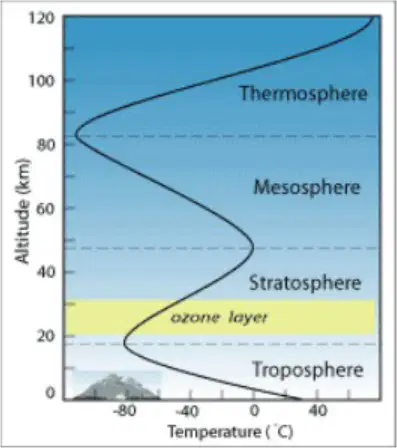
As altitude increases in the atmosphere, the range of temperatures found in each layer does not rise or fall consistently. Which statement best explains why this happens?
The layers of the atmosphere are all at different altitudes – this causes layers further from Earth’s surface to be warmer than layers closer.
The layers of the atmosphere are all different densities – this causes some layers to have a higher temperature although they are at a higher altitude.
The layers of the atmosphere absorb different amounts of radiation – this causes the troposphere to be the warmest and the thermosphere to be coldest.
The layers of the atmosphere reflect different amounts of infrared radiation – this causes the mesosphere to be the warmest layer.
Which of the following is one way that the subtropical jet stream can impact weather in Florida? (6.E.7.3)
The jet stream does not have an impact on Florida’s weather.
The jet stream stops fronts from moving.
The jet stream can increase the severity of thunderstorms in its path.
The jet stream can decrease the severity of thunderstorms in its path.
Riley is teaching her younger brother about interactions on Earth. She tells him that the geosphere and hydrosphere are in constant interaction. What evidence could she use to support her statement? (6.E.7.4)
Rain falls on the ground and runs along the surface of the ground, eroding soil and depositing it into a nearby lake bed.
The Sun's energy evaporates water which rises as water vapor and condenses as clouds.
Tree roots weather rock by breaking it into smaller pieces.
Moist soil allows Earthworms to absorb oxygen through their skin.
Within a given region, the mean air temperature over a forested area is significantly cooler than the mean air temperature over a land area without trees. What would be the most likely cause for the difference in mean air temperature between the forested and non-forested areas? (6.E.7.5)
The humidity in the air decreased the surface temperature.
The shading from the trees increased the surface temperature.
The humidity in the air increased the surface temperatures.
The shading from the trees decreased the surface temperature.
What term is used to describe the daily atmospheric conditions in an area? (6.E.7.6)
Climate
Weather
Temperature
Precipitation
For the at least the last century, Florida has experienced a hurricane season every year, from June to November. Which of the following statements best describes this occurrence? (6.E.7.6)
Florida’s precipitation
Florida’s global patterns
Florida’s climate
Florida’s weather
Why would a mountain climber need an air tank to breathe when climbing Mt. Everest?
Air is less dense at this altitude.
The air is too cold to breathe safely at this altitude.
The air is too warm to breathe at this extreme altitude.
The air is too dense to breathe safely at this altitude.
Why is it important for scientists to share not only their results, but also their procedure with other scientists? (6.N.1.4)
Scientists don’t care about results, they only want to know the procedure.
So scientists can repeat the experiment and compare methods used, results obtained, and offer further explanations.
A scientist’s findings can only become a Law if it is repeated 10 times.
Other scientists can compare methods and then copy your data if you used the same method.
Students in a class conduct experiments on the percent of oxygen in the air. When discussing their results, it is discovered that each lab group came to different conclusions. What should they do?
Compare their methods and results to find discrepancies.
Ignore the differences and choose the most common result.
Redo the experiments without discussing.
Ask the teacher for the correct answer.



