
Font size
 Worksheets
Physics Semester 2 Exam
Total questions: 25
Worksheet time: 14mins
Newton’s First Law states:
Whenever one object exerts a force on a second object, the second object also exerts a force on the first object, equal in magnitude and opposite in direction.
An object at rest will stay at rest and an object in motion will remain in motion unless acted on by an unbalanced force.
The acceleration of an object is directly proportional to the net force on the object and inversely proportional to the mass of the object.
Newton’s Second Law states:
Whenever one object exerts a force on a second object, the second object also exerts a force on the first object, equal in magnitude and opposite in direction.
An object at rest will stay at rest and an object in motion will remain in motion unless acted on by an unbalanced force.
The acceleration of an object is directly proportional to the net force on the object and inversely proportional to the mass of the object.
Newton’s Third Law states:
Whenever one object exerts a force on a second object, the second object also exerts a force on the first object, equal in magnitude and opposite in direction.
An object at rest will stay at rest and an object in motion will remain in motion unless acted on by an unbalanced force.
The acceleration of an object is directly proportional to the net force on the object and inversely proportional to the mass of the object.
For a rocket to launch off of the ground, a net force is required to cause the necessary __________.
velocity
force
acceleration
mass
What is the magnitude of the force of gravity on an object with a mass of 42.8 kg. g = 9.81 m/s2 (your answer must include correct significant figures and units)
(a)
A force of 800 N gives a 60.0 kg sled an acceleration of 10.0 m/s^2 to the right. The force of kinetic friction acting on the sled is _________.
200 N to the right
480 N to the right
200 N to the left
480 N to the left
The tendency of an object to resist any change to its motion is called _______.
force
mass
potential energy
inertia
A force is a push or pull on an object that causes the ________ of the object to change.
gravity
inertia
velocity
mass
An object experiencing no acceleration will:
it depends
continue with its original velocity
slow to a stop
never move
A massive train hits a compact car sitting on the tracks. The acceleration of the train is _____________ the acceleration of the car.
the same as
less than
more than
not related to
The velocity of an object undergoing uniform circular motion is always
parallel to its acceleration.
perpendicular to its acceleration.
opposite to its acceleration.
the same as its acceleration.
For a car moving on a circular road, the required centripetal force is provided by
the force of friction between the wheels of the car and the road.
the normal force of the road on the wheels.
the force of the steering wheel on the tires.
the force of gravity.
A 1,500 N space probe is orbiting a 750,000 N asteroid. What must be true about the force of gravity between the two?
The space probe pulls harder than the asteroid
The asteroid pulls harder than the space probe
There is no gravity between them because they are orbiting the Sun
They pull on each other will equal magnitude force

Which of the planets in this solar system must be travelling the fastest?
A
B
C
D
Kepler’s first law states the path of each planet around the sun is a/an ____________________ with the sun at one focus.
circle
ellipse
parabola
oval
A truck of mass 1500 kg and moving at an 80 m/s speed collides with a stationary car of mass 1000 kg, and the two vehicles lock together on impact. What is the final velocity of the car and truck after they are stuck together?
0 m/s
200 m/s
32 m/s
48 m/s
In an elastic collision, ___________ is/are conserved.
momentum
potential energy and momentum
kinetic energy
momentum and kinetic energy
If the speed of a flying cannonball is doubled, then the kinetic energy of the cannonball must be _____________.
doubled
halved
quartered
quadrupled
1. You watch and hear two objects collide. After the collision the two objects move in opposite directions at lower speeds. Which of the following are evidence that this collision was inelastic? (select all that apply).
You heard the collision
The objects remained separate after collision
The difference in velocities between the two objects was less after the collision
Total momentum was conserved
What is the law of the conservation of energy?
An object at rest tends to stay at rest.
The change in energy is equal to the amount of heat added plus the amount of work done.
Energy can be changed from one form to another form but cannot be created nor destroyed.
Energy can only be converted from potential energy to kinetic energy.
If there is no transfer of energy between two objects then their Temperature is
Same
Different
Zero
Infinite
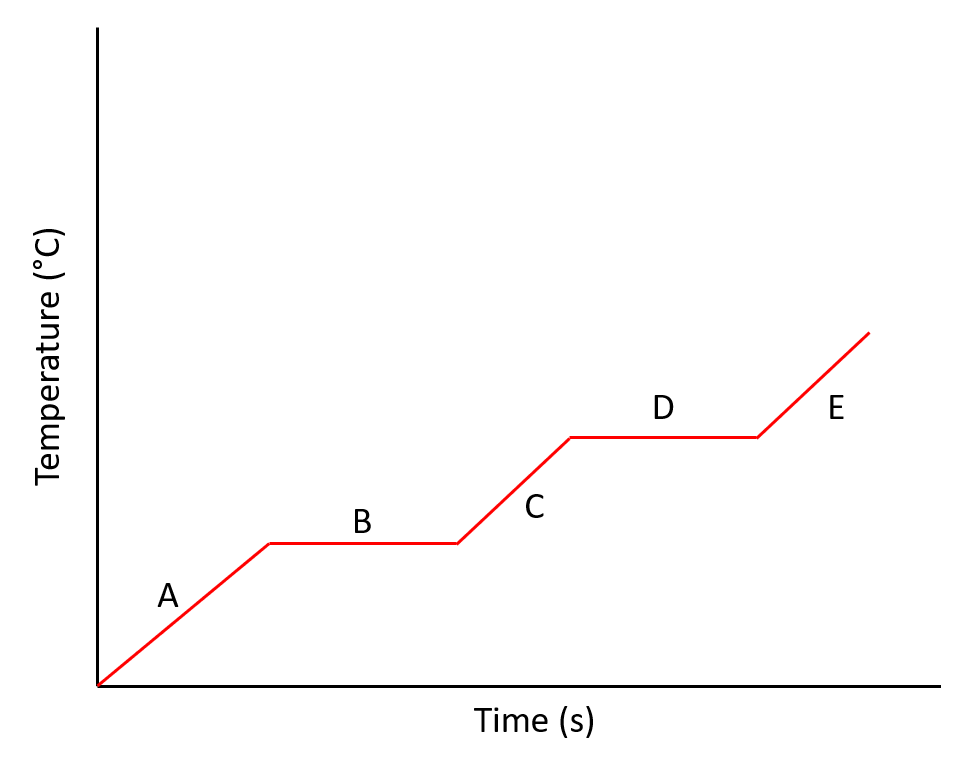
Why are lines B and D flat?
The ice is melting
The ice is freezing
All of the thermal energy is used to break the bonds
They stopped the stopwatch
They stopped heating the ice.

