wayground logo

Free Printable Worksheets

NEW

Font size

S
M
L
XL
Worksheets

PHY: Electric Current (Level 1)

Total questions: 61

Worksheet time: 43mins

Name
Class
Date
1.
Which word means how hard it is for electrons to flow?
a)
Current
b)
Voltage
c)
Resistance
d)
Power
2.
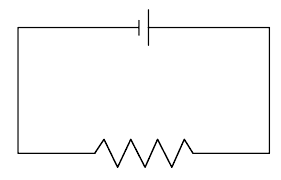
This is an example of a _______ circuit
a)
open
b)
series
c)
parallel
d)
square
3.
If the Voltage is increased and the resistance stays the same, Current will
a)
Increase
b)
Decrease
c)
Stay the same
d)
Not enough info
4.
If the Voltage stays the same and Resistance is increased, Current will 
a)
Increase
b)
Decrease
c)
Stay the same
d)
Not enough info
5.
In a series circuit, which of the following is the same throughout the circuit?
a)
Resistance
b)
Voltage
c)
Current
d)
Power
6.
What is current measured in?
a)
Ω (Ohms)
b)
V (Volts)
c)
A (Amps)
d)
W (Watts)
7.
What does power mean?
a)
Joules transferred per second
b)
Electron flow per second
c)
Speed of electrons
d)
Electron energy
8.
In a series circuit, which of the following will vary based on the resistor?
a)
Power
b)
Voltage
c)
Current
d)
None of the above
9.
What is resistance measured in?
a)
Ω (Ohms)
b)
V (Volts)
c)
A (Amps)
d)
W (Watts)
10.
What is the unit of power?
a)

Ohms

b)
Volts
c)
Amps
d)

Watts

11.
What is voltage?
a)

The flow of protons

b)
The number of charged particles that pass each second
c)
The difference in potential energy of charged particles
d)
The rate at which energy is being transformed
12.
What voltage is needed to produce 2A of current through a 10Ω resistor?
a)
20V
b)
0.2V
c)
5V
d)
2V
13.
A circuit with 3 resistors, 20 Ohms, 10 Ohms, and 20 Ohms are in series. What is the total resistance?
a)
43 Ohms
b)
50 Ohms
c)
60 Ohms
d)
33 Ohms
14.
Battery cells are connected in series to _______
a)
Increase voltage output
b)
Decrease voltage output
c)
Increase current capacity
d)
Decrease current capacity
15.
Current is...
a)
moving protons
b)
moving electrons
c)
measured in volts
d)
measured in ohms
16.
Resistance is...
a)
What "slows down" electrons
b)
What "speeds up" electrons
c)
Moving electrons
d)
What "pushes" electrons
17.
What characteristics impact resistance of a material?
a)
Thickness 
b)
Temperature
c)
Length
d)
All of these
18.
If the voltage stays the same, but the resistance goes up, the current will....
a)
increase (speed up)
b)
decrease (slow down)
c)
stay the same
19.
If the current increases it could be because of...
a)
increasing voltage
b)
decreasing resistance
c)
both
20.
A light bulb is an example of a _______.
a)
current
b)
resistor
c)
battery
21.

A potential difference of 24 V is applied to a 150 resistor. How much current flows through the resistor?

a)

0.15 A

b)

3600 A

c)

6.25 A

d)

0.16 A

22.

This is an example of a ______ circuit

a)

Series

b)

Parallel

c)

Open

d)

Dihexihedral

23.
An object through which electrons can easily flow is called a(n) ___________.
a)
Conductor
b)
Insulator
24.
What size resistor would produce a 3 Amp current flow with a 12 Volt battery
a)
1 Ohm
b)
3 Ohms
c)
4 Ohms
d)
12 Ohms
25.
What is the Voltage of a circuit that has a resistance of 5 Ω and a current of 2 A?
a)
25 V
b)
10 V
c)
2.5 V
d)
0.4 V
26.
This circuit has a 24 volt battery and the resistor is 8 ohms. How many amps are running through the circuit?
a)
3 Amps
b)
192 Amps
c)
2 Amps
d)
4 Amps
27.
Good conductors are _______ resistors
a)
bad
b)
good
28.
The movement of electrically charged _____ is called electric _____
a)
particles, transport
b)
ions, current
c)
particles, current
d)
ions, transport
29.
To have a complete electric circuit, the path must be _____
a)
small
b)
closed
c)
big
d)
open
30.

Charged particles that flow continuously through material is called

a)

Insulator

b)

Electric Current

c)

Flashlight

d)

closed circuit

31.

A device that converts chemical energy into electrical energy is call a

a)

battery

b)

conductor

c)

parallel circuit

d)

flashlight

32.

Most circuits include a device that opens and closes the circuit. This device allows you to turn a light bulb on and off. This device is a

a)

computer

b)

wire

c)

switch

d)

flashlight

33.

Home circuits have a safety device that opens or breaks the circuit when it overheats. This device is called a

a)

flashlight

b)

circuit breaker

c)

conductor

d)

simple circuit

34.

An electric current that continually reverses direction over time is known as a(n)

a)

direct current

b)

alternating current

c)

simple current

35.

An electric current that has constant magnitude and direction over time is known as a(n)

a)

direct current

b)

alternating current

c)

simple current

36.
Define electric current. 
a)
It is the work done by the source in driving charges around a complete circuit.
b)
It is a measure of the rate of flow of electric charge through a given cross-section of a conductor.
c)
It is the work done by the source in driving a unit charge around a complete circuit.
d)
It is a measure of the flow of electric charge through a given cross-section of a conductor.
37.

An electric current flowing in one direction only

a)

voltage

b)

parallel current

c)

direct current

d)

electric current

38.

A form of energy caused by the movement of electrons

a)

electricity

b)

voltage

c)

electric current

d)

parallel circuit

39.
_________________ found that current, voltage, and resistance are always related.
a)
Isaac Newton
b)
Albert Einstein
c)
Georg Ohm
40.

Which equation can be rearranged to calculate the time?

a)

t = Q ÷ I

b)

t = IQ

41.

Which equation can be rearranged to calculate the the electric current given?

a)

I = Q ÷ t

b)

Q = It

c)

I = Qt

d)

I = t ÷Q

42.

Calculate the quantity of charge, Q, obtained when a current of 25 amps runs for 1 minute

a)

Q = 1,800 C

b)

Q = 1,500 C

c)

Q = 1000 C

d)

Q = 3000 C

43.

What is a circuit?

a)

A rate of charges flow through a cross-sectional area of a wire

b)

A closed path that a current can flow along

44.

When an electric current pass through by the conductors, the conductor ___________ ______

a)

to begin crash

b)

going to freeze

c)

heats up

d)

going to melt

45.

Why is a battery important in an electrical circuit?

a)

As a source of energy.

b)

As a path for electricity to flow through.

c)

As a connector to connect all parts of a circuit.

46.

Look at the circuits in the diagram. In which circuit will the bulb be brighter?

a)

Circuit A

b)

Circuit B

c)

Both circuits, the bulbs will have the same brightness.

47.

The complete path through which an electric current is flowing is called

a)

Open circuit

b)

Closed circuit

c)

Both

48.
The voltage supplied to a circuit is 17 V and the current running through is 10 A. What is the power generated?
a)
170 W
b)
170 A
c)
1.7 V
d)
1.7 W
49.

Electric power is defined as,

a)

the rate of conversion of temperature

b)

the rate of conversion of current

c)

the rate of conversion of electric energy

d)

none of the above

50.

One watt is equal to,

a)

one meter per second

b)

one Joule per second

c)

One ampere per second

d)

one farad per second

51.

What is the name of this component?

a)

battery

b)

cell

c)

open switch

d)

lamp

52.

What is the name of this component?

a)

battery

b)

cell

c)

open switch

d)

lamp

53.

What is the name of this component?

a)

fuse

b)

cell

c)

battery

d)

wire

54.

What is the name of this component?

a)

fuse

b)

cell

c)

motor

d)

lamp

55.

What is the name of this component?

a)

fuse

b)

cell

c)

bell

d)

lamp

56.

Identify this symbol.

a)

Ammeter

b)

Voltmeter

57.

A current of 2 A is flowing through a conductor.

How long does it take for 10 C of charge to pass any point?

a)

0.2 s

b)

5 s

c)

12 s

d)

20 s

58.

A battery moves a charge of 60 C around a circuit in a time of 20 s.

What is the average current in the circuit?

a)

0.30 A

b)

3.0 A

c)

40 A

d)

1200 A

59.

Frayed wires are a common cause of what?

a)

infection

b)

short circuits that cause fires

c)

lightning

60.

If the current in a circuit gets too high, the circuit can:

a)

damage the components

b)

overheat

c)

start fires

d)

all of the above

61.

Fuses and circuit breakers can be used to _______ a circuit if the current gets too high.

a)

adjust

b)

cool down

c)

open

d)

reverse