
 Worksheets
7th Grade Quarter 2 Science Review
Total questions: 59
Worksheet time: 47mins
Name
Class
Date
1.
What form of energy is being used when a person pushes heavy boxes across the floor?
a)
Electrical energy
b)
Mechanical energy
c)
Heat energy
d)
Sound energy
2.
A girl turned the light off and went to bed. She remembered she had accidentally left her glass of ice water on the counter. When she got up the next morning, the ice had melted. What form of energy caused the ice to melt?
a)
Sound energy
b)
Light energy
c)
Thermal energy
d)
Mechanical energy
3.
Which form of energy is produced when a guitar string vibrates?
a)
Sound energy
b)
Electrical energy
c)
Chemical energy
d)
Light energy
4.
Which form of energy is produced when a lamp is switched on?
a)
Sound energy
b)
Electrical energy
c)
Chemical energy
d)
Light energy
5.
Biomass, petroleum, natural gas, propane, and coal are examples.
a)
Chemical Energy
b)
Radiant Energy
c)
Stored Mechanical Energy
d)
Gravitational Energy
6.
Stored energy
a)
Thermal Energy
b)
Stored Mechanical Energy
c)
Kinetic Energy
d)
Potential Energy
7.
Energy of place or position.
a)
Gravitational Energy
b)
Mechanical Energy
c)
Thermal Energy
d)
Chemical Energy
8.
Motion Energy
a)
Stored Mechanical Energy
b)
Potential Energy
c)
Electrical Energy
d)
Kinetic Energy
9.
Solar energy is an example.
a)
Sound Energy
b)
Thermal Energy
c)
Radiant Energy
d)
Gravitational Energy
10.
Electromagnetic energy that travels in transverse waves.
a)
Sound Energy
b)
Thermal Energy
c)
Radiant Energy
d)
Gravitational Energy
11.
Movement of electrons.
a)
Nuclear Energy
b)
Radiant Energy
c)
Mechanical Energy
d)
Electrical Energy
12.

The sun shines down on this family as the play on the beach.
a)
conduction
b)
convection
c)
radiation
13.

A group of friends gather around a fire to stay warm.
a)
conduction
b)
convection
c)
radiation
14.

Walking on the warm sand sand with your bare feet.
a)
conduction
b)
convection
c)
radiation
15.

Blow drying your wet hair.
a)
conduction
b)
convection
c)
radiation
16.

Which direction will the heat flow while this person holds a hot cup of tea?
a)
from the cup to her hand
b)
from her hand to the cup
c)
no heat is transferred
17.

Which direction will the heat flow while this ice cap melts?
a)
there is no heat transfer
b)
from the icecap to the water
c)
from the water to the icecap
18.
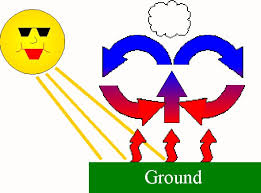
Warm air rises and the cool air sinks.
a)
conduction
b)
convection
c)
radiation
19.

In this experiment, the WARM red dye and the COLD blue dye was placed in the water at the same time. The warm red dye rose to the top while the cold blue dye sank to the bottom.
a)
conduction
b)
convection
c)
radiation
20.
Sound travels FASTEST through which of these materials?
a)
Air
b)
Empty space
c)
Metal
d)
Water
21.
Sound is caused by?
a)
force
b)
vibrations
c)
instruments
22.
What is vibration?
a)
how loud a sound is
b)
the back and forth movement of matter
c)
how high or low a sound is
d)
the loudness or softness of a sound
23.

What is frequency?
a)
the number of vibrations per second
b)
how high or low a sound is
c)
the loudness or softness of a sound
d)
the back and forth movement of matter
24.

Sound is a form of?
a)
energy
b)
pitch
c)
volume
25.
Why is sound able to travel faster through a solid than a gas?
a)
Gas molecules are packed tightly.
b)
Sound does not travel faster through a solid than a gas.
c)
Solid molecules are packed tightly.
d)
Gas molecules move slowly.
26.
An object that does not vibrate cannot produce
a)
sound
b)
light
c)
heat
d)
electricity
27.
What medium does sound travel through slowest?
a)
gas
b)
solid
c)
liquid
d)
trees
28.
Sound does not travel in space because
a)
Space is too far away.
b)
There is no matter in space.
c)
Space is the final frontier
d)
Space has planets.
29.
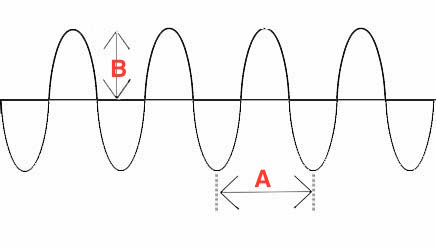
What property of this wave is represented by the letter "A"
a)
amplitude
b)
crest
c)
trough
d)
wavelength
30.
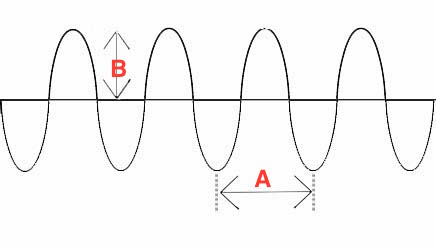
What property of the wave is represented by the letter "B"?
a)
amplitude
b)
crest
c)
trough
d)
wavelength
31.
The highest point on a wave is:
a)
the crest
b)
the trough
c)
the top
d)
the coast
32.
The lowest point on a wave is the:
a)
Amplitude
b)
Crest
c)
Trough
d)
Wavelength
33.
The number of wavelengths that pass a point each per second is:
a)
frequency
b)
period
c)
longitudinal
d)
transverse wave
34.
The type of waves that require medium to pass:
a)
Mechanical Waves
b)
Electromagnetic Waves
35.
When the frequency of a wave increases, what happens to the wavelength?
a)
The wavelength is not directly affected by the frequency of a wave.
b)
The wavelength increases.
c)
The wavelength decreases.
d)
More specific information is needed to form a conclusion about the wavelength.
36.
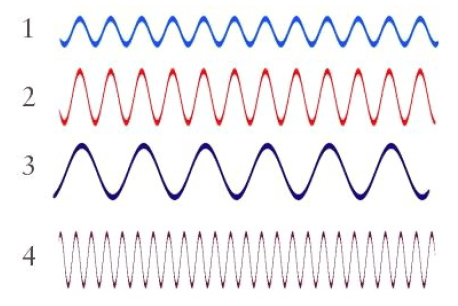
Which wave in the diagram has the greatest frequency?
a)
1
b)
2
c)
3
d)
4
37.
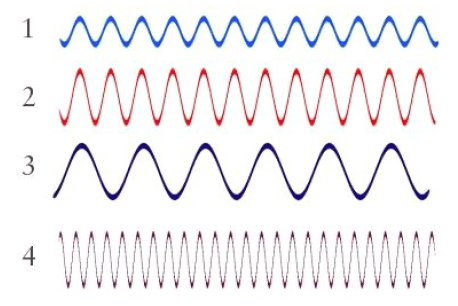
Which wave in the diagram has the greatest wavelength?
a)
1
b)
2
c)
3
d)
4
38.
When a wave bends as it passes through at an angle from one medium to another.(example: pencil in a glass of water-)
a)
medium
b)
refraction
c)
reflection
d)
interference
39.
When a wave strikes and object and bounces off. (example echo)
a)
medium
b)
refraction
c)
reflection
d)
interference
40.
When light shines through a prism it creates ________________
a)
visible light
b)
infrared radiation
c)
ultraviolet rays
d)
electromagnetic wave
41.
Material that allows light to pass through allowing you to see "clearly" to the other side
a)
opaque
b)
translucent
c)
transparent
42.
Compressions are...
a)
associated with transverse waves
b)
associated with longitudinal waves
c)
light waves
d)
visible light
43.
Light travels in a straight line
a)
True
b)
False
44.
High frequency equals
a)
high energy
b)
low energy
c)
no change in energy
d)
none of the above
45.
Wave height
a)
frequency
b)
wavelength
c)
amplitude
d)
wave speed
46.
Mechanical waves can be transverse or longitudinal waves
a)
True
b)
False
47.
Rarefactions are...
a)
were waves are farthest apart
b)
were waves are closest together
c)
associated with transverse waves
d)
found near the crest of a wave
48.
When waves overlap
a)
Interference
b)
Resonance
c)
Reflection
d)
Diffraction
49.
What does refract mean?
a)
To shrink
b)
To bend
c)
To widen
d)
To enlarge
50.

mirror
a)
absorbs
b)
reflects
c)
refracts
51.

lenses
a)
reflect
b)
refract
c)
absorb
52.
black
a)
refracts
b)
absorbs
c)
reflects
53.
Like any scientific law, the law of gravity describes a pattern in ___________________.
a)
the laboratory
b)
nature
c)
science
54.
A scientific theory is well-supported and _________________________.
a)
known
b)
widely accepted
c)
liked
d)
agreed upon
55.
A scientific theory...
a)
is based on lots of evidence
b)
is not valid
c)
is not reliable
d)
has not been tested many times
56.
A scientific ____________ is a statement that describes what always happens under certain conditions in nature.
a)
law
b)
theory
c)
method
d)
variable
57.

All matter is made of _____ that are constantly moving.
a)
insulators
b)
particles
c)
convection
d)
pieces of plastic
58.
Which of the following is NOT a part of the Kinetic Theory of Matter?
a)
All matter is made up of tiny particles.
b)
Occasionally, particles stop moving.
c)
Particles are always moving in random paths.
d)
The type of movement of particles depends on the amount of energy.
59.
Which of the following states of matter has the LOWEST level of energy?
a)
Solid
b)
Liquid
c)
Gas
d)
Plasma
100 %

