wayground logo

Free Printable Worksheets

Font size

S
M
L
XL
Worksheets

TBF Quiz 2 - Topics 3 & 4

Total questions: 54

Worksheet time: 54mins
Name
Class
Date
1.

A gas

a)

has a definite shape but no definite volume

b)

has a definite volume but no definite shape

c)

has no definite volume and no definite shape

2.

Which form of matter has a definite shape and has a definite volume?

a)

liquid

b)

solid

c)

gas

d)

clay

3.

What are the states of matter?

a)

solid, liquid, and water

b)

solid and liquid

c)

solid and gas

d)

solid, liquid, and gas

4.
Which form of matter take the shape of a container like this juice?
a)
liquid
b)
solid
c)
glass
d)
gas
5.
Which form of matter fills the space like it has in the balloon?
a)
liquid
b)
string
c)
solid
d)
gas
6.
The milk in the glass has volume and takes the shape of its container. Therefore, it is assumed that milk is a ______________.
a)
solid
b)
liquid
c)
gas
d)
plasma
7.
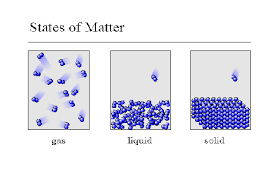
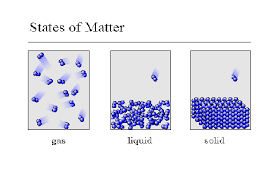
The molecules in the picture are tightly held together with little movement. They have shape and energy.  Therefore, the picture represents _________.
a)
solid
b)
liquid
c)
gas
d)
plasma
8.
What does this picture represent? 
a)
solid
b)
liquid
c)
gas
d)
plasma
9.
What does this picture represent? 
a)
solid
b)
liquid 
c)
gas
d)
plasma
10.

Which example has particles that are travelling the fastest?

a)

gas

b)

solid

c)

liquid

d)

amorphous solid

11.

Matter that has a definite shape and definite volume.

a)

solid

b)

liquid

c)

gas

12.

Matter that always fills the entire container it is in.

a)

solid

b)

liquid

c)

gas

13.

How is a gas defined?

a)

no definite shape, no definite volume

b)

Definite shape, definite volume

c)

Found in stars

d)

Definite volume, no definite shape

14.
At higher temperatures
a)
particles in an object have less energy
b)
particles in an object move faster
c)
a gas contracts
15.
The phase change from water vapor to liquid water is known as...
a)
evaporation
b)
precipitation
c)
condensation
d)
sublimation
16.

2. A change of state from a liquid to a solid is called....

a)

Fusion

b)

Freezing

c)

Evaporation

17.
5. What is it called when a solid turns directly into a gas?
a)
Sublimation
b)
Condensation
c)
Liquid
18.
7. All phase changes (changing states) requires energy to be added or taken away.
a)
True
b)
False
19.
Change from Gas to Solid is called........
a)
Sublimation
b)
Deposition
c)
Fusion
d)
condensation
20.
Change from gas to liquid...
a)
condensation
b)
evaporation
c)
expansion
d)
movement
21.
Change from Liquid to Solid is call......
a)
fusion
b)
Freezing
c)
sublimation
d)
evaporation
22.

change from liquid to gas is called....

a)

expansion

b)

vaporization

c)

condensation

d)

sublimation

23.

What happens to particles when they are heated?

a)

They speed up and spread out

b)

They slow down and get closer together

c)

They stop moving

d)

They move closer together and speed up

24.

Fusion is ...

a)

liquid to solid

b)

solid to liquid

c)

solid to gas

d)

gas to liquid

25.
Freezing is...
a)
Solid to gas
b)
Liquid to solid
c)
Gas to solid
d)
Liquid to gas
26.

Vaporization is ...

a)

liquid to gas

b)

gas to solid

c)

gas to liquid

d)

solid to liquid

27.

Vaporization is ...

a)

liquid to gas

b)

gas to solid

c)

gas to liquid

d)

solid to liquid

28.

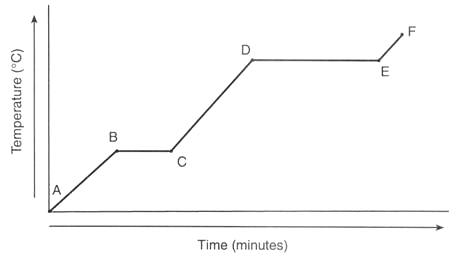
Is the substance gaining or losing energy?

a)

Gaining

b)

Losing

29.

Are the particles moving faster or slower as time goes on?

a)

Faster

b)

Slower

30.

What is happening to the particles in the substance between points A and B?

a)

Melting

b)

Freezing

c)

Speeding Up

d)

Slowing Down

31.

Which interval demonstrates vaporization occurring?

a)
B-C
b)
C-D
c)
D-E
d)
E-F
32.
As substance goes from D to E what happens to the distance between the particles?
a)
particles get closer together
b)
particles disappear
c)

particles get farther apart

33.
At what temperature is this substance melting?
a)
50C
b)
100C
c)
0C
34.

At which point does this substance finish melting?

a)
B
b)
C
c)
D
d)
E
35.
How long does it take this substance to change from a liquid to a gas?
a)
1 minute
b)
2 minutes
c)
10 minutes
d)
15 minutes
36.

What state/phase is the object likely from points A to B?

a)

Solid

b)

Liquid

c)

Gas

d)

Plasma

37.

What is happening to the particles in the substance between points D and E?

a)

Melting

b)

Freezing

c)

Vaporizing

d)

Sublimating

38.
Find the volume of the given figure.
a)
308.9 cm3
b)
308.2 cm3
c)
312.8 cm3
d)
302.9 cm3
39.

What 2 measurements are used for DENSITY

a)

Mass and Weight

b)

Mass and Acceleration

c)

Mass and Volume

d)

Length and Width

40.

How much water has been displaced in the image shown?

a)

40.0 mL

b)

65.0 mL

c)

20.0 mL

d)

25.0 mL

41.

An object is is placed into 45 mL of water. The water rises to 48 mL. What is the volume of the object?

a)

3.0 mL

b)

93.0 mL

c)

8.0 mL

d)

83.0 mL

42.

What two units could be used for a density measurement?

a)

mL/g

b)

g/mL

c)

cm3

d)

g/cm3

43.
What units are used to measure mass?
a)
g
b)
cm3
c)
g/cm3
d)
cm3/g
44.
What is the formula for density?
a)
density = mass x volume
b)
density = mass / volume
c)
density = mass + volume
d)
density = mass - volume
45.

A sample of seawater has a mass of 158 g and a volume of 156 mL. What is the density?

a)

1.01 g/mL

b)

0.99 g/mL

c)

24,648 g/mL

46.

True or False: As long as the temperature and pressure do not change, the density of a specific type of material never changes.

a)

True

b)

False

47.

A cube made of an unknown material has a height of 9cm. The mass of this cube is 3645 g. What is the density of this cube?

a)

5.0 g/cm3

b)

405.0 gcm3

c)

135.0 g/cm3

48.

A rock occupies a volume of 20 cm3 and has a mass of 54 g. What is the density of this rock?

a)

2.7 g/cm3

b)

0.37 g/cm3

c)

1080.0 g/cm3

d)

27.0 g/cm3

49.

Calculate the density of the cube.

a)

2.0 g/cm3

b)

4.0 g/cm3

c)

6.0 g/cm3

d)

8.0 g/cm3

50.
Why do ice cubes float in a  glass of water?
a)
the ice cubes are more dense than the water
b)
the water is more dense than the ice cubes
c)
the water is more dense than the glass
d)
the ice is more dense than the glass
51.
Why do objects sink or float in H2O
a)
Because their densities are higher or lower than compared to water
b)
Because their densities are using gravity to pull down
c)
Because their densities are heavier or lighter
d)
Because their mass and volumes are equal 
52.
Helium balloons rise on earth because
a)
helium is less dense than air
b)
helium is more dense than air
c)
helium is cooler than air
d)
helium is warmer than air
53.

The density of a cat can be measured using which of these quantities?

a)

mass and weight

b)

mass and volume

c)

height and weight

d)

length and volume

54.

A scientist has four different liquids and pours them all into a bottle. The silver liquid sinks to the bottom, the red liquid settles on top of the silver one, and the pink liquid stays at the surface. Which liquid has the smallest density?

a)

the pink liquid

b)

the silver liquid

c)

the red liquid

d)

the water