
 Worksheets
PMA Q1 Review
Total questions: 50
Worksheet time: 25mins

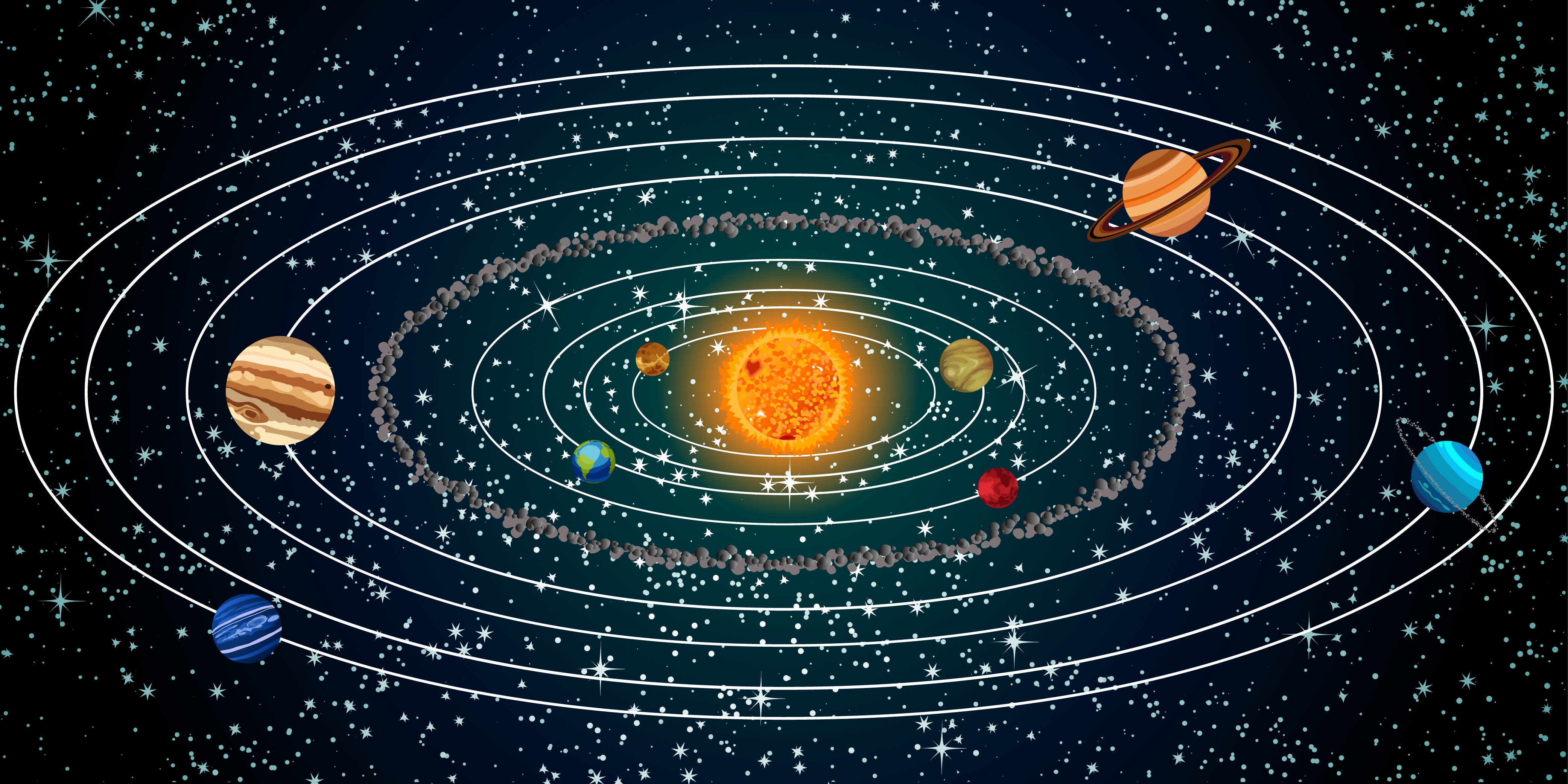
What model of the solar system is shown in this picture?
Heliocentric
Geocentric

Which pairing has the strongest force of gravity?
A
B
C
D

Why is the moon's gravity less that Earth's gravity?
The moon is so far away from Earth.
The moon is less massive than Earth.
The moon is too far from the sun.
The moon has a different type of core than Earth.

Which theory came 1st: Heliocentric or Geocentric?
Heliocentric
Geocentric
Sir Isaac Newton
is responsible for the idea of heliocentristm
designed and built instruments to study the position of the planets
discovered planets move in an ellipse instead of a circle
wrote the laws of motion and developed ideas about gravity
Why is it easier to lift a bowling ball on the moon than on Earth?
it has less mass moon
it has less weight on the moon
it has more force on the moon
it has more air resistance on the moon



Objects with greater mass have less gravity than those with lesser mass
True
False
What are the parts of the cell theory?
All cells come from preexisting cells
All organisms are composed of one or more cells
cells are the basic unit of life
All the above
What do red blood cells do?
send signals to nerve cells
transport oxygen
protect our body
A group of tissues creates...
an atom
organ
organ system
organism
A group of organs creates...
organ system
organism
tissue
organelle
The smallest unit of life is..
an atom
molecule
organelle
cell
How many domains are there when categorizing species?
2
3
4
which is multi cellular?
bacteria
archaea
eukarya
1. Luis rubbed a balloon on his hair and held the balloon next to the wall. He observed the balloon stick to the wall. Which of the following is responsible for the balloon sticking to the wall?
Gravity
Friction
Magnetic Force
Electrical Force
1. Forces that act at a distance include electrical force and gravitational force. What other type of force acts at a distance?
Friction
Contact Force
Magnetic Force
Conduction

The teacher instructs her students to return the books closest to them back to the shelf. Neither Jennifer nor Brianna wants to take the book, seen below, back to the shelf. Being in the exact middle, they begin to push the book back and forth to force it on the other’s side. Who will be forced to return the book, and what will be the resultant net force?
Brianna and 2 N
Brianna and 38 N
Jennifer and 2 N
Jennifer and 38 N
If a car travels 150 km in 2 hours, what is its average
speed?
300 km/hr
75 km/hr
100 km/hr
150 km/hr
You are riding in a car and the driver presses harder on
the gas pedal, causing an increase in speed. This is an example of ___________________.
velocity
positive acceleration
constant speed
negative acceleration
Which of the following accurately contrasts velocity and speed?
Speed is distance traveled in a certain amount of time. Velocity is time traveled in a certain distance.
Speed is distance traveled in a certain amount of time. Velocity is speed in a specific direction.
Velocity is distance traveled in a certain amount of time. Speed is velocity in a specific direction.
Velocity is distance traveled in a certain amount of time. Speed is how fast you’re going.

During which segment did the car come to a complete stop?
Segment A to B
Segment B to C
Segment C to D
Segment D to E
Scientists frequently repeat the experiments of others scientists. Why is this important in science?
Scientists often ask each other for help in performing experiments.
Replication of experiments helps to confirm and verify results.
Scientists frequently perform other scientists’ experiments in order to practice their technique.
Repeating experiments is an effective way to make sure a laboratory is in optimal condition.
Why are favorable traits more likely to be passed onto offspring?
Because they are more likely to survive and reproduce.
Because they come from dominant alleles.
Because they come from recessive alleles.
Because the trait is an acquired phenotype.
The scientific theory of evolution by natural selection relates changes in species to environmental changes. According to this theory what takes place when a change in the environment occurs more rapidly than a species is able to adapt?
The species changes to become a new species.
The species begins breeding with another species.
The species begins to produce more offspring.
The species dies out and goes extinct.
Classification is the organization of items based on characteristics. Which of the following shows the correct order of the Linnaean classification system, from the broadest classification to the most specific classification?
Phylum, Class, Order, Domain, Kingdom, Genus, Species
New Question New Question
Species, Genus, Family, Order, Class, Phylum, Kingdom, Domain
Domain, Kingdom, Genus, Species, Phylum, Class, Order, Family
Domain, Kingdom, Phylum, Class, Order, Family, Genus, Species
Which of the following correctly describes the modern six-kingdom classifications?
Bacteria, Monera, Protist, Fungus, Plant, and Animal
Eubacteria, Archaea, Protist, Fungus, Plant, and Animal
Eubacteria, Archaea, Plant, Animal, Birds, and Fish
Fungus, Plant, Animal, Bacteria, Archaea, and Eukarya
According to the cell theory, where do plant cells come from?
organelles
other plant cells
proteins
chemical reactions
Which of the following best describes the relationship between cells and living things in general?
The larger the living thing, the larger are its cells.
All living things are made up of one or more cells.
The number of cells in all living things is the same.
There is one kind of cell of which all living things are made.
All organisms are made of one or more cells AND the cell is the basic unit of all living things AND all cells come from existing cells is stated in _____________.
nuclear theory
quantum physics
cell theory
homeostasis theory
The smallest unit of matter that has the properties of a substance
atom
molecule
element
none of these
Which choices shows the parts of an organism arranged by size from smallest to largest?
Atom, Tissue, Cell, Organ
Molecule, Cell, Tissue, Organ
Organ, Tissue, Cell, Molecule
Cell, Organ, Tissue, Organ System
1. Humans and other complex organisms have a hierarchical system of organization. Which of the following statements is true regarding this system of organization?
Atoms are made of cells.
Organs are made of organ systems.
Cells are made of tissues.
Organs are made of tissues.


