
 Worksheets
Classification
Total questions: 50
Worksheet time: 41mins
Name
Class
Date
1.
Linnaeus' systems of naming organisms which give a scientific two word Latin name to species- first being the genus name and the second being the species
a)
Outgroup
b)
Phylogenetic Tree
c)
Cladogram
d)
binomial nomenclature
2.
Traits that evolved in one species after it branched off from the other.
a)
derived characterisitics
b)
ancestral characteristics
c)
Binomal Nomenclature
d)
Cladogram
3.
The evolutionary history of a species
a)
Phylogenetic Tree
b)
Outgroup
c)
Carolous Linnaeus
d)
Clade
4.
Father of Taxonomy. He created binomial nomenclature; still used today.
a)
Carolus Linnaeus
b)
Charles Darwin
5.
The grouping of organisms based on a set of criteria that helps organize, communicate, and retain information.
a)
Clade
b)
Taxonomy
c)
Classification
d)
Cladogram
6.
A species is a group of similar organisms that
a)
can mate with each other and produce fertile offspring.
b)
can live together on an island.
c)
can migrate to an island from the mainland.
d)
all have exactly the same traits.
7.
Which term refers to the process by which individuals that are better adapted to their environment are more likely to survive and reproduce?
a)
natural selection
b)
overproduction
c)
competition
d)
variation
8.
Darwin said that the number of offspring an organism has ___________________
a)
stays the same
b)
is more than can survive
c)
is less than needed
9.
Which organisms are closely related?
a)
Equus ceballas (horse) & Equus burchellii (zebra)
b)
Cyanea artica (jellyfish) & Asterias rubens (sea star)
c)
Naja naja (cobra) & Crotalus atrox (rattlesnake)
d)
Alligator mississippiensis (alligator) & Crocodylus porosus (crocodile)
10.
Who first proposed binomial nomenclature as a way of classifying organisms?
a)
Carlus Linneaus
b)
Charles Darwin
c)
Albert Einstein
d)
Francis Crick
11.
The science of classifying and naming organisms is
a)
taxonomy
b)
grouping
c)
anatomy
d)
evolution
12.
Canis, in the scientific name Canis Lupus, is known as the...
a)
Genus
b)
Species
13.

What would be the most correct binomial nomenclature for the grizzly bear?
a)
Carnivora ursidae
b)
Ursus Horriblis
c)
Horriblis Ursus
d)
Ursus horriblis
14.
Binomial nomenclature makes it easier for scientists to communicate because ...
a)
everyone speaks latin
b)
everyone uses the same scientific name
c)
everyone knows all the animals
d)
its fun to call organisms by name
15.
a series of questions with two possible answers that is used to identify organisms
a)
genus
b)
binomial nomenclature
c)
cladogram
d)
dichotomous key
16.

A student discovers an arachnid with a segmented abdomen, long legs, and a tail with no stinger. The student uses the dichotomous key below to identify it. Which arachnid has the student found?
a)
Whip Scorpion
b)
Wind Scorpion
c)
Daddy long legs
d)
Scorpion
17.
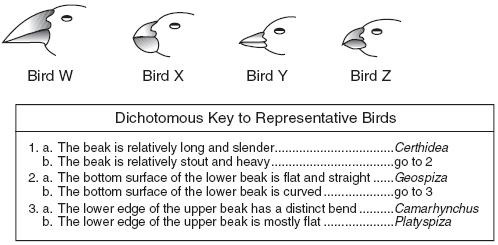
What is the name of bird W?
a)
Certhidea
b)
Geospiza
c)
Camarhynchus
d)
Platyspiza
18.

Which domain is capable of living in extreme environments like hot springs, geysers, or very salty waters?
a)
Bacteria
b)
Archaea
c)
Eukarya
19.

Which domain includes all animals and plants?
a)
Archaea
b)
Eukarya
c)
Bacteria
20.
To say that an organism is heterotrophic means...
a)
it cannot reproduce asexually
b)
it cannot make its own food
c)
it cannot breathe oxygen gas
21.
Which kingdoms have some organisms that can make their own food (autotrophic)?
a)
Plantae and Animalia
b)
Fungi and Plantae
c)
Protista and Plantae
22.
Organisms whose cells have NO nucleus are classified as...
a)
Eukaryotic
b)
Prokaryotic
c)
Dead
23.

Moss belongs in the kingdom...
a)
Fungi
b)
Plantae
24.

Algae and Kelp belong to the Kingdom...
a)
Plantae
b)
Protista
c)
Fungi
d)
Eubacteria
25.

Fungi are a type of...
a)
decomposer
b)
producer
26.

Mold, yeast, and mushrooms all belong to the Kingdom _______.
a)
Archaebacteria
b)
Fungi
c)
Eubacteria
d)
Protista
27.
What are the 8 levels of classification of living things from most general to most specific?
a)
domain, kingdom, phylum, class, order, family, genus, species
b)
domain, kingdom, phylum, class, order, family, genius, species
c)
domain, kingdom, phamily, class, order, family, genus, species
d)
domain, king, phillip, class, order, family, genus, species
28.

The scientific name for water bear is Hypsibius dujardini. What is its species?
a)
Hypsibius
b)
dujardini
c)
water
d)
tardigrade
29.
If two species share the same class, they also share the same______.
a)
phylum
b)
order
c)
genus
d)
species
30.
In a properly written scientific name, which part is lowercase?
a)
species
b)
genus
31.
In a properly written scientific name, which part is capitalized?
a)
species
b)
genus
32.

Who is the closest relative to the birds?
a)
crocodiles
b)
sharks
c)
fish
d)
amphibians
33.
Who is the closest relative to the sharks?
a)
crocodiles
b)
sharks
c)
ray-finned fish
d)
amphibians
34.
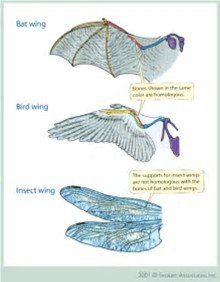
a)
Homologous
b)
Vesitigial
c)
Analogous
35.

a)
Homologous
b)
Vestigial
c)
Analogous
36.
Human appendix
a)
Homologous
b)
Analogous
c)
Vestigial
37.
Same structure, different function
a)
Homologous
b)
Analogous
c)
Vestigial
38.
Same function, different structure
a)
Homologous
b)
Analogous
c)
Vestigial
39.

Which organism in the chart is most distantly related from the other organisms?
a)
Organism "A"
b)
Organism "B"
c)
Organism "C"
d)
Organism "D"
40.

Which two organisms in the chart are most closely related?
a)
A and B
b)
A and C
c)
B and C
d)
C and D
41.
What type of cell has a nucleus?
a)
eukaryotic
b)
prokaryotic
42.
I have cell walls
I am an autotroph
I am multicellular
What am I?
I am an autotroph
I am multicellular
What am I?
a)
Plant
b)
Animal
c)
Eubacteria
d)
Unicorn
43.
I am unicellular
I am prokaryotic
I am found in extreme ecosystems
What kingdom do I belong to?
I am prokaryotic
I am found in extreme ecosystems
What kingdom do I belong to?
a)
The Candy Kingdom
b)
Kingdom Plantae
c)
Kingdom Animalia
d)
Kingdom Archaebacteria
44.
Members of Kingdom Animalia are...
a)
heterotrophs.
b)
autotrophs
45.
How many kingdoms are there?
a)
2
b)
3
c)
6
d)
8
46.
Mosses, hornworts, liverworts, ferns are examples of
a)
Protists
b)
Fungi
c)
Plants
d)
Animals
47.
Sponges, cnidarians, mollusks, echinoderms are examples of
a)
Protists
b)
Plants
c)
Animals
d)
Fungi
48.

Autotroph or heterotroph?
a)
Autotroph
b)
Heterotroph
49.

Which type of cell?
a)
Prokaryote
b)
Eukaryote
50.
The basic unit of life is called a (n)
a)
atom
b)
compound
c)
cell
d)
energy
100 %

