

Wayground logo

Free Printable Worksheets

Font size

S
M
L
XL
Worksheets

Electricity

Total questions: 60

Worksheet time: 1hrs 24mins

Name
Class
Date
1.

What particles move from atom to atom?

a)

Protons

b)

Neutrons

c)

Electrons

d)

Dust

2.

Particles with the same charge...

a)

they do nothing

b)

they tend to pull closer

c)

they tend to disappear

d)

they tend to pull apart

3.

What particles are found in the nucleus?

a)

Neutrons

b)

Protons and electrons

c)

Protons and neutrons

d)

Neutrons and electrons

4.

This is the flow of electrons from atom to atom

a)

Electric pulse

b)

Electric current

c)

Electric energy

d)

Electric flow

5.

Why do we use standardised symbols?

a)

To resolve an electric circuit

b)

To have fun

c)

To classify elements

d)

To draw electric circuits

6.

Which of the following formulas represents Ohm´s law?

a)

V = R / I

b)

R = V x I

c)

I = V / R

d)

R = I / V

7.

Combing your hair with a plastic comb produces static electricity.

a)

True

b)

False

8.

When we talk about electricity, we can distinguish two types of materials:

a)

Hard and soft.

b)

Conductive and insulating.

c)

Rigid and flexible.

9.

The electrical conductor allow the electricity to pass through them.

a)

True

b)

False

10.

Which ones are conductive materials:

a)

Wood

b)

Silver

c)

Gold

d)

Copper

11.

Insulating materials are....

a)

Copper

b)

Plastic

c)

Iron

d)

Wood

12.

Which are the components of a circuit?

a)

Generator, cables, switches and receptors.

b)

Generator, cables and switches.

c)

Cables, receptors and light bulbs.

13.

Examples of receptors are...

a)

Light bulb

b)

Television

c)

Switch

d)

Batteries.

14.

.....................poles attract each other.

a)

Opposite

b)

Similar

15.

Similar or equal poles....................each other.

a)

attract

b)

repel

16.
A circuit made of wires, a lamp, a switch, and a cell is shown at the right. What change is needed for the lamp to glow? 
a)
The switch needs to be opened.
b)
The switch needs to be closed.
c)
The cell needs an insulator.
d)
The wire needs to be connected to the bottom of the cell.
17.
Which statement best explains why the lamp does not glow? 
a)
Circuit 1 is an open circuit.
b)
 Circuit 1 is a closed circuit.
c)
 The negative terminal of Circuit 1 is connected to the cell.
d)
The positive terminal of Circuit 1 is connected to the cell.
18.
Why is an insulator used in a circuit? 
a)
An insulator helps keep the electric charges inside the pathway.  
b)
 An insulator transforms electrical energy into other forms of energy.      
c)
   An insulator provides the pathway electric current moves through.
d)
 An insulator provides the energy to pump electric charges through the circuit. 
 
19.
Which statement best describes the circuit in the diagram?
a)
It is a series circuit.
b)
It is a parallel circuit.
c)
There are 2 paths.
d)
The circuit is opened.
20.
Which statement best describes the circuit in the diagram?
a)
If one light goes out the other light will also go out because it is a series circuit.
b)
There is only 1 path.
c)
If one light goes out the other light will stay on because it is a parallel circuit.
d)
The circuit is opened.
21.

What is electricity?

a)

an object that electrons do not flow through

b)

energy created by moving charged particles

c)

when two objects repel each other

d)

a circuit that has only one path for electricity to flow

22.

This picture shows a circuit that is

a)

closed

b)

open

c)

an insulator

d)

static electricity

23.

What type of circuit is this?

a)

Series

b)

Parallel

c)

Simple

24.

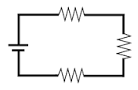
Why are Christmas lights wired in parallel?

a)

It is cheaper to make

b)

You can make longer strands

c)

It uses less electricity

d)

If a light breaks, the others keep working
25.
What is current measured in?
a)
Ω (Ohms)
b)
V (Volts)
c)
A (Amps)
d)
W (Watts)
26.
What voltage is needed to cause a 2A current flow through a 10Ω resistor?
a)
5V
b)
0.2V
c)
20V
d)
200V
27.
What voltage is needed to cause a 5A current flow through a 2Ω resistor?
a)
10V
b)
2.5V
c)
7V
d)
0.4V
28.
What resistance is needed to cause a 20A current flow because of a 100V battery?
a)
0.2Ώ
b)
2000Ώ
c)
120Ώ
d)
5Ώ
29.
What type of circuit is pictured?
a)
series
b)
parallel
30.
What kind of circuit is this?
a)
Series
b)
Consecutive
c)
Parallel
d)
Training
31.
If the battery produced 12.6 Volts and what would be the current flow be for a 6 Ohm resistor
a)
2.1 Amps
b)
2.4 Amps
c)
1.71 Amps
d)
15 Amps
32.
What voltage is needed to cause a 2A current flow through a 10Ω resistor?
a)
5V
b)
0.2V
c)
20V
d)
200V
33.

What voltage is needed to cause a 50A current flow through a 10Ω resistor?

a)

15V

b)

500V

c)

500 kV

d)

0.2V

34.
If the battery produced 12.6 Volts and what would be the current flow be for a 6 Ohm resistor
a)
2.1 Amps
b)
2.4 Amps
c)
1.71 Amps
d)
15 Amps
35.
What would the circuit resistance be if a 7.5 Amp draw was present with the engine running and the charging system producing 15 Volts
a)
15 Ohms
b)
4 Ohms
c)
0.3333 Ohms
d)
2 Ohms
36.

Which choice describes the behavior of an electric charge?

a)

Like charges attract. Unlike charges repel.

b)

Like charges repel. Unlike charges attract.

c)

Like charges attract. Unlike charges attract.

d)

Like charges repel. Unlike charges repel.

37.

In order to work, a circuit must be:

a)

Open

b)

Closed

38.

How can it be explained that someone's hair can stick to a balloon?

a)

There is static electricity.

b)

There is too much dust in the air.

c)

The person needs to wash his hair.

39.

Opposite charges _______________.

a)

attract

b)

repel

c)

nothing changes

40.

Like charges _______________.

a)

attract

b)

repel

c)

nothing changes

41.

The flow of electric charge in a circuit is called _______.

a)

Heat

b)

Sound

c)

Electric Current

d)

Magnetic

42.

Identify the part of the circuit that is labeled 1.

a)

battery

b)

wire

c)

switch

d)

bulb

43.

Identify the part of a circuit that is labeled 3.

a)

battery

b)

wire

c)

switch

d)

bulb

44.

If the light is on, the circuit is _________________.

a)

closed

b)

open

45.
A/an _________________ is an object that will allow electricity to flow through it.
a)
insulator
b)
conductor
46.
A/an _________________ is a material that will not allow electricity to flow through it.
a)
insulator
b)
conductor
47.
Identify the insulator below.
a)
aluminum foil
b)
paperclip
c)
rubber eraser
48.

What would best complete this circuit?

a)

A wire

b)

A switch

c)

A battery

d)

A light bulb

49.

What object would best complete this circuit?

a)

A battery

b)

a conductor

c)

an insulator

50.

How could you make this circuit work?

a)

Close the switch

b)

Take out the bulbs

c)

Add another battery

d)

Add another bulb

51.
Why are metals useful for making electrical wire?
a)
Metals do not bend.
b)
Metals hold much heat.
c)
Metals are insulators.
d)
Metals are conductors.
52.
Using the picture above, which letter correctly labels the battery?
a)
A
b)
B
c)
C
d)
D
53.
Using the picture above, which letter correctly labels the switch?
a)
A
b)
B
c)
C
d)
D
54.
Using the picture above, which letter correctly labels the light bulb?
a)
A
b)
B
c)
C
d)
D
55.
Using the picture above, which letter correctly labels the wire?
a)
A
b)
B
c)
C
d)
D
56.
Which subatomic particles have a positive charge?
a)
neutrons
b)
electrons
c)
protons
57.
An accumulation of electrons on an object is known as ___________.
a)
current
b)
AC
c)
static electricity
58.
How many volts are in a circuit with a battery that has a resistance of 10 Ohms and a current of 2 Amps? 
a)
.5 Volts
b)
5 Volts
c)
20 Volts
59.
Electricity is the flow of _________.
a)
protons
b)
neutrons
c)
electrons
60.
What type of circuit is pictured?
a)
series
b)
Parallel
