wayground logo

Free Printable Worksheets

Font size

S
M
L
XL
Worksheets

Chemistry Unit Test Review

Total questions: 44

Worksheet time: 31mins

Name
Class
Date
1.

All matter is composed of _____.

a)

Mixtures

b)

Molecules

c)

Compounds

d)

Atoms

2.

Tiny pieces that all matter is made of?

a)

Ions

b)

Molecules

c)

Atoms

d)

Electrons

3.

The smallest unit of an element that maintains the properties of that element is known as--

a)

a proton

b)

a neutron

c)

an element

d)

an atom

4.

A neutron is ---

a)

a subatomic particle with a negative charge.

b)

a subatomic particle with a neutral charge.

c)

the center of the atom where subatomic particles are found.

d)

a subatomic particle with a positive charge.

5.
Which subatomic particle causes the nucleus to have a positive charge?
a)
Neutron
b)
Electrons
c)
Protons
d)
Valence electrons
6.
Protons are equal to:
a)
Atomic Mass
b)
Number of neutrons
c)
Atomic Number
d)
All of the subatomic particles
7.
A one or two letter abbreviation  used to represent an element is called a(n) ________
a)
chemical symbol
b)
element sign
8.

a grouping of elements based on similar properties, arranged by columns in the periodic table; also known as a group

a)

family

b)

period

c)

row

d)

isotope

9.

a row on the Periodic Table of Elements

a)

family

b)

period

c)

row

d)

isotope

10.
The atoms along the staircase are called 
a)
metals
b)
nonmetals
c)
metalloids
d)
noble gases
11.
Elements in a ..................have similar chemical properties.  
a)
period
b)
group
c)
row
12.

Elements which are shiny, conduct electricity and heat are called

a)

metal

b)

nonmetal

c)

metalloid

d)

nonexistent

13.

The atoms on the right of the staircase are called

a)

metalloids

b)

non-metals

c)

metals

d)

noble gases

14.

Elements that are in the same group have ______________.

a)

properties that are similar to each other and behave the same.

b)

nothing in common at all.

c)

the same number of protons.

d)

very different properties.

15.

An _______________ is made up of one or more of the same kind of atom chemically combined.

a)

atom

b)

element

c)

molecule

d)

compound

16.

A _____________ contains a variety of elements and compounds that are not chemically combined with each other.

a)

compound

b)

element

c)

molecule

d)

mixture

17.

___________ are the smallest unit of an element that maintains the properties of that element.

a)

Atoms

b)

Elements

c)

Compounds

d)

Mixtures

18.

A ______________ mixture is one that does not have a uniform composition.

a)

heterogeneous

b)

homogenous

c)

pure substance

19.

A _________________ mixture is one where the substances are evenly spread throughout.

a)

heterogeneous

b)

homogeneous

c)

pure substance

20.
How are ionic bonds formed?
a)
Transfer of electrons
b)
Sharing of electrons
21.
What two types of atoms make a covalent bond?
a)
2 Nonmetals
b)
1 Nonmetal and 1 Metal
c)
2 Metals
d)
2 Noble Gases
22.
Ionic bonds are between...
a)
nonmetals and nonmetals
b)
carbon and oxygen
c)
metals and nonmentals
d)
hydrogen and chlorine
23.
How many elements are in C6H12O6?
a)
1
b)
2
c)
3
d)
4
24.
How many atoms are there TOTAL in:
H2SO4
a)
6
b)
5
c)
7
d)
3
25.
A subscript is the small number below a(n) ________ that tells the number of _______ of that element.
a)
element symbol; atoms
b)
atom; element symbol
c)
subscript; protons
d)
compound; elements
26.
How would this element be classified?
a)
Metal
b)
Nonmetal
c)
Metalloid
d)
Metamorphic
27.
What two types of measurements make up DENSITY
a)
Mass and Volume
b)
Temperature and Mass
c)
Grams and Centimeters
d)
Volume and Weight
28.
Look at this image.  Which object has the LOWEST density in water? How
a)
The Ping Pong Ball because it floats to the top 
b)
The bolt because it has sunk to the bottom
c)
The soda cap because it is not just full of air like the Ping Pong ball
29.
If an object has a density of .6 g/mL and you put it into water, will it sink or float?  
a)
sink
b)
float
30.
Silicon is a semiconductor and has properties of both metals and nonmetals. What type of element is Silicon? 
a)
Metal
b)
Nonmetal
c)
Metalloid
d)
Pretty
31.
Non-metals are good conductors of heat and electricity. 
a)
TRUE
b)
FALSE
32.

What is the main evidence that a chemical change has occured?

a)

Change of color

b)

Production of Bubbles

c)

Production of Fire

d)

A new substance is produced

33.

Which of the following are examples of chemical properties?

a)

Conductivity

b)

Flammability

c)

Reactivity

d)

Malleability

34.

Which of the following are examples of chemical changes?

a)

Burning paper

b)

Cutting paper

c)

Iron rusting

d)

Wrinkling paper

35.

Which of the following are physical changes?

a)

Cutting your hair

b)

Fruit rotting

c)

Water boiling

d)

Dropping an alka-seltzer in water

36.

Let's practice! Before reads 50 mL. After we drop in the object, the new water level goes up to 60 mL. What is the volume of the blocks?

a)

8 mL

b)

10 mL

c)

60 mL

d)

5 mL

37.
An irregularly shaped stone was lowered into a graduated cylinder holding a volume of water equal to 2 ml. The height of the water rose to 7 ml. If the mass of the stone was 25 g, what was its density?
a)
30g/mL
b)
5g/mL
c)
20g/mL
d)
2.77g/mL
38.
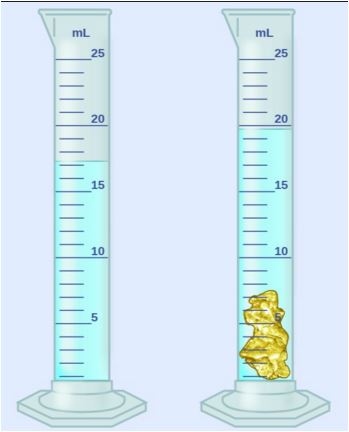
An irregularly shaped piece of gold was lowered into a graduated cylinder holding a volume of water equal to 17 ml. The height of the water rose to 20 ml. If the mass of the gold was 27 g, what was its density?
a)
9 g/mL
b)
10.5 g/mL
c)
6.5 g/mL
d)
8 g/mL
39.

Which of the following is true about mixtures and compounds?

a)

Mixtures and compounds are both made of two or more different substances.

b)

A mixture contains different substances that are not chemically combined with one another.

c)

A compound forms when different substances chemically combine to form a new substance.

d)

all of these

40.
Why do ice cubes float in a  glass of water?
a)
the ice cubes are more dense than the water
b)
the water is more dense than the ice cubes
c)
the water is more dense than the glass
d)
the ice is more dense than the glass
41.

Which object has the highest density in this picture?

a)

A

b)

B

c)

C

42.
A student places a piece of a potato into a container of hydrogen peroxide. One observation the student makes is that bubbles form around the potato. The presence of bubbles might indicate the formation of a new substance because bubbles - 
a)
could show that a gas is forming
b)
always rise to the top of a liquid. 
c)
are almost always perfectly spherical.
d)
usually burst after a few minutes.
43.

Which lab experiments below describe a situation where a chemical change has occurred? Check all that apply.

a)

After adding zinc (Zn) to hydrochloric acid (HCl), a student observes bubbles forming in the solution and a thermometer registers a  10°10\degree  change in temperature.

b)

A student uses a mortar and pestle (a grinding stone) to break up large pieces of ammonium thiocyanate ( NH4SCNNH_4SCN  ) into smaller pieces.

c)

After combining Unknown A (a solid, white crystal) with Unknown B (a clear, odorless liquid), there is a strong smell produced and a thermometer registers a  15°15\degree  change in temperature.

d)

A student dissolves sugar ( C6H6O6C_6H_6O_6  ) into water ( H2OH_2O  ). The sugar crystals seem to disappear.

44.

What evidence can you use to infer that a chemical reaction has occurred here?

a)

A dark solid formed on the zinc metal

b)

The zinc metal remained silver-colored and shiny

c)

The CuSO4CuSO_4 solution turned blue when the zinc metal was added

d)

None of these