
 Worksheets
Econ-Final Exam Review
Total questions: 107
Worksheet time: 4hrs 34mins
The definition of economics is the study of
how governments set social policy.
the influence of the Federal Reserve on history.
how governments dictate which businesses succeed or fail in a country.
the use of scarce resources that have alternative uses.
You have $20. With that $20, you can either put gas in your car, take a date to the movies, or buy new clothes. You cannot, however, do all three choices. Your first choice for the use of the $20 is to put gas in your car. Your second choice is to take a date to the movies. Your third choice is to buy new clothes. The opportunity cost for using the $20 to put gas in your car is
$20
taking a date to the movies.
buying new clothes.
both taking a date to the movies and buying new clothes.
You have 12 hours available for study (homework, test preparation, work on school project), relaxation (watching TV, spending time on Facebook, etc.), and sleeping between when you get home on a school day and when you must get up for school the next day. When you are considering spending an extra hour studying instead of using that hour for sleep or relaxation, you are illustrating the principle of
thinking at the margin.
opportunity cost.
incentives.
TANSTAAFL.
Which of these statements is descriptive of a market economy?
Most media is state-owned and operated.
The government determines what is produced and by whom.
Major economic decisions are made for individuals, not by them.
Major economic decisions are made by individuals, not for them.
Opportunity cost refers to
the dollar amount attached to a good or service.
the value of the next best alternative.
the cost of not expanding production.
the cost of labor when production is expanded or changed.
Which of these is an accurate statement about mixed economies today?
There are more mixed economies in the world than any other kind.
Very few economies today can be accurately described as “mixed.”
Mixed economies exist mostly in nations with communist governments.
Most nations that once had a mixed economy have evolved into command economies.
A nation’s leaders must decide whether to spend money on the military or on funding safety net programs. What do economists call this type of choice?
guns or butter issue
underutilization of resources
a decision at the margin
the law of increasing costs

The desire to have some good or service and the ability to pay for it
supply
equilibrium
demand
quantity demanded
When producers offer more of a good as its price increases and less as its price falls, this defines the
law of demand
law of supply
change in demand
change in supply
The willingness and ability of a producer to make a product is referred to as
quantity supplied
quantity demanded
supply
demand


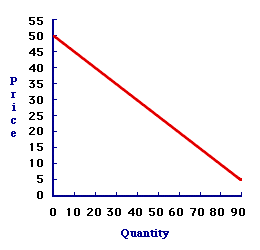
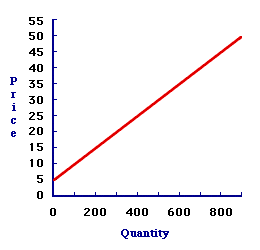
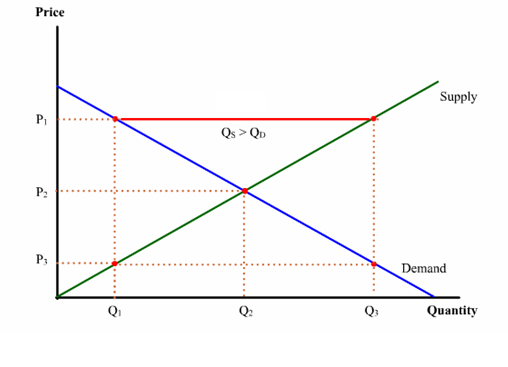
A situation in which a minimum price is set is referred to as
a shortage
a surplus
a price ceiling
a price floor
A situation in which a maximum price is set is referred to as
a shortage
a surplus
a price ceiling
a price floor
Hint: think of the soda market
Firms in this kind of market produce goods that are very close substitutes.
Perfect Competition
Pure Monopoly
Monopolistic Competition
Oligopoly
Which of the following is an example of a positive externality resulting from an outdoor band concert?
An elderly woman in her apartment hears a song that she liked as a child.
A pair of endangered birds leave their nest in a nearby tree when the concert starts.
A pizza parlor closes early, because all of its customers are at the concert.
A traffic jam occurs as drivers hunt for parking spots near the concert.
An Economic side effect of a good or service that generates benefits or costs to someone other than the person deciding how much to produce or consume.
Public good
Free rider
Externalities
Private sector
Which of the following is the definition for Franchise
business investment that involves renting or leasing another successful business model
unincorporated business owned and run by a single person who has rights to all profits and unlimited liability for all debts of the firm; most common form of business organization in the United States
unincorporated business owned and operated by two or more people who share the profits and have unlimited liability for the debts and obligations of the firm
form of business organization recognized by law as a separate legal entity with all the rights and responsibilities of an individual, including the right to buy and sell property, enter into legal contracts, and to sue and be sued
Which of the following is the definition for Partnership?
business investment that involves renting or leasing another successful business model
unincorporated business owned and run by a single person who has rights to all profits and unlimited liability for all debts of the firm; most common form of business organization in the United States
unincorporated business owned and operated by two or more people who share the profits and have unlimited liability for the debts and obligations of the firm
form of business organization recognized by law as a separate legal entity with all the rights and responsibilities of an individual, including the right to buy and sell property, enter into legal contracts, and to sue and be sued
Which business type makes up approximately 75% of all businesses?
Sole Proprietorship
Partnership
Corporation
The negotiation of wages and other conditions of employment by an organized body of employees
Labor Unions
Workers Rights
Worker Strikes
Collective Bargaining
An organization of workers dedicated to protecting members' interests and improving wages, hours and working conditions for all.
Labor Union
Workers Rights
Worker Strikes
Collective Bargaining
Training and experiences is considered
physical capital
human capital
labor
necessary to obtain an unskilled job
What is the price for labor
value
labor productivity
wages
human capital
Practice of contracting with an outside company to provide goods or services
labor productivity
outsourcing
insourcing
human capital
The practice of foreign companies establishing operations in, and therefore bringing jobs to the United States.
outsourcing
insourcing
labor market
collective bargaining
Which category of labor usually receives the lowest wages?
Unskilled
Semi skilled
Skilled
Professional
Which category of labor requires workers to operate complex equipment and machinery?
Unskilled
Semi skilled
Skilled
Professional
(Click all that apply)
The civilian labor force is made up of...
Men and Women at least 16 years old.
Working people
People looking for a job
People in prison
Your health, skills, education and abilities are just some of the things that make up your...
human capital
wage
category of labor
labor mobility
A yard and lawn landscaper requires enough mechanical skill or training to run a lawn mower. This type of job falls under the category of...
unskilled labor
semi-skilled labor
skilled labor
professional labor
A carpenter is able to operate complex machinery and can perform their job with little supervision. This type of job falls under the category of...
unskilled labor
semi-skilled labor
skilled labor
professional labor
A computer programmer writing software has the highest levels of education. This type of job falls under the category of...
unskilled labor
semi-skilled labor
skilled labor
professional labor
What can affect the labor force?
Higher Populations
Higher Participation Rate
Pandemics
Recessions
All of the Above
The transfering of work from a specific area of the company ( e.g. accounting, manufacturing) to an outside supplier, which can be done to a company that is located in the home country or anywhere else is called______.
Offshoring
Outsourcing
Globalization
Moving operations from the country where a company is headquartered to a country where pay rates are lower and the necessary skills are available.
Foreign markets
Offshoring
Outsourcing
Employees who work with information or who develop or apply information in the workplace
Knowledge workers
Blue collar workers
White collar worker
Employees that are employed for limited amounts of time
Temporary Workers
Knowledge Workers
Skilled Workers
Professional Workers
A(n) ___________________ is a wage rate that results in neither a surplus or a shortage of qualified workers
Wage
Equilibrium Wage
Labor Shortage
Minimum Wage
Non-wage compensations offered to workers in addition to their pay
Salary
Minimum Wage
Fringe Benefits
Cost of Living
A ___________________ tax is one that takes the same share of income at all levels
Proportional
Progressive
Regressive
A _________________ tax is a tax that takes a larger share of income as income increases.
Proportional
Progressive
Regressive
A _______________ tax is a tax that takes a smaller share of income as income increases
Proportional
Progressive
Regressive
The _____________________ is a form of payroll taxes.
Social Security Tax
Medicare Tax
Unemployment Tax
Inheritance Tax
In Michigan, the ____________________ is 6% that you pay on top of the purchase price of goods and services.
Excise Tax
Luxury Tax
Sales Tax
Property Tax
The largest business tax is the ______________________, which is applied to the profits of corporations
Income Tax
Luxury Tax
Sales Tax
Corporate Income Tax
__________________ are typically levied on goods and services that the government wants to regulate, like cigarettes and alcohol. They are also called "sin taxes"
Sales Taxes
Excise Taxes
User Fees and Tolls
Property Taxes
___________________ are levied on the sale of luxury goods, such as private jets.
Sales Taxes
Excise Taxes
Luxury Taxes
Property Taxes
The price you pay to cross the Mackinac Bridge or to enter a National Park is considered a(n):
User Fee/Toll
Sales Tax
Excise Tax
Estate Tax
The federal government imposes an _________________ on assets left to heirs of someone who dies.
Sales tax
Property tax
Estate tax
Social Security tax
_______________ is the idea that the tax system should be fair.
Tax Base
Tax Equity
Tax Rate
Tax Incidence
The _______________ is the thing that is taxed, such as personal income.
Tax Base
Tax Equity
Tax Rate
Tax Incidence
The _______________ is the percentage of income that is taxed.
Tax Base
Tax Equity
Tax Rate
Tax Incidence
This agency oversees the testing and approval of drugs before they go on the market.
Food and Drug Administration (FDA)
Federal Deposit Insurance Agency (FDIC)
Securities and Exchange Commission (SEC)
Occupational Safety and Health Administration (OSHA)
This agency insures nearly all bank deposits for up to $100,000 per depositor.
Food and Drug Administration (FDA)
Federal Deposit Insurance Agency (FDIC)
Securities and Exchange Commission (SEC)
Occupational Safety and Health Administration (OSHA)
This agency sets safety and health standards for industries to ensure worker safety.
Food and Drug Administration (FDA)
Federal Deposit Insurance Agency (FDIC)
Securities and Exchange Commission (SEC)
Occupational Safety and Health Administration (OSHA)
_____________________ are spillover effects (positive or negative) that result from production or consumption and are costs or benefits that affect someone other than the producer or consumer of a good or service.
Externalities
Subsidies
Taxes
Property Rights
The ______________________ is the percentage of households in America whose incomes fall below the poverty threshold.
Poverty Rate
Economic Mobility
Unemployment Rate
Welfare
The __________________ is the total amount owed by a nation's government as a result of borrowing.
Tax Rate
Federal Deficit
National Debt
Tax Base
The __________________ is the shortfall between tax revenues and government expenditures in a given year.
Tax Rate
Federal Deficit
National Debt
Tax Base
________________ spending is spending that is fixed by law, such as paying interest on the national debt and paying for Social Security
Mandatory
Discretionary
________________ spending is spending that is made up of expenditures that may be raised or lowered as Congress sees fit. The biggest chunk of this spending goes towards funding national defense (the military).
Mandatory
Discretionary
This form of economics focuses on the decision making of individuals, households, and firms
Microeconomics
Macroeconomics
This form of economics focuses on the workings of the economy as a whole
Microeconomics
Macroeconomics
_______________ is the percentage of the labor force that is seeking work
unemployment rate
structural unemployment
full employment
cyclical unemployment
When an economy reaches ______________________, jobs exist for everyone who wants to work, even though a percentage of those jobs and workers will not yet have been matched together
unemployment rate
structural unemployment
full employment
cyclical unemployment

