

Wayground logo

Free Printable Worksheets

Font size

S
M
L
XL
Worksheets

USH Final Exam Review

Total questions: 30

Worksheet time: 16mins

Name
Class
Date
1.

What are war bonds?

a)

A new type of military weapon.

b)

A government certificate sold to U.S. citizens to help the war effort.

c)

A promise to support allies during WWI.

d)

A peace treaty.

2.
This underlying cause of WWI involves the build-up of armies and weapons.
a)
alliance system
b)
militarism
c)
imperialism
d)
nationalism
3.
This underlying cause of WWI involves the desire to gain territory by taking control of weaker countries.
a)
militarism
b)
isolationism
c)
nationalism
d)
imperialism
4.
This underlying cause of WWI involves intense loyalty to one's country or group.
a)
imperialism
b)
assassination
c)
nationalism
d)
militarism
5.
This underlying cause of WWI involves nations that have made a pledge to each other to come to one another's defense at times of war.
a)
militarism
b)
imperialism
c)
alliance system
d)
nationalism
6.
This event involves a message offering an alliance to Mexico from the German foreign minister.
a)
the Sussex Pledge
b)
the interception of the Zimmerman telegram
c)
the sinking of the Lusitania
d)
unrestricted submarine warfare
7.
This event involves a British passenger ship that was torpedoed by U-boats, killing over 100 Americans.
a)
the Sussex Pledge
b)
the interception of the Zimmerman telegram
c)
the sinking of the Lusitania
d)
unrestricted submarine warfare
8.
The day the stock market crashed is known as:
a)
Black Monday
b)
Black Tuesday
c)
Black Wednesday
d)
Black Thursday
9.
What was the name of the program Roosevelt created to make jobs and stimulate the economy?
a)
Relief Now
b)
Recovery Plan
c)
New Deal
d)
Big Deal
10.

What years did WWII begin and end?

a)

1938-1951

b)

1945-1951

c)

1939-1945

d)

1936-1944

11.
Japanese and Japanese Americans from the West Coast of the USA during WWII who were sent to camps called "War Relocation Centers" in remote portions of the nation's interior
a)
Cornelia Fort
b)
Japanese Internment
c)
Allied Powers
d)
Axis Powers
12.
Alliance of Great Britain, Soviet Union, United States, and France during World War II
a)
axis powers
b)
rationing
c)
Japanese internment
d)
allied powers
13.

What was the Allied strategy in the Pacific known as?

a)

island-hopping

b)

island-jumping

c)

appeasement

d)

rationing

14.

The United States Foreign Policy after World War II was the policy of Containment, which was?

a)

The U.S. would try to restrict the spread of Fascism in Europe.

b)

The U.S. would help to rebuild the nations of Japan and Germany.

c)

Due to the importance, the U.S. would increase spending into the Space Race.

d)

The U.S. would try to prevent the spread of Communism anywhere in the world.

15.

Which of these events was the closest the United States and the Soviet Union actually came to fighting each other during the Cold War?

a)

Cuban Missile Crisis, 1962

b)

Gulf of Tonkin, 1964

c)

Bay of Pigs, 1961

d)

Suez Crisis, 1956

16.
How did the Korean War end?
a)
Peace Treaty
b)
South Korea Victory
c)
North Korea Victory
d)
Armistice
17.
Dr. Martin Luther King, Jr. believed that the only moral way to end segregation and racism was through...
a)
violence and riots.
b)
the political system.
c)
education.
d)
nonviolent passive resistance.
18.

What was a main goal of the Black Panthers?

a)

Housing

b)

Challenge police brutality in African American communities

c)

Full employment

d)

All of the above

19.
What did the American Indian Movement want to see happen?
a)
Treaty rights honored and to assist urban American Indians
b)
They wanted more reservations
c)
They wanted more boarding schools
d)
They wanted the right to vote
20.

What was so important about the Stonewall Uprising?

a)

The stonewall riots sparked the beginning of the fight against LGBTQ+ oppression.

b)

It showed the defiance of citizens

c)

It created the pride flag

d)

It made a celebrity famous

21.

What does A.I.M. stand for?

a)

Ancient Indian Mojo

b)

Anti-Indian Management

c)

American Independence Movement

d)

American Indian Movement

22.

What were the three major goals of the Chicano Movement?

a)

Restoration of Land

b)

Rights for Farmworkers

c)

Educational Reforms

d)

All of the Above

23.

The United Farm Workers used which techniques to protest their labor conditions?

a)

sit ins and school walk-outs

b)

riots and carrying guns

c)

strike, hunger strike, boycott

d)

petitions and lobbyists

24.

What amendment banned alcohol (Prohibition)?

a)

16

b)

18

c)

19

d)

21

25.

Why was the 1920s known as the "Roaring 20s?"

a)

huge increase in immigration which led to fighting

b)

economic depression

c)

people were free to drink and party at their leisure

d)

it was a time of cultural and social changes

26.

Amendment that ended prohibition

a)

16

b)

18

c)

19

d)

21

27.
What happened to farmers during the Great Depression?
a)
They continued to have a rise in their harvests.  
b)
They could not charge much for their crops. 
c)
They changed from harvesting cotton to growing turnips. 
d)
They charged higher prices because the demand was high.
28.
The ____ granted the president broad military powers in Vietnam
a)
Geneva Accords
b)
Tonkin Gulf Resolution
c)
Marshall Plan
d)
Operation Rolling Thunders
29.

One reason the USA was involved in the Vietnam War was to

a)

prevent the spread of communism in Indochina

b)

reduce French influence in Vietnam

c)

stop china from seizing Vietnam

d)

support the government of North Vietnam
30.
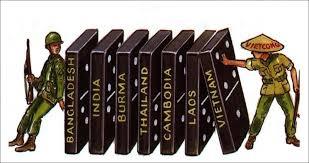
The idea that if South Vietnam fell to communism, other nations would soon follow...
a)
Vietnamization 
b)
Communism
c)
Domino Theory
d)
Imperialism
