
NEW
Font size
 Worksheets
Evolution Test
Total questions: 41
Worksheet time: 2hrs 3mins
In the 1800s Jean-Baptiste Lamarck offered a hypothesis about evolution called the inheritance of acquired characteristics. Which of the following is an example of how Lamarck thought animals evolved?
Fish mutated the genes necessary to develop lungs and were able to eventually survive on land.
Giraffes once had short necks and stretched them reaching for leaves on trees, later passing the longer neck trait to their offspring.
Dark moths, once outnumbered by light moths, began to survive longer and reproduce more after the industrial revolution turned the trees black.
The earth has been here so long that animals have had plenty of time to adapt to their environment through natural selection.
Which of the following men developed a theory of evolution very similar to Charles Darwin’s around the same time that Darwin developed his theory?
Malthus
Lyell
Lamarck
Wallace
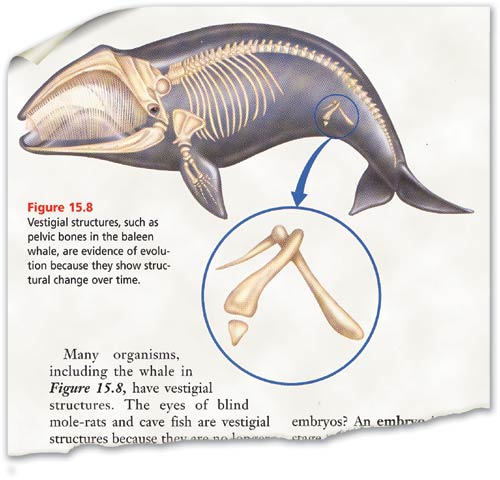
The hip bones in a whale are examples of
homologous structures
analogous structures
fossils
vestigial structures


The hypothesis that evolution occurs at an irregular rate through geologic time is known as
directional equilibrium
punctuated evolution
directional evolution
punctuated equilibrium
According to natural selection organisms with greater fitness pass their genes onto the next generation at a higher rate than other organisms. In evolutionary terms, great fitness refers to organisms _____________.
Surviving Longer
Reproducing more
Being physically stronger
Which statement best describes the process of evolution?
Populations can survive in different locations on earth
Environmental conditions limit the number of species on Earth
Populations grow when resources are abundant
The traits of a species can change over time
All of the following are evidence for evolution EXCEPT for:
Similar developmental patterns (embryos)
Homologous structures
Similarities in DNA
Different genes
Which of the following is NOT part of Darwin's original theory of evolution?
Natural selection eliminates the least fit organisms from the population.
Members of the population compete for resources.
Gene mutations add more diversity to the population.
Those that have the best traits survive and reproduce.

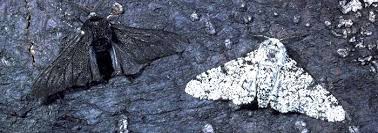
Predict which moth would increase in population
light
dark
There will equal amounts of dark and light

Genetic drift is change in the allele frequency of a population due to...
random chance
natural selection
non-random mating (sexual selection)
artificial selection

Mimicry is a type of adaptation allowing an organism to copy traits from another organism. Why would a non venomous milk snake want to mimic a venomous coral snake?
to protect itself from predators
so it can attract prey
so it can interbreed with a coral snake
The formation of a new species as a result of an ancestral population's becoming isolated by a geographic barrier
bottleneck effect
speciation
allopatric
sympatric
Form of natural selection by which the center of the curve remains in its current position; occurs when individuals near the center of a distribution curve have higher fitness than individuals at either end
stabilizing selection
disruptive selection
directional selection
vestigial selection

Which statement is true comparing natural selection and artificial selection?
In natural selection, traits benefit humans and in artificial selection, the traits benefit the species
In natural selection, traits benefit the species and in artificial selection, the traits benefit humans
In natural and artificial selection, the process takes hundreds of years to occur
In natural and artificial selection, nature determines what traits will be passed down to offspring.
If a population experiences no migration, is very large, has no mutations, has random mating, and there is no selection, which of the following would you predict?
The population will evolve, but much more slowly than normal
The makeup of the population's gene pool will remain virtually the same as long as these conditions hold.
The composition of the population's gene pool will change slowly in a predictable manner.
Dominant alleles in the population's gene pool will slowly increase in frequency while recessive alleles will decrease.
The population probably has an equal frequency of A and a alleles.
One sex competes over obtaining mates, and only those with specific traits are successful.
Male Competition
Female Choice
Evolution
Species

Choose the Type of Selection this represents: Larger squirrels can carry larger acorns to their burrows, and they outcompete smaller squirrels when acorn supplies are limited
Directional
Stabilizing
Disruptive

Altruism directed toward those who are related to you. The primary motive is the increased probability of shared reproductive success due to genetic relatedness.
kin selection
small group reciprocal altruism
Handicap principle
group selection

The three species pictured share a common ancestor and have adapted so that each lives in a different environment. This is an example of
Law of Superposition
Evolutionary Arms Race
Divergent Evolution
Convergent Evolution

