wayground logo

Free Printable Worksheets

Font size

S
M
L
XL
Worksheets

Final Exam Practice

Total questions: 81

Worksheet time: 3hrs 55mins

Name
Class
Date
1.

Divide  43\frac{4}{\sqrt{3}}  

a)

 433\frac{4\sqrt{3}}{3}  

b)

 432\frac{4\sqrt{3}}{2}  

c)

 434\sqrt{3}  

2.

What is the measure of side c?

a)

7

b)

72\frac{7}{\sqrt{2}}

c)

727\sqrt{2}

d)

14

3.
What is side b?
a)
hypotenuse
b)
leg
c)
long leg
d)
short leg
4.

What is the measure of side c?

a)

6

b)

626\sqrt{2}

c)

636\sqrt{3}

d)

12

5.
What is the length of y in this picture?
a)
45
b)
5√2
c)
90
d)
5
6.

In this 30-60-90 triangle, what is the length of the long leg?

a)

6√2

b)

3√3

c)

12

d)

6√3

7.
Find x.
a)
10
b)
10√3
c)
10√2
d)
20
8.
sin (π/2)
a)
√3/2
b)
√2/2
c)
1/2
d)
1
9.
 tan 2π = 
a)
0
b)
1
c)
-1
d)
undefined
10.
sin(5π/3)
a)
-√3/2
b)
-√2/2
c)
-1/2
d)
√3/2
11.
tan(7π/6)
a)
1/2
b)
√3
c)
-1/2
d)
√3/3
12.

Name the quadrant in which the angle θ lies.

sec θ > 0 and tan θ > 0

a)

Quadrant I

b)

Quadrant II

c)

Quadrant III

d)

Quadrant IV

e)

Does not exist

13.

Name the quadrant in which the angle θ lies.

sin θ < 0 and cot θ > 0

a)

Quadrant I

b)

Quadrant II

c)

Quadrant III

d)

Quadrant IV

e)

Does not exist

14.
The period of a sine or cosine graph can be found by ....
a)
It's always 2π
b)
2π/B
c)
B(2π)
d)
2π+B
15.
Which value represents a vertical shift in the following function y=a*sin(bx - c)+d?
a)
a
b)
b
c)
c
d)
d
16.
Sine or Cosine?
a)
y=sinx
b)
y=cosx
17.
Sine or Cosine?
a)
y=sinx
b)
y=cosx
18.
What is the period of
y= -3sin(x)
a)
π
b)
c)
d)
19.
What is the amplitude of y = 3 cos 2x?
a)
3
b)
2
c)
90
90⁰
d)
350⁰
20.
What is the equation of the graph?
a)
 y = 2 cos x
b)
y = sin x
c)
y = 2 sin x
d)
y = sin 2x 
21.
What is the period
of
 y = 3 sin 2x?
a)
2
b)
3
c)
180
d)
360
22.
Write the equation for a sine function with an amplitude of 6 and a period of π/4.
a)
y=6sin(8x)
b)
y=6sin8(x-1)
c)
y=6sin1/4x
d)
y=6sinx
23.

Describe the horizontal shift.

a)

left π / 2

b)

left 2π

c)

right 2π

d)

right π / 2

24.

Describe the horizontal shift.

a)

left 3π / 4

b)

left 4π / 3

c)

right 3π

d)

right 3π / 4

25.

What is the equation of the graph shown?

a)

y = 2sin(θ + π/2) + 3

b)

y = 3cos(θ - π/2) + 2

c)

y = 3sin(θ - π/2) + 2

d)

y = 2cos(θ + π/2) + 3

26.

What is the equation of the graph shown?

a)

y = 2sin(θ + π/2) + 2

b)

y = 2cos(θ - π/2) + 2

c)

y = 2sin(θ - π/2) + 2

d)

y = 2cos(θ + π/2) + 2

27.

What is the equation of the graph shown?

a)

y = 3sin(θ + π/4) - 1

b)

y = 3cos(θ - π/4) -1

c)

y = 3sin(θ - π/4) + 1

d)

y = 3cos(θ + π/4) + 1

28.

What is the equation of the graph shown?

a)

y = -sinθ -1

b)

y = -sinθ/2 -1

c)

y = -2sin2θ + 1

d)

y = sinθ/2 + 1

29.

Write the equation of the function graphed:

a)

y = cosx

b)

y = - cosx

c)

y = sinx

d)

y = - sinx

30.
Which of
A sin B(x – C) + D
affects the period?
a)
A
b)
B
c)
C
d)
D
31.
At a pier, scientists measure the depth of the water according to the tides.  At high tide, the water depth is 8 feet.  At low tide, 6.2 hours later, the depth is 5 feet.  Which of the following shows how you would fill-in the next 4 depths in the table?
a)
6.5,  5,  6.5,  8
b)
4,  0,  4,  8
c)
5,  2.5,  5,  8
d)
5,  8,  5,  8
32.
At a pier, scientists measure the depth of the water according to the tides.  At high tide, the water depth is 8 feet.  At low tide, 6.2 hours later, the depth is 5 feet.  Use the equation or table to decide: how often does the tide cycle repeat?
a)
Once every 3.1 hours.
b)
Once every 6.2 hours.
c)
Once every 9.3 hours.
d)
Once every 12.4 hours.
33.
Which of the following is NOT
a solution to
sin θ = √(3) / 2 ?
a)
π / 3
b)
2π / 3
c)
5π / 3
d)
7π / 3
34.
TRUE or FALSE:
There is NO SOLUTION to sinθ = -1.
a)
TRUE
b)
FALSE
35.
Solve sinθ = ½ on θ∈[0, 2π)
a)
θ = π / 6,  7π / 6
b)
θ = π / 6,  5π / 6
c)
θ = 5π / 6,  7π / 6
d)
θ = 7π / 6,  11π / 6
36.

Solve on [0, 2π)

a)

No solution

b)

π/3, 5π/3

c)

π/6, 11π/6

d)

2π/3, 4π/3

37.

Solve on [0, 2π)


2 sinθ+3=2

a)

π/6,2π/3

b)

7π/6

c)

7π/6, 11π/6

38.

Solve equation for  0θ<2π0\le\theta<2\pi  .
 2+cotθ=3-2+\cot\theta=-3  

a)

 θ=3π4,4π3,7π4\theta=\frac{3\pi}{4},\frac{4\pi}{3},\frac{7\pi}{4}  

b)

 θ=3π4,7π4\theta=\frac{3\pi}{4},\frac{7\pi}{4}  

c)

 θ=π3,4π3\theta=\frac{\pi}{3},\frac{4\pi}{3}  

d)

 θ=3π4,4π3\theta=\frac{3\pi}{4},\frac{4\pi}{3}  

39.

Solve equation for  0θ<2π0\le\theta<2\pi  .
 1=58cosθ1=5-8\cos\theta  

a)

 θ=π6,π3,11π6\theta=\frac{\pi}{6},\frac{\pi}{3},\frac{11\pi}{6}  

b)

 θ=π6,11π6\theta=\frac{\pi}{6},\frac{11\pi}{6}  

c)

 θ=π6\theta=\frac{\pi}{6}  

d)

 θ=π3,5π3\theta=\frac{\pi}{3},\frac{5\pi}{3}  

40.

Solve equation for  0θ<2π0\le\theta<2\pi  .
 2=5+3secθ-2=-5+3\sec\theta  

a)

 θ=0,π3\theta=0,\frac{\pi}{3}  

b)

 θ=0\theta=0  

c)

 θ=π3,5π3\theta=\frac{\pi}{3},\frac{5\pi}{3}  

d)

 No SolutionNo\ Solution  

41.

Solve equation for  0θ<2π0\le\theta<2\pi  .
 1+tan2θ=4tan2θ1+\tan^2\theta=4\tan^2\theta  

a)

 θ=π6,5π6,7π6,11π6\theta=\frac{\pi}{6},\frac{5\pi}{6},\frac{7\pi}{6},\frac{11\pi}{6}  

b)

 θ=π3,2π3,4π3,5π3\theta=\frac{\pi}{3},\frac{2\pi}{3},\frac{4\pi}{3},\frac{5\pi}{3}  

c)

 θ=π6,7π6\theta=\frac{\pi}{6},\frac{7\pi}{6}  

d)

 θ=π6,5π6,7π6\theta=\frac{\pi}{6},\frac{5\pi}{6},\frac{7\pi}{6}  

42.

Solve equation for  0θ<2π0\le\theta<2\pi  .
 3sin2θ+4=5+sin2θ3\sin^2\theta+4=5+\sin^2\theta  

a)

 θ=π4,5π4,7π4\theta=\frac{\pi}{4},\frac{5\pi}{4},\frac{7\pi}{4}  

b)

 θ=π4,7π4\theta=\frac{\pi}{4},\frac{7\pi}{4}  

c)

 θ=π4,3π4\theta=\frac{\pi}{4},\frac{3\pi}{4}  

d)

 θ=π4,3π4,5π4,7π4\theta=\frac{\pi}{4},\frac{3\pi}{4},\frac{5\pi}{4},\frac{7\pi}{4}  

43.

Solve equation for  0θ<2π0\le\theta<2\pi  .
 0=3sinθ2sin2θ0=-\sqrt{3}\sin\theta-2\sin^2\theta  

a)

 θ=0,2π3,π,5π3\theta=0,\frac{2\pi}{3},\pi,\frac{5\pi}{3}  

b)

 θ=π2,7π6,3π2,11π6\theta=\frac{\pi}{2},\frac{7\pi}{6},\frac{3\pi}{2},\frac{11\pi}{6}  

c)

 θ=0,π,4π3,5π3\theta=0,\pi,\frac{4\pi}{3},\frac{5\pi}{3}  

d)

 θ=0,π,5π3\theta=0,\pi,\frac{5\pi}{3}  

44.

Solve equation for  0θ<2π0\le\theta<2\pi  .
 sec2θ+3=2secθ+2\sec^2\theta+3=2\sec\theta+2  

a)

 θ=0,π2,2π3,5π3\theta=0,\frac{\pi}{2},\frac{2\pi}{3},\frac{5\pi}{3}  

b)

 θ=π3,π,5π3\theta=\frac{\pi}{3},\pi,\frac{5\pi}{3}  

c)

 θ=π4\theta=\frac{\pi}{4}  

d)

 θ=0\theta=0  

45.

Solve equation for  0θ<2π0\le\theta<2\pi  .
 3sin2θ=7sin2θ+4sinθ+13\sin^2\theta=7\sin^2\theta+4\sin\theta+1  

a)

 θ=7π6\theta=\frac{7\pi}{6}  

b)

 θ=0,π3,5π3\theta=0,\frac{\pi}{3},\frac{5\pi}{3}  

c)

 θ=3π4,7π4\theta=\frac{3\pi}{4},\frac{7\pi}{4}  

d)

 θ=7π6,11π6\theta=\frac{7\pi}{6},\frac{11\pi}{6}  

46.

Solve equation for  0θ<2π0\le\theta<2\pi  .
 sin2θ=sinθ+13sin2θ-\sin^2\theta=\sin\theta+1-3\sin^2\theta  

a)

 θ=π2,11π6\theta=\frac{\pi}{2},\frac{11\pi}{6}  

b)

 θ=π2,7π6,11π6\theta=\frac{\pi}{2},\frac{7\pi}{6},\frac{11\pi}{6}  

c)

 θ=2π3,7π6\theta=\frac{2\pi}{3},\frac{7\pi}{6}  

d)

 θ=0,2π3,4π3\theta=0,\frac{2\pi}{3},\frac{4\pi}{3}  

47.
Which of the following formulas shows the Law of Cosines?
a)
c2 = a2 + b2 - 4ac + cosA
b)
c2 = a2 - b2 - 2abcosC
c)
c2 = a2 + b2 - 2abcosC
d)
(cos A)/a = (cos B)/b
48.
Which Law would you use?
a)
Law of Sines
b)
Law of Cosines
c)
Law of the Jungle
d)
Law of Gravity
49.
Which Law would you use?
a)
Law of Sines
b)
Law of Cosines
c)
Law of the Jungle
d)
Law of Gravity
50.

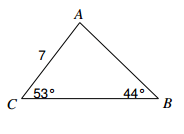
Use the appropriate Law (Sines or Cosines) to complete.


What is the measure (to the nearest degree) of angle A?

a)

50 degrees

b)

60 degrees

c)

78 degrees

d)

74 degrees

51.

Find the length of side AB.

a)

10

b)

8

c)

6.1

d)

4.9

52.

Find the length of side AC.

a)

12

b)

10

c)

23

d)

14

53.
Rewrite 34 = 81 in logarithmic form.
a)
log34 = 81
b)
log813 = 4
c)
log381 = 4
d)
log481 = 3
54.
Write 23= 8 in logarithmic form.
a)
log2 8 = 3
b)
log2 3 = 8
c)
log3 8 = 2
d)
log3 2 = 8
55.
Log with a base "e" (loge) is the same thing as...
a)
"e"
b)
Natural Logarithm (LN)
c)
Common Logarithm (Log)
d)
Natural Log, base "e"
LNe
56.
The common logarithm has what base?
a)
10
b)
0
c)
e
d)
-e
57.
Evaluate logb(b)
a)
-1
b)
0
c)
1
d)
b
58.
Evaluate:
log416
a)
2
b)
4
c)
1/2
d)
-2
59.
log5(4x-7)=log5(x+5)
a)
3
b)
12
c)
4
d)
7
60.
a)
5
b)
13
c)
84
d)
-20
61.

log2(x+3)=4

a)

16

b)

13

c)

3

d)

10

62.

log8(4x+4)=2

a)

15

b)

12

c)

10

d)

3

63.

Without a calculator, evaluate log41

a)

1/4

b)

0

c)

-1

d)

not possible

64.

 Evaluate log818Evaluate\ \log_8\frac{1}{8}  


(a)  

65.

 Evaluate log55Evaluate\ \log_5\sqrt{5}  


(a)  

66.

Rewrite as an exponential:  log93=12\log_93=\frac{1}{2}  

a)

 912=39^{\frac{1}{2}}=3  

b)

 312=93^{\frac{1}{2}}=9  

c)

 93=129^3=\frac{1}{2}  

d)

 (12)9=3\left(\frac{1}{2}\right)^9=3  

67.

Rewrite as an exponential:  log7(149)=2\log_7\left(\frac{1}{49}\right)=-2  

a)

 7149=27^{\frac{1}{49}}=-2  

b)

 (149)2=7\left(\frac{1}{49}\right)^{-2}=7  

c)

 72=1497^{-2}=\frac{1}{49}  

d)

 (2)7=149\left(-2\right)^7=\frac{1}{49}  

68.
a)
This is correct
b)
This is incorrect
69.

(x3-8x2+6x+41)÷(x-4)

a)

x2-4x-7, R 2

b)

x2-4x-11, R 1

c)

x2-2x-12, R 3

d)

x2-4x-10, R 1

70.

Use long division to divide.


(2x3 - 5x2 + 3x + 7) ÷ (x - 2)

a)

2x3 - x2 + x + 9

b)

2x2 - x + 1

c)

2x2 - x + 1 remainder 9

d)

2x2 - 9x - 15 remainder -23

71.
Find the zero(s) of the function.
a)
x = 1
b)
x = -3
c)
x = {-1, 3}
d)
x = 2
72.

Find the zeros of f(x).


f(x) = (x + 2)(x - 3)(3x - 5)

a)

x=-2, x=3, x=5/3

b)

x=2, x=-3, x=-3/5

c)

x=2, x=-3, x=5/3

d)

x=-2, x=3, x=5

73.
Solve by factoring:  2x3+ 7x2 + 6x = 0
a)
x=0, x= 3/2 and x = 2
b)
x=0, x = -3/2 and x = -2
c)
x=0, x = 6 and x = 7
d)
x=2, x = -6 and x = -7
74.
What is another way to say "where a function crosses the x-axis"?
a)
x-intercept
b)
zero
c)
root
d)
all of these.
75.

If the zeros of a polynomial are -1, 3, and 7 then what does the polynomial look like in factored form?

a)

(x-1)(x+3)(x+7)

b)

(x+1)(x-3)(x-7)

c)

-x2 + 3x + 7

d)

(x-1)

76.

f(x) = -3x4 + x3 - 2x2 + x - 1

What is the degree of f(x)?

a)

3

b)

1

c)

4

d)

2

77.

A polynomial with ONE term is called a

a)

monomial

b)

binomial

c)

trinomial

d)

none of the above

78.

Write the polynomial below in standard form.
 x2+4x386xx^2+4x^3-8-6x  

a)

 86x+x2+4x3-8-6x+x^2+4x^3  

b)

 4x3+x26x84x^3+x^2-6x-8  

c)

 4x3+x2+6x+84x^3+x^2+6x+8  

d)

 86x+4x3+x2-8-6x+4x^3+x^2  

79.

What is the constant term in the expression below?

 10y5+2y3y+710y^5+2y^3-y+7  

a)

10

b)

2

c)

7

d)

5

80.
Classify by number of terms:
3x3 – 6x
a)
Monomial
b)
Binomial
c)
Trinomial
d)
4-Term Polynomial
81.

What is the constant of this polynomial?

2x3-8x2+3x-7

a)

2

b)

-8

c)

3

d)

-7