
 Worksheets
C4 Heat
Total questions: 22
Worksheet time: 35mins

13.3°C
23.3°C
51.4°C
43.3°C

You leave your cold spoon in a hot bowl of oatmeal. What happens after an hour?
The temperature of both the oatmeal and the spoon stay the same
The spoon and the oatmeal become the same temperature
Only the temperature of the oatmeal will change
Only the temperature of the spoon will change

Which statement is correct when V and W are at thermal equilibrium?

13.3 cm
14.5 cm
15.7 cm
15.2 cm
A piece of silver is heated to 87.36 oC and dumped into a calorimeter containing 65.86 g of water at a temperature of 24.03 oC. Calculate the mass of this silver sample if the final temperature of the silver and water are 28.69 oC.
(csilver = 235 J kg-1oC-1)
(cwater = 4200 J kg-1oC-1)
0.0123 kg
0.0935 kg
93.500 kg
14819 kg
The temperature of an unknown piece of metal with a mass of 30 g changes from 25 °C to 35 °C when the metal absorbs 350 J of energy. What is the specific heat capacity of the metal?
1166.7 J kg-1°C-1
1.17 J kg-1°C-1
1000 J kg-1°C-1
0.857 J kg-1°C-1
20 g of water. specific heat of water is 4200 J kg-1°C-1. temperature changes from 25° C to 20° C, how much heat energy (Q) moves from the water to the surroundings?
418 J
430 J
420 J
42000 J


Which material heats up quickest?
Aluminium
Concrete
Diamond
Glass
Water
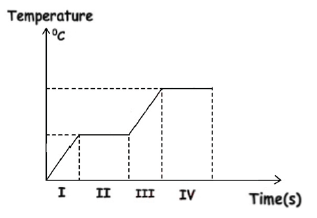
Consider the following temperature-time graph when a solid is heated. which part of the graph involves latent heat of vaporization?
Part I
Part II
Part III
Part IV
How much energy is required to change 2600 g of water at 100 ° C into steam temperature? (specific latent heat of vaporization is 2.26 x 10⁶ J kg−1 )
Q = 5.9 X 10⁶ J
M = 5.9 X 10⁶ J
C = 5.9 X 10⁶ J
Δ T = 5.9 X 10⁶ J

The graph shows the cooling curve of a substance. At which stages the specific latent heat released?
AB and CD
BC and DE
AB and EF
BC and CD
Latent heat is
the heat absorbed or released at a boiling process during a change of phase
the heat absorbed or released at a constant temperature during a change of phase
the heat absorbed or released at a constant temperature during a change of phase of 1 kg object
the heat absorbed or released by an object to increase or decrease its temperature by 1 degree Celcius
You have a gas that has a pressure of 2 × 10⁵ Pa and a volume of 1000 cm3. What would be the new volume if the pressure was changed to 1 × 10⁵ Pa?
5 000cm3
2 000 cm3
It would stay at 10 cm3
1 cm3
Consider a sample of oxygen gas at 27° C with a volume of 9550 cm3 at constant pressure. The gas is heated to 125° C. What’s the new volume?
12670 cm3
4600 cm3
15917cm3
1600 cm3
If I have 5600 cm3 of gas in a piston at a pressure of 1.5 × 10⁵ Pa and compress the gas until its volume is 4800 cm3, what will the new pressure inside the piston be?
1.75 × 10⁵ Pa
1.8 × 10⁵ Pa
1.3 × 10⁵ Pa
1.29 × 10⁵ Pa
A gas at 928 kPa at a temperature of 129 °C. Calculate the temperature at 645 kPa.
6.41 °C
279 °C
89.66 °C
34.56 °C

The pressure of the sea is higher than that on the land.
The specific heat capacity of sea water is higher than the specific heat capacity of the land.
The temperature of the land becomes higher than the temperature of the sea water.
The specific heat capacity of sea water is lower than the specific heat capacity of the land.


0.18 kg
0.36 kg
3.00 kg
5.60 kg

control the rate of melting of ice
ensure that the water used is pure
determine the average value of the specific latent heat of fusion of ice
determine the mass of ice which is melts without heating it with the heater

