
 Worksheets
7th Grade Science Final Exam (1st Semester)
Total questions: 35
Worksheet time: 35mins
Anything that has mass and takes up space is referred to as ______.
Matter
Mixture
Mass
Chemistry
The starting substance of a chemical reaction is referred to as _____.
mixture
reactant
property
product
What vocabulary term is being described: Unique characteristic that helps identify a substance.
matter
substance
property
product
The "new stuff" created by a chemical reaction is called ________.
phase change
reactant
product
chemical reaction
A __________ is described as: "substances interacting and combining to form a new substance with new properties."
chemical reaction
physical change
phase change
burning
Something is considered a ________ when it is made of one type of material all the way through. An example could be water, chalk, vinegar, or copper.
molecule
chemical
substance
solvent
Which of the following are signs for a chemical reaction? Click all that apply
phase change
color change
mass
temperature change
formation of gas
All of the following a signs that a chemical reaction occurred except ___. (there may be more than one correct choice)
mass of the substance
formation of a precipitate (solid substance)
amount/size of the substance
color change
According to scientific principle #6 properties (denstiy, hardness, melting point, solubility) of a substance will:
change because it isn't possible to stay the same if the amount changes
stay the same ONLY if the amount of the substance is the same
stay the same, even if the amount of the substance is different
change based on the amount of the substance present
Scientific principle #6 states: properties of a given substance are the same regardless of the amount of the substance. Based on this scientific principle, which options below will not change if the amount of a substance is increased?
melting point of the substance
volume of the substance
mass of the substance
density of the object
solubility of the substance
When a substance goes through a phase change ___.
molecules are rearranged in some of the substances
molecules rearrange making new substances
a chemical reaction occurs
the atoms making up molecules are not rearranged
When 2 or more substances are mixed together and the resulting substances properties HAVE NOT changed a chemical reaction has occurred.
True
False
Maybe

According to the law of conservation of mass, the number of Carbon, Hydrogen, and Oxygen atoms are the same on both sides of the chemical equation above.
True
False
Matter and atoms can not be created nor destroyed: it can only be
Destroyed a little bit
Invisible
Rearranged
None of the above


For an investigation a student added 100 mL of a blue solution of CuSO4 into a beaker. The student then placed a new, shiny, silver-colored strip of zinc metal into the solution and observed the changes. The student inferred that a chemical reaction occurred. What evidence best supports this inference?
A dark solid formed on the zinc metal.
The zinc metal remained silver-colored and shiny
The CuSO4 solution stayed blue when the zinc metal was added.
None of these

A scientist performed four investigations using eight different liquids. In each investigation, the scientist combined two of the liquids under a fume hood and recorded observations in the table below.In which investigation is it least likely that the liquids resulted in a chemical reaction?
1
2
3
4
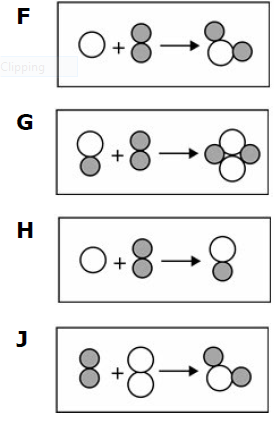
Which of the following models best demonstrates the law of conservation of mass?
F
G
H
J
How do molecules at warm temperatures differ from molecules at cool temperatures?
a. At warm temperatures, molecules move around more, so they have more TE & KE
b. At warm temperatures, molecules grow in size
c. At warm temperatures, molecules lose KE but gain TE
d. At warm temperatures, molecules loose both KE & TE


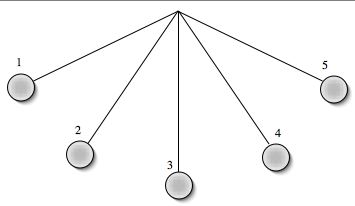
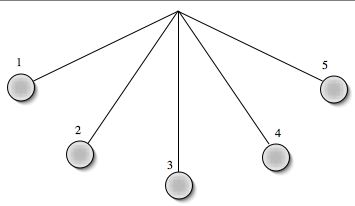
What happens to the amount of GE and KE as an object moves from point 1 to the ground at point 5.
The amount of GE and KE does not change
The amount of KE will decrease and the amount of GE will increase
The amount of GE and KE will both increase as the object moves
The amount of GE will decrease and the amount of KE will increase
Elastic potential energy is energy stored in object that are __________. (click all that apply)
at rest
stretched
compressed
dropped

At what position would a cyclist have the most KE?
A
B
D
F
At what position would a cyclist have the most GE?
A
B
D
F

The H2O in the image above are moving quickly and have a lot KE. What is the relationship between KE and TE?
As KE increases TE decreses
As TE decreases KE increases
As KE increases TE increases
As KE increases CE increases



