
Font size
 Worksheets
fundamental unit of life- II
Total questions: 18
Worksheet time: 14mins
Who discovered the nucleus of the cell?
Robert Hooke
Robert Brown
Leeuwenhoek
Purkinje
The term 'cell' was given by:
Leeuwenhoek
Robert Hooke
Flemming
Robert Brown

Identify A,B,C and D
A – Nucleus; B – Chromatin; C – Nuclear membrane; D – Nucleoplasm
A – Nucleons; B – Chromatin; C – Nuclear membrane; D – Nucleoplasm
A – Nucleolus; B – Chromatin; C – Nuclear membrane; D – Nucleoplasm
A – Nucleolus; B – Chromatin; C – Nuclear membrane; D – Nuclear wall
Nucleus contains :
Chromosomes
Chromatin
DNA
Chloroplast
----------- is known as the energy currency of the cell.
Adenosine triphosphate
deoxyribo nucleic acid
ATP
Chloroplast
First living cell was observed by
Antoin von Leeuwenhoek
Robert Hooke
Rudolph Virchow
Robert Brown
The term protoplasm was coined by
Robert Brown
M J Schleiden
Theodore Schwann
Purkinje
When we sprinkle salt on salad, water comes out because of
endosmosis
Exosmosis
Diffusion
None of the above
Cell wall of plant cells chiefly composed of
Phospholipids
Protein
Cellulose
Hemicellulose
Amoeba acquires its food through a process termed as
Endocytosis
Exocytosis
Plasmolysis
Exocytosis and endocytosis both
Rough endoplasmic reticulum contains
DNA
RNA
cellulose
Ribosome
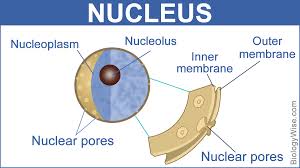
Made up of two layers (an inner and an outer), this acts like a cushiony outer shell of protection.
nucleoplasm
nuclear pores
nuclear membrane
nucleolus
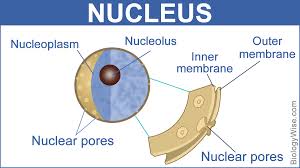
Tiny holes in the nuclear membrane that allow different cellular materials to come in and go out of the cell.
nucleus
nucleoplasm
nucleolus
nuclear pores
Why is the nucleus important?
Because is to efficiently package DNA into a small volume to fit into the nucleus of a cell and protect the DNA structure and sequence.
Because it has a close relationship to the chromosomal matter of the cell.
It contains the genetic materials which is responsible for controlling and directing all the activities of the cells.

