
 Worksheets
Basics of chromatography
Total questions: 20
Worksheet time: 12mins

Ink can be separated by a method of -----------------------------------------------
distillation
filtration
chromatography
sedimentation
What is the correct image of paper chromatography???


What is chromatography?
A way to see pretty colors
A laboratory technique used to separate a mixture.
A form of distillation
Which of the following mixture/s is/are separated by chromatography?
Pigments from natural colours
Colours in a dye
Colours of flowers extracts
All the above
If a substance is not soluble in the solvent, what happens to the spot placed on the start line?
a) Dot moves to the top of the paper
b) Dot does not move at all
c) Dot moves to the left or right
d) Dot moves down to the bottom of the paper
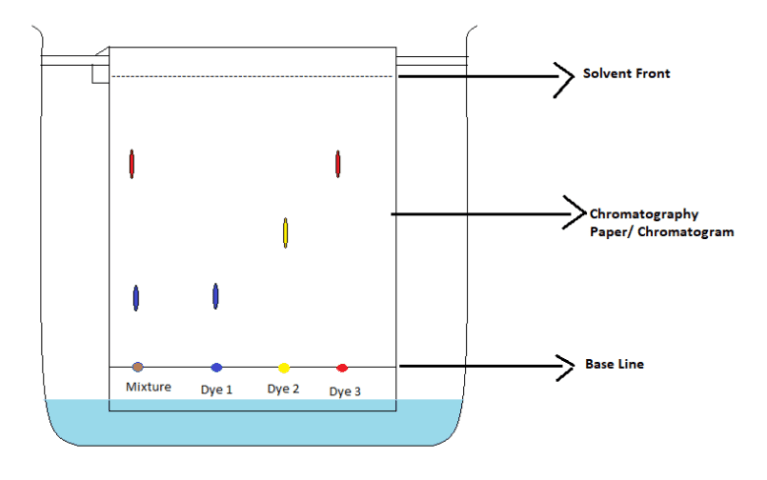
The stationary phase in this experiment is...
chromatography paper
water
beaker
dye
Thin layer chromatography is
partition chromatography
electrical mobility of ionic species
adsorption chromatography
none of the above
Ion-Exchange chromatography:
separate and analyze compounds that can be vaporized without decomposition
Also known as Liquid-Solid Chromatography
Materials used are either cation or anion resins
Separation based on partition coefficient between 2 immiscible liquids
TLC stands for...
Tender Love & Care
Thick Layer Chromatography
Thin Layer Chromatography
Thin Liquid Chromatography
The distance travelled by the compound depends on how soluble it is in the chosen solvent.
TRUE
FALSE
What is normally required to visualise the spots on a TLC chromatogram? Tick all that apply.
X-rays
Ultraviolet light
Infrared light
Developing agent
How to calculate Rf?
Rf = distance travelled by sample / distance travelled by solvent
Rf = distance travelled by solvent / distance travelled by sample

