Wayground logo

Free Printable Worksheets

Font size

S
M
L
XL
Worksheets

Final Exam Review 2023

Total questions: 101

Worksheet time: 1hrs 18mins

Name
Class
Date
1.
The Aztec capital city was built in the middle of Lake __________.
a)
Michigan
b)
Tenochtitlan
c)
Texcoco
d)
Mexico
2.
Where was the Mayan civilization located? 
a)
The Indian Ocean
b)
Nile River
c)
Euphrates River
d)
Yucatan Peninusla
3.

Much of the land that was once the Inca Empire is in which countries today?

a)

Peru and Ecuador

b)

Brazil and Paraguay

c)

Mexico and Guatemala

d)

Colombia and Venezuela

4.
Greece was a ...
a)
island
b)
peninsula
c)
isthmus
d)
glacier
5.
What is a democracy?
a)
people make the decisions
b)
government led by a dictator
c)
government with no rules
d)
government that is ruled by land owners
6.
The main city-state in Ancient Greece was...
a)
Athens
b)
Olympia
c)
Delphi
d)
Sparta
7.
the Ancient Greeks were...
a)
...polytheistic
b)
...monotheistic
c)
...both polytheistic and monotheistic
d)
...neither polytheistic and monotheistic
8.

Which of the major Roman architectural achievements helped bring water from far away springs and mountains into the cities and towns?

a)

Bridges

b)

Tunnels

c)

Aqueducts

d)

Roads

9.

The term "all roads lead to Rome" stems from their impressive achievement of creating:

a)

Aqueducts

b)

An expansive road netowork

c)

Concrete

d)

Weapons

10.

The language of Rome, which influenced future "Romance Languages" was:

a)

English

b)

Greek

c)

Latin

d)

Italian

11.
A monotheist is someone who:
a)
worships 1 god
b)
worships many gods
c)
is married to only 1 person
d)
has many spouses
12.

Title used by Egyptian rulers

a)

pharaoh

b)

Ka

c)

dynasty

d)

obelisk

13.

On what continent is Egypt?

a)

Asia

b)

Africa

c)

Europe

d)

North America

14.

What is the ancient Egyptian form of writing?

a)

cuneiform

b)

hieroglyphics

c)

Sanskrit

d)

Greek

15.
Which term best defines the concept that the earth is the center of the universe?
a)
Heliocentric
b)
Geocentric
c)
Eurocentric
d)
Egotistical
16.
Which term best defines the concept that the sun is the center of the universe?
a)
heliocentric
b)
geocentric
c)
Ethnocentric
d)
Eurocentric
17.

Who was the Italian physicist and astronomer who proved that objects of different weights, if dropped from the same height, fell at the same rate of speec. He was also responsible discovering the law of the pendulum.

a)

Galileo

b)

Vesalius

c)

Hooke

d)

Boyle

18.

Who was the English scientist who discovered the laws of gravitation?

a)

Galileo

b)

Newton

c)

Kepler

d)

Copernicus

19.
Who created an improved telescope that confirmed the findings of Copernicus?
a)
Ptolemy
b)
Nicolaus
c)
Galileo
d)
Bacon
20.

Which of these men of the Renaissance was known equally for his art as well as inventions?

a)

Rueben

b)

Leonardo da Vinci

c)

Michelangelo

d)

Aristotle

21.

Which of these changes occurred during the Renaissance?

a)

The Church was all-powerful.

b)

The Church’s power declined.

c)

Factories began using electricity.

d)

Women gained equal rights with men.

22.

• Nicolaus Copernicus

• Galileo Galilei

• Tycho Brahe

• Johannes Kepler

All of the above were famous Renaissance

a)

philosophers.

b)

priests.

c)

artists.

d)

scientists.

23.

Which of these statements reflects an influence of the Renaissance?

a)

dominance of the church

b)

constant feudal warfare

c)

lack of any governance

d)

increased interest in the arts

24.

Johann Gutenberg invented...

a)

calligraphy

b)

the astrolabe

c)

the printing press

d)

woodblock printing

25.

Luther published this, and it began the Protestant Reformation.

a)

5 Pillars of Faith

b)

24 Barons

c)

12 Tables

d)

95 Theses

26.

What provoked Luther's conscience against the Catholic Church?

a)

the calling for the Crusades to the Holy Land

b)

the sale of indulgences to fund the Church

c)

the translation of the Bible into German

d)

the undermining of the Pope's authority

27.

What allowed Luther's ideas to spread?

a)

the printing press

b)

war in Europe

c)

the Renaissance

d)

his preaching tours

28.

During the Reformation, the power of the Roman Catholic Church

a)

decreased.

b)

doubled.

c)

vanished altogether.

d)

stayed the same.

29.
In what sea was Rome a peninsula, which allowed it to prosper in trade and interact with and conquer other lands? 
a)
Red
b)
Black
c)
Mediterranean
d)
Arabian
30.
Who made himself dictator for life and was seen as a hero to the plebeians because he gave them land & food, but was power-hungry to the patricians?
a)
Julius Caesar
b)
Mark Antony
c)
Scipio
d)
Caesar Augustus
31.
By expanding the empire and reorganizing the military and government to make it safe and strong, Caesar Augustus created a new era of prosperity that lasted 200 years called 
a)
Pax Romana
b)
Golden Years
c)
Pax Augustus
d)
Age of Prosperity
32.
Who said, "I found Rome a city of brick and left it a city of marble?"
a)
Julius Caesar
b)
Cleopatra
c)
 Augustus Caesar
d)
Mark Antony
33.

Why is it called the black plague?

a)

Only white animals die from it

b)

Only black cats die from it

c)

Peoples blood goes black from internal bleeding

d)

Your head turns black as an effect

34.
Where did the Black Plague first entered Europe?
a)
Through port cities first because of trade routes.
b)
The Black Death took several centuries to spread throughout Europe.
c)
The Black Death spread from Europe to Asia in 1854.
d)
The Black Death did not affect northern Europe the most.
35.
What is another name for the Bubonic Plague?
a)
Bubonic Illiness
b)
Black Spots
c)
Black Blood
d)
Black Death
36.
What job did this person have?
a)
Farmer
b)
Bishop
c)
Pope
d)
Doctor
37.
How did the black death spread?
a)
fleas and rats
b)
beds and coats
c)
air and skin
d)
dogs and cats
38.
Which German priest started the Reformation?
a)
John Calvin
b)
Henry VIII
c)
Pope Paul III
d)
Martin Luther
39.
Luther's criticism of the Catholic Church was called what?
a)
Criticism of the Catholic Church
b)
95 Theses
c)
101 Problems with Catholics
d)
Chicken Soup for the Catholic Soul
40.
What did the Catholic Church sell to forgive sins?
a)
Forgiveness
b)
Sacraments
c)
Indulgences
d)
Confession
41.

What does renaissance mean?

a)

rebirth

b)

recreation

c)

re-acclimation

42.

Where did the Renaissance begin?

a)
Spain
b)
Italy
c)
Germany
43.

This is a famous Renaissance painting called the _______

a)
Madonna
b)
Mona Lisa
c)

Ms. Badamo

44.

Where did the Renaissance begin?

a)

Mesopotamia

b)

Japan

c)

Florence, Italy

d)

Mongolia

45.
The Printing Press 
a)
Allowed ideas to be spread faster because books were easier to get
b)
Was created by Leonardo Da Vinci
c)
Was invented by the Ottoman Turks
d)
Helped Mansa Musa spread Islam
46.
Before Julius Caesar was killed, many senators were afraid that he was planning to turn the Roman Republic into an empire.  What caused them to believe this was possible?
a)
Caesar had attempted to dissolve the Senate
b)
Caesar did not participate in Rome's government
c)
Caesar conquered large areas of land for Rome
d)
Caesar had been declared a dictator for life.
47.
How did the Roman Empire's use of roads help their economic growth?
a)
the Romans were payed well for building the roads
b)
the Romans rented their roads to other empires
c)
the roads made trading easier within the empire
d)
the roads were owned by private businesses
48.
How did the Romans carry water from mountains into cities?
a)
by combining a set of layers
b)
by combining a set of arches
c)
by building aqueducts
d)
by building a bridge
49.
Which popular Roman attraction is pictured?
a)
Colosseum
b)
Pantheon
c)
Circus Maxiums
d)
Forum
50.
Gladiator fights mostly took place in the
a)
Circus Maximus
b)
Forum
c)
Colosseum
d)
Pantheon
51.
The wealthy ruling class of Rome was called
a)
Ciceros
b)
Plebeians
c)
Visogoths
d)
Patricians
52.
The social class made up of craftsmen, merchants, and poor farmers
a)
Ciceros
b)
Patricians
c)
Visogoths
d)
Plebeians
53.

Rome's government began as a _______ and changed to an ___________.

a)

democracy, republic

b)

republic, empire

c)

empire, republic

d)

tyranny, empire

54.

How was the Roman Republic different from the Roman Empire?

a)

The Republic was very large; the Empire was fairly small.

b)

The Republic was ruled by elected representatives; the Empire was not.

c)

The Republic had no army; the Empire had a massive army.

d)

The Republic

55.
Which describes the reason for the growth of the Roman Empire?
a)
Rome's army conquered other lands
b)
Rome's rulers were very kind
c)
Rome used christianity to force others to join
d)
Rome's roads made joining the empire easy
56.
What religion was adopted by the Roman Empire after being persecuted for many years?
a)
Islam
b)
Buddhism
c)
Christianity
d)
Hunnism
57.

What is the Qur'an?

a)

A place in Arabia

b)

Bible

c)

The holy book of Islam

d)

It teaches the Arabic language

58.

What are the 5 pillars of Islam?

a)

5 things Muslims are NOT suppose to do

b)

Fasting, Belief, Prayer, Pilgrimage, Charity

c)

5 items part of the Muslim diet

d)

It is part of a famous mosque

59.

Who is the most famous Muslim prophet (messenger)?

a)

Adam

b)

Moses

c)

Abraham

d)

Muhammad

60.

What is the language of Islam?

a)

Greek

b)

Hebrew

c)

Arabic

d)

Latin

61.

A follower of Islam is called

a)

Jew

b)

Hindu

c)

Christian

d)

Muslim

62.

What is the name of the Islamic holiday that Muslims must fast between sunrise to sunset?

a)

Hanukkah

b)

Ramadan

c)

Passover

d)

Raksha Bandhan

63.

Which of the following is the Holy City of Islam?

a)

Cairo

b)

Makkah(Mecca)

c)

Baghdad

d)

Amritsar

64.
Hinduism is polytheistic.  What does that mean?
a)
Hindus believe in one God.
b)
Hindus believe in multiple gods and goddesses that control the universe.
c)
Hindus believe in more than one version of heaven.
d)
Hindus believe in multiple classes of people.
65.

The ______ is the Jewish holy book.

a)

Torah

b)

Synagogue

c)

Monotheism

66.
__________ is the belief in one god.
a)
Polytheism
b)
Monotheism
67.
A ______ is a Jewish house of worship.
a)
synagogue
b)
mosque
c)
Torah
68.

What are the 10 Commandments?

a)

Laws and guidelines on how to be a good person

b)

The Jewish Holy Book

c)

A letter God wrote to Abraham

69.
Abraham started the Jewish religion in Canaan. Where is that located today?
a)
Mesopotamia
b)
Israel
c)
Egypt
70.
____________ leads the Israelites out of Egypt and parts the Red Sea.
a)
Moses
b)
Saul
c)
David
d)
Maccabees
71.
Where are the Inca located? 
a)
Sierra Madre Mountains 
b)
Alps Mountains
c)
Andes Mountains
d)
Appalachian Mountains 
72.
What system of farming did the Inca develop in order to farm in the mountains? 
a)
Chinampas
b)
Irrigation
c)
Aqueducts
d)
Terrace Farming
73.
What was the name of the Aztec capital city?
a)
Tenochtitlan
b)
Cuzco
c)
Mexico City
d)
Haiti
74.
What did the Spanish build on the ruins of Tenochtitlan?
a)
Cuzco
b)
Machu Picchu
c)
Mexico City
d)
Fayetteville
75.
The Aztec offered _________ sacrifices to please their gods.
a)
Strange
b)
Animal
c)
Fun
d)
Human
76.
Galileo was tried for heresy because he argued  
a)
That heaven did not exist
b)
That Earth revolved around the sun
c)
Against the law of gravity
d)
That the sun revolved around the Earth
77.

Heliocentric Theory means?

a)

The sun is the middle of the universe

b)

The Earth is in the middle of the universe

c)

The Moon is in the middle of the universe

d)

Jupiter is in the middle of the universe

78.

Galileo ideas were so controversial that he was placed in?

a)

Jail

b)

Mental Institute

c)

House Arrest

79.

Geo means _____________.

a)

Sun

b)

Earth

c)

Moon

d)

Stars

80.

Helio means _________.

a)

Earth

b)

Moon

c)

Sun

d)

Stars

81.

Which theory does this picture depict.

a)

Heliocentric

b)

Geocentric

c)

Solar

d)

Moon

82.

Why was Constantinople such a prosperous city?

a)

located at the crossroads of trade

b)

Great architecture

c)

Strong autocratic rulers

d)

The pope lives there

83.

Who conquered the Byzantines in 1453?

a)

The Franks

b)

The Ottoman Turks

c)

The Holy Roman Empire

d)

The Mongols

84.

Which Byzantine emperor rebuilt the Hagia Sophia, a masterpiece of Byzantine architecture?

a)

Justinian

b)

Constantine

c)

Zeno

d)

Irene

85.

Which of the following was followed by the Eastern Orthodox Church?

a)

Practice of taxing non citizens

b)

Use of icons for worship

c)

Services conducted in Greek language

d)

Use of Latin in the holy book

86.

Which language was used by the Byzantine Church?

a)

Italian

b)

Greek

c)

Latin

d)

Russian

87.

What is the title of the head of the Roman Catholic Church?

a)

King

b)

Pope

c)

Tsar

d)

Emperor

88.
What was the capital city of the Byzantine Empire? 
a)
Rome 
b)
Athens 
c)
Constantinople 
d)
Italy 
89.

The Byzantine Empire was originally the

a)

western Roman empire

b)

eastern Turkish empire

c)

western Greek empire

d)

eastern Roman Empire

90.

What is the Justinian Code?

a)

books of laws

b)

writings of Emperor Justin

c)

religious document

d)

books of hieroglyphs

91.
What was the primary language of the Byzantine Empire?
a)
Greek 
b)
Roman
c)
Latin
d)
Turkish
92.
Constantinople served as a center for what two cultures?
a)
Greece and Rome
b)
Persia and Rome
c)
Phoenicia and Rome
d)
Greece and Hebrew
93.
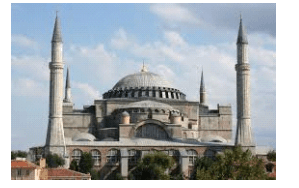
Identify this Byzantine Church that was commissioned by Justinian.
a)
Hagia Sophia
b)
National Cathedral
c)
Notre Dame
d)
Taj Mahal
94.

What church was found in the Byzantine Empire?

a)

Eastern Orthodox

b)

Roman Catholic

c)

Lutheran

d)

Methodist

95.

One economic advantage of naming Constantinople as the capital of the Eastern Roman Empire was that it __________

a)

was surrounded by protective walls.

b)

was a center of religious power.

c)

had shrunk in size.

d)

was located near trade routes between Europe and Asia.

96.

Missionary

a)

Someone who tries to convert others to a particular religion

b)

Follower of a polytheistic religion

c)

Follower of a monotheistic religion

d)

Someone who opposes authority

97.

Which of the following was a major factor in the decline of the Byzantine empire?

a)

Conversion of the Slavs

b)

Iconoclasm

c)

Attacks from invaders

d)

Recapture of Rome

98.

The city of _____________ was the capital of the Eastern Byzantine Empire.

a)

Alexandria

b)

Rome

c)

Istanbul

d)

Constantinople

99.

What is a serf?

a)

A noble who cannot leave the farm they were born on

b)

A peasant who cannot own property and must work a nobles land

c)

A knight who serves a lord for life

d)

A peasant who pays the noble to farm the noble's land

100.

What is a knight?

a)

A higher noble who owns a large amount of land

b)

A lower noble who trains for war in tournaments and jousting

c)

A lower noble who refuses to fight

d)

A peasant who fights in the noble's army

101.

Medieval knights followed rules called the code of

a)

the king

b)

the knight

c)

chivalry

d)

servitude