

wayground logo

Free Printable Worksheets

NEW

Font size

S
M
L
XL
Worksheets

Light, Sound, Air, Matter

Total questions: 80

Worksheet time: 1hrs 8mins
Name
Class
Date
1.
Waves transfer
a)
water. 
b)
wind. 
c)
energy. 
d)
particles. 
2.
Sound travels as a ___________ wave. 
a)
longitudinal
b)
transverse
c)
water
d)
slinky
3.
Sound reflecting off a surface produces a(n) 
a)
wave. 
b)
echo. 
c)
transverse. 
d)
reflection. 
4.
How high or low a sound is, is that sound's
a)
wave. 
b)
pitch. 
c)
longitude. 
d)
amplitude. 
5.
Something that emits light is known as a(n) _____   _____. 
a)
light source
b)
flashlight
c)
light saber
d)
reflect
6.
A narrow beam of light that travels in a straight line. 
a)
lightning
b)
flood light
c)
light ray
d)
light weight
7.
If you see an object as orange,
a)
it is absorbing orange light and reflecting all other colors. 
b)
it is reflecting all colors. 
c)
it is absorbing all colors. 
d)
it is reflecting orange light and absorbing all other colors. 
8.
If you cannot see through an object, in other words, light does not pass through it,  it is 
a)
transparent.
b)
translucent.
c)
opaque.
d)
solid.
9.
This type of material allows most light to pass through but forms a blurry image, like looking through a fogged up window.
a)
opaque
b)
translucent
c)
transparent
d)
echo
10.
Sound waves are ___________ waves that can only travel through ______.
a)
transverse,   air
b)
transverse, matter
c)
longitudinal, liquids
d)
longitudinal, matter
11.
A sound wave can travel through a vacuum or empty space.
a)
True
b)
False
12.
Any reflecting surface is known as a(n)
a)
opaque object.
b)
mirror.
c)
lens.
d)
glass.
13.
A ______ has at least one curved side and causes light to bend.
a)
light
b)
mirror
c)
lens
d)
retina
14.
Sound intensity is measured in units called ________ named after Alexander Graham Bell.
a)
tones
b)
hertz
c)
amplitudes
d)
decibels
15.
A sound wave requires a medium, or material to travel through.
a)
True
b)
False
16.
A green plant appears green because it is absorbing all colors except
a)
yellow.
b)
blue.
c)
red.
d)
green.
17.
Glasses and contacts contain ______ which bend light to hit your retina correctly.
a)
lenses
b)
glass
c)
polish
d)
coatings
18.
The distance from one point on a wave to that same point on the next wave is known as
a)
amplitude.
b)
frequency.
c)
wavelength.
d)
reflection.
19.
When light shines through a prism it creates a ________________
a)
colors
b)
ROY G. BIV
c)
spectrum
d)
electromagnetic wave
20.
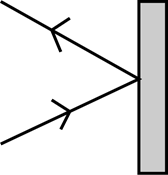
The illustration shows a light ray striking an object.
In the illustration, the light ray striking the object is-
a)
absorbed
b)
stopped
c)
reflected
d)
refracted
21.
What do we call this tool that separates white light into the colors of the Visible Spectrum?
a)
tuning fork
b)
prism
c)
microscope
d)
graduated cylinder
22.
What is light?
a)
waves
b)
energy
c)
the sun
d)
a source
23.
Sound is caused by....
a)
molecules
b)
vibrations
c)
people
d)
space
24.
Sound does not travel in space because
a)
Space is too far away.
b)
There is no matter in space.
c)
Space is the final frontier
d)
Space has planets.
25.
What medium (solid, liquid, gas) does sound travel fastest through?
a)
solid
b)
liquid
c)
gas
26.
Sound is a form of? 
a)
energy
b)
pitch
c)
volume
27.
Sound travels FASTEST through which of these materials?
a)
Air
b)
Empty space
c)
Metal
d)
Water
28.
How are light and sound ALIKE?
a)
Both travel as rays
b)
Both can vary in pitch
c)
Both depend on vibrations in air
d)
Both are forms of energy that travel as waves
29.
The frequency of a sound wave determines it _________.
a)
amplitude
b)
energy
c)
pitch
d)
volume
30.
Sally's voice is higher pitched than Lucy's.  Which is true?
a)
Lucy speaks at a higher volume than Sally.
b)
Sally can speak at a higher amplitude than Lucy.
c)
Sally speaks at a greater range of frequencies than Lucy
d)
Sally's vocal cords vibrate faster than Lucy's
31.
The bending of light as it moves from one transparent material to another
a)
reflection
b)
refraction
c)
spectrum
d)
pitch
32.
Volume describes
a)
how high or low a sound is
b)
how loud or quiet a sound is
c)
how long the sound lasts
d)
how beautiful the sound is
33.
A black cat
a)
reflects black light
b)
absorbs all colors of light
c)
reflects all colors of light
d)
reflects white light
34.
A pink kite ______.
a)
absorbs pink light and reflects the other colors
b)
reflects pink light and absorbs all the other colors
c)
absorbs all the colors
d)
reflects all the colors
35.
What is this?
a)
Concave lens
b)
Convex lens
c)
Prism
d)
Sound Wave
36.
What is this?
a)
Concave Lens
b)
Convex Lens
c)
Prism
d)
Sound Wave
37.
A __________ separates white light into all the colors of the spectrum.
a)
concave lens
b)
convex lens
c)
prism
d)
mirror
38.
Light travels in a ___________ path.
a)
straight
b)
cury
c)
bent
d)
winding
39.
What does the term pitch describe?
a)
a high point of a wave
b)
how low or high a sound is
c)
how loud or soft a sound is
d)
the matter through which a wave travels
40.
a)
reflection
b)
refraction
41.
What are the three states of matter?
a)
solid, liquid, and gas
b)
solid, water, and gas
c)
wood, liquid, and gas
d)
solid, liquid, and helium
42.
Solids have a definite _______________.
a)
smell
b)
shape
c)
picture
d)
sound
43.
Liquid matter takes the shape of _______.
a)
a gas
b)
water
c)
a pet
d)
Its container
44.
When a solid is turned into a liquid, the solid _______________.
a)
melts
b)
freezes
c)
turns into a gas
d)
floats
45.
The amount of matter something contains is its ______________.
a)
gas
b)
solid
c)
weight
d)
mass
46.
________________ is anything that has mass and takes up space.
a)
volume
b)
matter
c)
mass
d)
weight
47.
What can causes ice to transform from a solid to a liquid?
a)
The air.
b)
The cold.
c)
Shape
d)
Heat
48.
Which state of matter has particles that are tightly packed?
a)
liquid
b)
gas
c)
solid
49.
The amount of space something takes up
a)
density
b)
volume
c)
mass
d)
matter
50.
You can measure ______ with grams.
a)
mass
b)
volume
c)
conductivity
d)
melting point
51.
Which state of matter has particles arranged like this?
a)
solid
b)
liquid
c)
gas
52.

What is the definition of matter?

a)

Anything that has mass and takes up space

b)

A substance that is liquid, solid, or gas

c)

Anything that is pure

d)

Anything that you can see or hold

53.

What term means "take up space"

a)

Volume

b)

Matter

c)

Mass

d)

Substance

54.

What term refers to a single kind of matter that is pure?

a)

Solution

b)

Mixture

c)

Substance

d)

Matter

55.

What term refers to "two or more substances combined physically, but are still able to be separated?"

a)

Mixture

b)

Solution

c)

Matter

d)

Combination

56.

What term refers to "two or more substances combined physically, but are still able to be separated?"

a)

Mixture

b)

Solution

c)

Matter

d)

Combination

57.

Which of the following is NOT an example of matter?

a)

Sunlight

b)

Air

c)

Tree trunk

d)

Sponge

58.
__________ are the building blocks of life.
a)
solids
b)
gases
c)
atoms
d)
nutrients
59.
I am 2 or more elements chemically bonded.
a)
atom
b)
molecule
c)
compound
d)
mixture
60.
Which 2 kinds of particles make up the nucleus of an atom?
a)
electrons and neutrons
b)
electrons and nuclei
c)
protons and neutrons
d)
protons and kryptons
61.
Which particle carries a negative charge?
a)
protons
b)
neutrons
c)
electrons
62.
A pure substance that cannot be broken down into any other substance by chemical or physical means. There are about 100 of us shown in the Periodic Table
a)
compound
b)
mixture
c)
molecule
d)
element
63.
Type of matter made of two or more elements...
a)
element
b)
mixture
c)
compound
64.
Neutrons have a ________ charge.
a)
positive
b)
negative
c)
neutral
65.

What is the smallest unit of matter that has properties of that element?

a)

Molecule

b)

Compound

c)

Mixture

d)

Atom

66.

Elements and compounds are examples of...

a)

Pure Substance

b)

Mixture

c)

Both

d)

None of these

67.

The combination of two or more substances that are NOT chemically combined is called a ___________________.

a)

Compound

b)

Pure Substance

c)

Mixture

d)

Element

68.

Why does a balloon expand when it is heated?

a)

The air particles move less so they need less room

b)

The air particles move more so they need less room

c)

The air particles move more so they need more room

d)

The air particles move less so they need more room

69.

Which of the following images best represents the particle model of a liquid?

a)
b)
c)
70.

When water freezes to form ice, energy is...

a)

Absorbed

b)

Released

c)

Created

d)

Destroyed

71.

The dew that is found on grass in the mornings is an example of which phase change?

a)

Melting

b)

Condensation

c)

Sublimation

d)

Deposition

72.

Phase changes in matter occur when _____________ is either released or absorbed.

a)

Plasma

b)

Liquid

c)

Mass

d)

Energy

73.

What is observed or measured without changing the substance?

a)

Physical property

b)

Chemical change

c)

Chemical property

d)

Physical change

74.
What type of matter is sand?
a)
Element
b)
Compound
c)
Heterogeneous Mixture
d)
Homogeneous Mixture
75.
What type of matter is copper wire?
a)
Element
b)
Compound
c)
Heterogeneous Mixture
d)
Homogeneous Mixture
76.
What type of matter is aluminum foil?
a)
Element
b)
Compound
c)
Heterogeneous Mixture
d)
Homogeneous Mixture
77.
The smallest particles having the same properties of an element is a (an)
a)
molecules
b)
ions and charged electrons
c)
atoms
d)
elements
78.
Elements can be described at
a)
cannot be categorized with with other substances
b)
cannot be combined with other substances
c)
cannot be broken down into simpler substances
d)
cannot be separated from other substances
79.
A _________ mixture is mixed well & you cannot see the individual parts.
a)
homogeneous
b)
heterogeneous
80.
_________ can be separated through physical means.
a)
Compounds
b)
Mixtures
c)
Elements
