wayground logo

Free Printable Worksheets

NEW

Font size

S
M
L
XL
Worksheets

Grade 6 Mega Quizizz

Total questions: 60

Worksheet time: 30mins

Name
Class
Date
1.

All living things or organisms in an ecosystem are

a)

None

b)

biotic factors

c)

abiotic factors

2.

Which of the following is NOT a biotic factor?

a)

Coyote

b)

air

c)

elephant

3.

Temperature is a(n)

a)

Biotic Factor

b)

Abiotic Factor

4.

Bacteria are

a)

Biotic factors

b)

Abiotic factors

5.
What is a producer?
a)
an organism that gets energy from eating other organisms
b)
an organisms that uses sunlight to make its own food
c)
an organism that gets energy from eating dead organisms, non-living material or waste
d)
an organism that uses chemical energy to make its own food
6.
What is a herbivore?
a)
an animal that gets energy from eating other animals
b)
an organism that gets energy from eating only plants
c)
an animal that gets energy by eating both plants and other animals
d)
an animal that eats only herbs
7.
What is a carnivore?
a)
an animal that gets energy by eating other animals
b)
An animal that gets energy by eating only plants
c)
an animal that gets energy by eating both plants and animals
d)
an animal that makes its own energy through photosynthesis
8.

Which biome is the driest? It receives less than 10 inches of rain a year.

a)

desert

b)

grassland

c)

deciduous forest

d)

tropical rain forest

9.

symbiotic relationship in which both organisms benefit

a)

competition

b)

mutualism

c)

predation

d)

commensalism

10.

symbiotic relationship in which one organisms benefits and the other organism is not affected

a)

competition

b)

mutualism

c)

parasitism

d)

commensalism

11.

In which biome would you find giraffes and elephants?

a)

desert

b)

deciduous forest

c)

savanna

d)

tundra

12.

Plants use _______________________ to make their own food.

a)

Carbon Dioxide

b)

Oxygen

c)

Materials

d)

Gravity

13.

Which of the following removes carbon dioxide from the atmosphere?

a)

Combustion

b)

Respiration

c)

Photosynthesis

d)

Death

14.

Which gas do plants release, that humans depend on for survival?

a)

Water

b)

Carbon Dioxide

c)

Oxygen

d)

Sugar

15.
All of the different populations that live in a specific area.
a)
ecosystem
b)
habitat
c)
ecology
d)
community
16.
The place where an organism lives that provides it with shelter, food and water.
a)
ecosystem
b)
population
c)
community
d)
habitat
17.
An organism made of one cell is called
a)
unicellular organism
b)
multicellular organism
18.

An organism made of two or more cells is called

a)

unicellular organism

b)

multicellular organism

19.
Bacteria are prokaryotes.
a)
True
b)
False
20.

Which type of cell has membrane bound organelles?

a)

Prokaryotic Cells

b)

Bacteria Cells

c)

Eukaryotic Cells

d)

E-coli bacterium

21.

Which type of cell appeared first on Earth?

a)

Prokaryotic Cells

b)

Eukaryotic Cells

c)

Animal Cells

d)

Plant Cells

22.

the brain of the cell

a)

cell membrane

b)

nucleus

c)

mitochondria

23.
jelly like substance in cell
a)
cytokseleton
b)
chloroplast
c)
central vacuole
d)
cytoplasm
24.
provides structure and support in plant cells
a)
cytokseleton
b)
cell wall
c)
central vacuole
d)
cytoplasm
25.
place of cellular respiration
a)
mitochondria
b)
nucleus
c)
nucleolus
d)
golgi
26.
Protects plants cells and helps plants stand upright. Makes treebark rough and rigid.
a)
Cell wall
b)
Cell membrane
c)
Cytoskeleton
d)
Cytoplasm
27.

the green pigment inside the chloroplast

a)

cytoplasm

b)

chlorophyll

c)

cell membrane

28.

Which of the following do ONLY plant cells have?

a)

Molecule

b)

Chloroplast and Cell Wall

c)

DNA

d)

Nucleus

29.

Groups of similar cells that work together.

a)

cell

b)

tissue

c)

organ

d)

organ system

e)

organism

30.

A living thing that is made up of organ systems.

a)

cell

b)

tissue

c)

organ

d)

organ system

e)

organism

31.
All matter is made of 
a)
energy 
b)
atoms 
c)
electrons 
d)
compounds 
32.
What are the 3 particles that make-up the atom?
a)
protons, neutrons, and isotopes
b)
neutrons, isotopes, and electrons
c)
positives, negatives, and electrons
d)
protons, neutrons, and electrons
33.
Particles in an atom that are neutral and have no charge are 
a)
negatrons 
b)
electrons 
c)
neutrons 
d)
protons 
34.
The particles that are found in the nucleus of an atom are
a)
neutrons and electrons
b)
electrons only
c)
protons and neutrons
d)
protons and electrons
35.

The negative particles of an atom are

a)

electrons

b)

positrons

c)

neutrons

d)

protons

36.
A molecule is made up of ____ or more atoms.
a)
1
b)
2
c)
3
d)
4
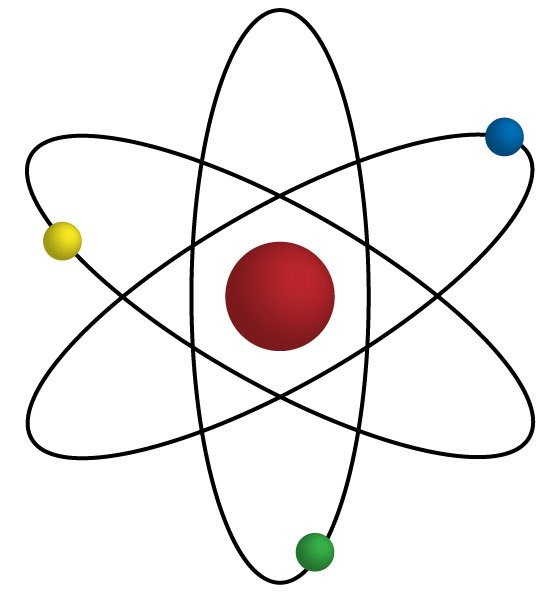
37.
What is the picture displayed?
a)
atom
b)
element
c)
molecule/compound
d)
cells
38.

This tells you how many protons are in each atom of a specific element, it is also known as the ID number of an element:

a)

atomic number

b)

atomic mass

c)

chemical formula

d)

chemical symbol

39.

How many H atoms are in H2O?

a)

1

b)

2

40.
What do we call a chemical substance made up of 2 or more different types atoms bonded together?
a)
formula
b)
atom
c)
subscript
d)
compound
41.

Hot things have ____________ thermal energy than cold things

a)

more

b)

less

c)

same

d)

potato

42.

As temperature increases, molecules _____________

a)

move slower

b)

move the same

c)

move faster

d)

stop moving

43.

Do molecules ever STOP moving entirely?

a)

No, Molecules never stop moving

b)

Yes, as soon as they turn solid!

44.
What two types of measurements make up DENSITY
a)
Mass and Volume
b)
Temperature and Mass
c)
Grams and Centimeters
d)
Volume and Weight
45.
Which state of matter has the highest kinetic energy (atoms move the fastest)?
a)
solid
b)
liquid 
c)
gas
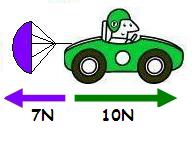
46.

What is the net force?

a)

3 N

b)

3 N, right

c)

17 N, right

d)

3 N, left

47.
What is the net force?
a)
20 N 
b)
0 N 
c)
400 N 
d)
40 N 
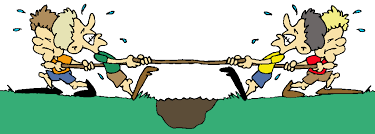
48.
If these teams are pulling with the same amount of force what will happen?
a)
The boy in blue will win.
b)
They will not move at all.
c)
The boy in red will win.
d)
Both will fall down.
49.

Forces that have a net force of zero Newtons

a)

Balanced force

b)

Unbalanced force

50.
What will cause an object to move?
a)
Applied forces
b)
Balanced forces
c)
Unbalanced forces
51.

The subatomic particles responsible for electricity and magnetism are called...

a)

electrons

b)

neutrons

c)

protons

d)

photons

52.
Rougher surfaces have ...
a)
greater friction
b)
less friction
c)
the same level of friction
53.

Mass is the amount of matter in an object.

a)

True

b)

False

54.

What's the difference between speed and velocity

a)

Speed is a scalar quantity (just a number).

While velocity also implies a direction (number + direction)

b)

They are the same thing

c)

The velocity is just a number, while speed informs the direction

55.

pulls objects toward Earth’s surface

a)

friction

b)

effort force

c)

gravity

d)

resistance force

56.

Newton's second law states.....

a)

If there is more mass then there is more acceleration

b)

An object at rest wants to be in motion

c)

Force = Mass x Acceleration

d)

The force exerted on an object is not related to mass or acceleration

57.

What is inertia?

a)

An object that is accelerating

b)

Gravitational force

c)

An objects tendency to stay at rest or in motion

d)

An unbalanced force

58.

Newton's third law states.......

a)

For each action there is a larger reaction associated with it.

b)

None of these choices

c)

For each action there is an equal and opposite reaction.

d)

For each action there is a smaller reaction associated with it.

59.

What is the unit to MEASURE force?

a)

Kilogram

b)

Meter

c)

Pounds

d)

Newton

60.

The net force acting on the object is acting _____.

a)

17N to the Right

b)

17N to the Left

c)

20N Up

d)

10N Down