
 Worksheets
P.3.4.1 Mechanics
Total questions: 167
Worksheet time: 2hrs 36mins
Two spheres, P and Q, have the same volume but P has a greater mass. The spheres fall in air at their terminal velocities vP and vQ respectively. Which row states the relationship between vP and vQ and the reason?
Relationship between vP and vQ : vP = vQ
Reason: Terminal velocity is unaffected by mass
Relationship between vP and vQ : vQ > vP
Reason: The mass of Q is less and it accelerates more
Relationship between vP and vQ : vQ > vP
Reason: P reaches equilibrium at a lower terminal velocity
Relationship between vP and vQ : vP > vQ
Reason: Q reaches equilibrium at a lower terminal velocity

An aircraft is flying due north through still air with a speed v
The aircraft enters a region where the wind is blowing with a speed u from a direction which makes an angle of θ with due south.
What is the time taken for the aircraft to fly a distance D due north of its current position in this windy region?


Three coplanar forces F1, F2 and F3 act on a point object.
Which combination of forces can never produce a resultant force of zero?
A
B
C
D

The diagram shows a gas particle about to collide elastically with a wall.
Which diagram shows the correct change in momentum Δmv that occurs during the collision?


Which row correctly states whether momentum, mass and velocity are scalar or vector quantities?
A
B
C
D

The diagram shows the path of a projectile launched from ground level with a speed of 25 m s–1 at an angle of 42° to the horizontal. What is the horizontal distance from the starting point of the projectile when it hits the ground?
23 m
32 m
47 m
63 m
Which of the following is a scalar quantity?
kinetic energy
momentum
force
acceleration

What is correct for the quantities impulse and force?
A
B
C
D
Which of the following is a scalar quantity?
acceleration
distance
displacement
momentum
Two forces of 6 N and 10 N act at a point. Which of the following could not be the magnitude of the result?
16 N
8 N
5 N
3 N
Which is a scalar quantity?
momentum
weight
power
moment

A small sphere, of mass m and carrying a charge Q, is suspended from a thread and placed in a uniform horizontal electric field of strength E. When the sphere comes to rest the thread makes an angle θ with the vertical and the tension in it is T, as shown in the diagram. W is the weight of the sphere and F is the electric force acting on it.
Under these conditions, which one of the following equations is incorrect?
T sin θ = EQ
T = mg cosθ + EQ sinθ
T2 = (EQ)2 + (mg)2
mg = EQ tanθ

Which line, A to D, in the table shows correctly whether the moment of a force, and momentum, are scalar or vector quantities?
A
B
C
D
Coplanar forces of 5 N, 4 N and 3 N act on an object. Which force, in N, could not possibly be the resultant of these forces?
0
4
12
16

Which one of the following pairs contains one vector and one scalar quantity?
A
B
C
D

The rectangular objects, A, B, C and D are each 2 cm long and 1 cm high. Which one of the bodies is in equilibrium?
A
B
C
D

A pivoted metre rule is supported in equilibrium horizontally by a thread inclined at 30° to the vertical.
The three forces acting on the rule are:
its weight W;
the tension T in the thread;
the reaction force R at the pivot.
Which one of these diagrams, drawn to scale, represents the magnitudes and directions of these three forces?


A bird sits on a uniform rod suspended from vertical wires P and Q.
The rod has a weight W and is 15.0 cm long. The weight of the bird is 2W and acts at a distance x from P.
What is the value of x when the tension in P is half the tension in Q?
7.50 cm
10.0 cm
11.3 cm
15.0 cm

A non-uniform sign is 0.80 m long and has a weight of 18 N. It is suspended from two vertical springs P and Q. The springs obey Hooke’s law and the spring constant of each spring is 240 N m–1
The top end of spring P is fixed and the top end of spring Q is adjusted until the sign is horizontal and in equilibrium. What is the extension of spring Q?
0.014 m
0.038 m
0.049 m
0.061 m

The diagram shows a uniform metre ruler of weight 1.5 N pivoted 15 cm from one end for use as a simple balance.
A scale pan of weight 0.5 N is placed at the end of the ruler and an object of unknown weight is placed in the pan. The ruler moves to a steady horizontal position when a weight of 2.5 N is added at a distance of 60 cm from the pivot as shown.
What is the weight of the object?
9.5 N
10.0 N
13.0 N
13.5 N
A light uniform rigid bar is pivoted at its centre. Forces act on the bar at its ends and at the centre.
Which diagram shows the bar in equilibrium?


A car bonnet, represented by QP, of mass 12 kg is pivoted at P. Its weight acts at G where QG = GP = 1.0 m.
What force, F, acting perpendicular to QP as shown, is required to hold the bonnet at 30° to the horizontal?
29 N
51 N
59 N
136 N
A body of mass 4 kg falls vertically through the air.
What is the acceleration of the body when the magnitude of the air resistance is 30 N?
17.3 m s−2
7.7 m s−2
2.3 m s−2
.4 m s−2

A car wheel nut can be loosened by applying a force of 200 N on the end of a bar of length 0.8 m as in X. A car mechanic is capable of applying forces of 500 N simultaneously in opposite directions on the ends of a wheel wrench as in Y.
What is the minimum length l of the wrench which would be needed for him to loosen the nut?
0.16 m
0.32 m
0.48 m
0.64 m
Four rectangular loops of wire A, B, C and D are each placed in a uniform magnetic field of the same flux density B. The direction of the magnetic field is parallel to the plane of the loops as shown.
When a current of 1 A is passed through each of the loops, magnetic forces act on them. The lengths of the sides of the loops are as shown. Which loop experiences the largest couple?


The diagram shows a vertical square coil whose plane is at right angles to a horizontal uniform magnetic field B. A current, I, is passed through the coil, which is free to rotate about a vertical axis OO'.
Which one of the following statements is correct?
The forces on the two vertical sides of the coil are equal and opposite.
A couple acts on the coil.
No forces act on the horizontal sides of the coil.
If the coil is turned through a small angle about OO' and released, it will remain in position.

Which line, A to D, in the table shows correctly whether the moment of a force, and momentum, are scalar or vector quantities?
A
B
C
D

In the system shown a light rigid beam, pivoted at X, is held in position by a string which is fixed at Y. The beam carries a load of 200 N. The load is moved towards X. Which one of the following statements is correct?
The tension in the string increases
The compression force in the beam increases
The moment of the load about X increases
The magnitude of the vertical component of the reaction at X increases

A uniform square block is sliding with uniform speed along a rough surface as shown in the diagram.
The force used to move the block is 200 N. The moment of the frictional force acting on the block about the centre of gravity of the block is
150 N m, clockwise
150 N m, anticlockwise
300 N m, clockwise
300 N m, anticlockwise

The rectangular objects, A, B, C and D are each 2 cm long and 1 cm high. Which one of the bodies is in equilibrium?
A
B
C
D

The diagram shows a uniform door hanging from two hinges 2.5 m apart.
The moment of the couple that the hinges exert on the door is
150 N m
200 N m
250 N m
500 N m
A girl is bouncing on a trampoline.
Assuming that air resistance is negligible, her acceleration
is zero when she is at maximum height.
is constant when she is in the air.
changes direction as she rises and then falls.
is maximum just before she lands on the trampoline.

An aircraft is flying due north through still air with a speed v.
The aircraft enters a region where the wind is blowing with a speed u from a direction which makes an angle of θ with due south.
What is the time taken for the aircraft to fly a distance D due north of its current position in this windy region?


A mass of 2.5 kg is released from rest at X and slides down a ramp, of height 3.0 m, to point Y as shown.
When the mass reaches Y at the bottom of the ramp it has a velocity of 5.0 m s–1.
What is the average frictional force between the mass and the ramp?
8.5 N
10.6 N
14.7 N
24.5 N

Which row gives two features of graphs that provide the same information?
A
B
C
D

Which graph best represents the velocity–time graph for a ball that is dropped from rest and bounces repeatedly?
A
B
C
D

A body travels with speed v, which varies with time t as shown in the graph.
Which one of the graphs shows how the distance s covered by the body varies with time t?


A firework is fired vertically up into the air and subsequently falls to the ground.
Which quantity relating to the motion of the rocket is never zero before it hits the ground? Assume that air resistance is negligible.
acceleration
velocity
momentum
kinetic energy

An object is accelerated from rest by a constant force F for a time t. Which graphs represent the variation of time with the change in the kinetic energy and the change in momentum of the object?
A
B
C
D
An object is dropped from a cliff. How far does the object fall in the third second?
Assume that g = 10 m s–2.
10 m
20 m
25 m
45 m

A car accelerates uniformly from rest along a straight road. Which graph shows the variation of displacement x of the car with time t?
A
B
C
D
A ballbearing X of mass 2m is projected vertically upwards with speed u. A ballbearing Y of mass m is projected at 30° to the horizontal with speed 2u at the same time. Air resistance is negligible. Which of the following statements is correct?
The horizontal component of Y's velocity is u.
The maximum height reached by Y is half that reached by X
X and Y reach the ground at the same time.
X reaches the ground first.
What is the relationship between the distance y travelled by an object falling freely from rest and the time x the object has been falling?
y is proportional to x2
y is proportional to √x
y is proportional to 1/x
y is proportional to 1/x2

The velocity of a vehicle varies with time as shown by the following graph.
Which graph below represents how the resultant force F on the car varies during the same time?


The velocity–time graph for a falling object is shown.
Which of the following shows the corresponding acceleration–time graph?


A girl jogs at 2.0 m s–1 in a straight line for 30 seconds, turns around and returns to her starting point 20 seconds later.
What is her average velocity and average speed?
A
B
C
D
A roller coaster car is raised to a height of 65 m and released from rest.
What is the maximum possible speed of the car?
11 m s−1
25 m s−1
36 m s−1
130 m s−1

The graph shows how the force acting on a body changes with time.
The body has a mass of 0.25 kg and is initially at rest. What is the speed of the body after 40 s assuming no other forces are acting?
200 ms–1
400 ms–1
800 ms–1
1600 ms–1
Take the acceleration due to gravity, gE, as 10 ms−2 on the surface of the Earth.
The acceleration due to gravity on the surface of the Moon is gE/6 . An object whose weight on Earth is 5.0 N is dropped from rest above the Moon’s surface. What is its momentum after falling for 3.0s?
2.5 kg m s−1
6.2 kg m s−1
15 kg m s−1
25 kg m s−1

A body is accelerated from rest by a constant force.
Which one of the following graphs best represents the variation of the body’s momentum p with time t?
A
B
C
D
A lunar landing module is descending to the Moon’s surface at a steady velocity of 10.0 m s–1. At a height of 120 m a small object falls from its landing gear. Assuming that the Moon’s gravitational acceleration is 1.60 m s–2, at what speed, in m s–1 does the object strike the Moon?
22.0
19.6
16.8
10.0
A steel ball of weight W falls through oil. At a time before the ball reaches terminal velocity, the magnitude of the viscous resistance force on the ball is
zero
between zero and W
equal to W
greater than W

The diagram shows a strobe photograph of a mark on a trolley X, moving from right to left, in collision with another trolley Y which had no mark on it.
After the collision both trolleys are in motion together.
Which one of the following is consistent with the photograph?
Trolley Y has the same mass as trolley X and was initially stationary
Trolley Y had a smaller mass than X and was moving from right to left
Trolley Y had the same mass and was initially moving left to right at the same speed as trolley X
Trolley Y had the same mass and was initially moving left to right at a higher speed than trolley X

A perfectly elastic rubber ball falls vertically from rest and rebounds from the floor. Which one of the following velocity-time, v–t, graphs best represents the motion from the moment of release to the top of the first rebound?
A
B
C
D

Two spheres, P and Q, have the same volume but P has a greater mass. The spheres fall in air at their terminal velocities vP and vQ respectively.
Which row states the relationship between vP and vQ and the reason?
A
B
C
D

A projectile is launched with a speed of 25 m s–1 at an angle of 35° to the horizontal, as shown in the diagram.
Air resistance is negligible. What is the time taken for the projectile to return to the ground?
1.5 s
2.1 s
2.9 s
4.2 s
Two identical balls, X and Y, are at the same height and a horizontal distance of 25 cm apart.
X is projected horizontally with a velocity of 0.10 m s–1 towards Y at the same time that Y is released from rest. Both X and Y move freely in the absence of air resistance.
What is the distance between the balls 1.0 s later?
0.15 m
0.25 m
2.4 m
4.9 m

The diagram shows the path of a projectile launched from ground level with a speed of 25 m s–1 at an angle of 42° to the horizontal.
What is the horizontal distance from the starting point of the projectile when it hits the ground?
23 m
32 m
47 m
63 m
A stone of mass 0.4 kg is projected horizontally at a speed of 6.0 m s−1 from the top of a wall, 5.0 m above the surrounding ground. When it arrives at the ground its speed is 10 m s−1.
How much energy is lost by the stone in falling through the air?
2.4 J
6.8 J
12.8 J
14.4 J

A ball of mass 0.20 kg is thrown and moves in a curved path, as shown below. At Q it is travelling horizontally.
Assume air resistance is negligible. What is the momentum of the ball at Q?
zero
2.0 N s
3.5 N s
4.0 N s
A ballbearing X of mass 2m is projected vertically upwards with speed u. A ballbearing Y of mass m is projected at 30° to the horizontal with speed 2u at the same time. Air resistance is negligible. Which of the following statements is correct?
The horizontal component of Y's velocity is u.
The maximum height reached by Y is half that reached by X
X and Y reach the ground at the same time.
X reaches the ground first.
A golf ball was hit from the surface of the Moon. The time of flight was 4.0 s. What is the best estimate for the maximum height reached by the ball?
acceleration due to gravity on the Moon = 1.6 m s–2
3 m
15 m
40 m
80 m
A golf ball was hit from the surface of the Moon. The time of flight was 4.0 s. What is the best estimate for the maximum height reached by the ball?
acceleration due to gravity on the Moon = 1.6 m s–2
3 m
15 m
40 m
80 m

Which line, A to D, in the table correctly describes the trajectory of charged particles which enter separately, at right angles, a uniform electric field, and a uniform magnetic field?
A
B
C
D
A ball X is projected horizontally from a certain point at the same time as a ball Y of the same diameter but twice the mass is released from rest and allowed to fall vertically from the same level. Air resistance is negligible. Which one of the following will occur?
Y will hit the floor just before X
X will hit the floor just before Y
X and Y will hit the floor at the same time
Y hits the floor while X is half way to the floor
Immediately after take-off from the surface of the Earth, a rocket of mass 12 000 kg accelerates vertically upwards at 1.4 m s–2
What is the thrust produced by the rocket motor?
1.7 × 10⁴ N
1.0 × 10⁵ N
1.3 × 10⁵ N
1.6 × 10⁵ N
A rocket of mass 12 000 kg accelerates vertically upwards from the surface of the Earth at 1.4 m s−2.
What is the thrust of the rocket?
1.7 × 10⁴ N
1.7 × 10⁵ N
1.3 × 10⁵ N
1.6 × 10⁵ N
A particle of mass m and charge q is accelerated through a potential difference V over a distance d.
What is the average acceleration of the particle?


A firework is fired vertically up into the air and subsequently falls to the ground.
Which quantity relating to the motion of the rocket is never zero before it hits the ground? Assume that air resistance is negligible.
acceleration
velocity
momentum
kinetic energy

A lift and its passengers with a total mass of 500 kg accelerates upwards at 2 m s–2 as shown. Assume that g = 10 m s–2.
What is the tension in the cable?
1000 N
4000 N
5000 N
6000 N
Which of the following statements is correct?
The force acting on an object is equivalent to
its change of momentum.
the impulse it receives per second.
the energy it gains per second.
its acceleration per metre.

Two masses hang at rest from a spring, as shown in the diagram. The string separating the masses is burned through.
acceleration of free fall = g
Which of the following gives the accelerations of the two masses as the string breaks?
A
B
C
D
An object falls freely from rest. After falling a distance d its velocity is v. What is its velocity after it has fallen a distance 2d?
2 v
4 v
2 v2
√2 v
A deep-space probe travelling forward at constant speed is briefly acted on by a force at right angles to its motion.
What is the effect of this force on the forward speed and sideways speed of this probe?
its forward speed increases and sideways speed increases
its forward speed decreases and sideways speed increases
its forward speed is unchanged and sideways speed increases
its forward speed decreases and sideways speed is unchanged
The mass of fuel in a racing car decreases during a race. As a result the lap time decreases.
Which of the following could explain this decrease?
there is less friction on the race track
the maximum speed of the car has increased
the maximum acceleration and deceleration are greater
the engine is more efficient
What is the acceleration of an electron at a point in an electric field where the field strength is 1.5 × 10⁵ V m–1?
1.2 × 10⁶ m s–2
1.4 × 10¹³ m s–2
2.7 × 10¹⁵ m s–2
2.6 × 10¹⁶ m s–2
Which one of the following could not be used as a unit of force?
A T m
W s–2
kg m s–2
J m–1

A ball of mass m, which is fixed to the end of a light string of length l, is released from rest at X. It swings in a circular path, passing through the lowest point Y at speed ʋ. If the tension in the string at Y is T, which one of the following equations represents a correct application of Newton’s laws of motion to the ball at Y?


The graph shows how the resultant force F on a football, which is initially at rest, varies with time t.
Which graph shows how the momentum p of the football varies with time t?


Objects P and Q are initially at rest at time t = 0
The same resultant force F is applied to P and Q for time T.
The mass of P is 10 times greater than the mass of Q.
What is the ratio shown?
0.1
1
10
10

The diagram shows a gas particle about to collide elastically with a wall.
Which diagram shows the correct change in momentum Δmv that occurs during the collision?


A bullet of mass 10 g is fired with a velocity of 100 m s–1 from a stationary rifle of mass 4.0 kg. Consider the rifle and bullet to be an isolated system.
What are the recoil velocity of the rifle and the total momentum of the rifle and bullet just after firing?
A
B
C
D

The graph shows how the force F applied to an object varies with time t.
What is the momentum gained by the object from t = 0 to t = 10 s?
18 kg m s–1
32 kg m s–1
40 kg m s–1
58 kg m s–1

Two bodies of different masses undergo an elastic collision in the absence of any external force.
Which row gives the effect on the total kinetic energy of the masses and the magnitudes of the forces exerted on the masses during the collision?
A
B
C
D
A car of mass 580 kg collides with the rear of a stationary van of mass 1200 kg.
Following the collision, the van moves with a velocity of 6.20 m s–1 and the car recoils in the opposite direction with a velocity of 1.60 m s–1.
What is the initial speed of the car?
5.43 m s–1
11.2 m s–1
12.8 m s–1
14.4 m s–1

Two unpowered toy cars, P and Q, are released from rest from X and travel down the track to Y. Car P has twice the mass of car Q. There is negligible friction.
What quantity is the same for car P and car Q?
The gravitational potential energy at X.
The accelerating force at X.
The velocity when they arrive at Y.
The momentum when they arrive at Y.
A ball of mass 0.20 kg is thrown and moves in a curved path, as shown below. At Q it is travelling horizontally.
Assume air resistance is negligible.
What is the momentum of the ball at Q?
zero
2.0 N s
3.5 N s
4.0 N s

An object is accelerated from rest by a constant force F for a time t. Which graphs represent the variation of time with the change in the kinetic energy and the change in momentum of the object?
A
B
C
D
A body falls freely, with negligible air resistance. What quantity of the body is its rate of change of momentum?
mass
power
kinetic energy
weight

A firework rocket is fired vertically into the air and explodes at its highest point. What are the changes to the total kinetic energy of the rocket and the total momentum of the rocket as a result of the explosion?
A
B
C
D
What is represented by the area under a force–displacement graph?
rate of change of kinetic energy
change in momentum
work done
acceleration
In a test a 500 kg car travelling at 10 m s–1 hits a wall. The front 0.30 m of the car crumples as the car is brought to rest.
What is the average force on the car during the impact?
830 N
7500 N
8300 N
83 000 N

Which line, A to D, in the table correctly shows what is conserved in an elastic collision?
A
B
C
D

The graph shows how the resultant force applied to an object of mass 2.0 kg, initially at rest, varies with time.
What is the speed of the object after 1.0 s?
2.5 m s−1
5.0 m s−1
7.5 m s−1
10 m s−1
Which one of the following has the same unit as the rate of change of momentum?
work
energy
acceleration
weight
The nucleus of a radioactive isotope X is at rest and decays by emitting an α particle so that a new nuclide Y is formed.
Which one of the following statements about the decay is correct?
The momentum of Y is equal and opposite to the momentum of the α particle.
The momentum of Y is equal to the momentum of X.
The kinetic energy of Y is equal to the kinetic energy of the α particle.
The total kinetic energy is the same before and after the decay.

Trolley T1, of mass 2.0 kg, collides on a horizontal surface with trolley T2, which is also of mass 2.0 kg. The collision is elastic. Before the collision T1 was moving at 4.0 m s–1 and T2 was at rest.
Which one of the following statements is correct?
Immediately after the collision
T1 is at rest and T2 moves at 4.0 m s–1.
T1 will rebound from T2 at 4.0 m s–1.
T1 and T2 will both move at 2.8 m s–1.
T1 and T2 will both move at 1.4 m s–1.

The graph shows how the force acting on a rocket varies with time. Which one of the following is represented by the area under the graph?
distance travelled
gain in kinetic energy
change in velocity
change in momentum
A golf club strikes a stationary golf ball of mass 4.8 × 10⁻² kg and the ball leaves the club with a speed of 95 m s–1. If the average force exerted on the ball is 7800 N, how long are the ball and club in contact?
5.8 × 10⁻⁴ s
1.2 × 10⁻² s
0.51 s
0.58 s
Water of density 1000 kg m–3 flows out of a garden hose of cross-sectional area 7.2 × 10⁻⁴ m2 at a rate of 2.0 × 10⁻⁴ m3 per second. How much momentum is carried by the water leaving the hose per second?
5.6 ×10⁻⁵ N s
5.6 × 10⁻² N s
0.20 N s
0.72 N s
Which one of the following is a possible unit of impulse?
Ns–1
kg ms–1
kg ms–2
sN–1

A railway truck of mass 8000 kg travels along a level track at a velocity of 2.5 ms–1 and collides with a stationary truck of mass 12000 kg. The two trucks move together at the same velocity after the collision.
What is the change in momentum of the 8000 kg truck due to the impact?
8000 N s
12000 N s
20000 N s
25000 N s
A gas molecule of mass m moving at velocity u collides at right angles with the side of a container and rebounds elastically. Which one of the following statements concerning the motion of the molecule is incorrect?
The magnitude of the change in momentum of the molecule is zero.
The magnitude of the change in momentum of the molecule is 2mu.
The force exerted by the molecule on the side of the container is equal to the force exerted by the container on the molecule.
The change in kinetic energy of the molecule is zero.

The graph shows how the resultant force, F, acting on a body varies with time, t.
What is the change in momentum of the body over the 5 s period?
2 Ns
8 Ns
10 Ns
12 Ns

A ball of mass m travelling at velocity v collides normally with a smooth wall, as shown in the diagram, and rebounds elastically.
Which line gives the correct expressions for the magnitude of the change of momentum, and the change of kinetic energy, of the ball?
magnitude of change of momentum: 2mv
change of kinetic energy: 0
magnitude of change of momentum: 2mv
change of kinetic energy: mv2
magnitude of change of momentum: 0
change of kinetic energy: 0
magnitude of change of momentum: 0
change of kinetic energy: mv2
A cricket ball of mass 0.16 kg travelling at a speed of 35 ms–1 is hit by a bat and, as a result of the impact, leaves the bat in the opposite direction at 30 ms–1. If the duration of the impact is 52 ms, what is the magnitude of the average force on the ball?
0.015 N
0.20 N
15 N
200 N

A ball is released so that it falls vertically. The graph shows how the resultant force acting on the ball changes with time.
Which one of the following is represented by the area under the graph?
distance travelled
gain in kinetic energy
acceleration
impulse

The graph shows how the force acting on a body changes with time.
The body has a mass of 0.25 kg and is initially at rest. What is the speed of the body after 40 s assuming no other forces are acting?
200 ms–1
400 ms–1
800 ms–1
1600 ms–1

A stationary unstable nucleus of mass M emits an α particle of mass m with kinetic energy E
What is the speed of recoil of the daughter nucleus?


Two ice skaters, initially at rest and in contact, push apart from each other.
Which line, A to D, in the table states correctly the change in the total momentum and the total kinetic energy of the two skaters?
A
B
C
D

A ball of mass 2.0 kg, initially at rest, is acted on by a force F which varies with time t as shown by the graph.
What is the velocity of the ball after 8.0 s?
20 ms–1
40 ms–1
80 ms–1
160 ms–1

A body X moving with a velocity v makes an elastic collision with a stationary body Y of equal mass on a smooth horizontal surface. Which line, A to D, in the table gives the velocities of the two bodies after the collision?
A
B
C
D

Which line, A to D, in the table shows correctly whether the moment of a force, and momentum, are scalar or vector quantities?
A
B
C
D

The graph shows how the resultant force applied to an object of mass 2.0 kg, initially at rest, varies with time.
What is the speed of the object after 1.0 s?
2.5 ms–1
5.0 ms–1
7.5 ms–1
10 ms–1
Which of the following is a possible unit for rate of change of momentum?
N s
N s–1
kg ms–1
kg ms–2

A rail truck X travels along a level track and collides with a stationary truck Y. The two trucks move together at the same velocity after the collision.
Which line states how the total momentum and the total kinetic energy of the trucks change as a result of the impact.
total momentum: unchanged
total kinetic energy: unchanged
total momentum: unchanged
total kinetic energy: decreases
total momentum: decreases
total kinetic energy: decreases
total momentum: decreases
total kinetic energy: unchanged
Which one of the following statements is correct?
The force acting on an object is equivalent to
its change of momentum.
the impulse it receives per second.
the energy it gains per second.
its acceleration per metre.

The graph shows how the force on a glider of mass 2000 kg changes with time as it is launched from a level track using a catapult.
Assuming the glider starts at rest what is its velocity after 40 s?
2.5 m s–1
10 m s–1
50 m s–1
100 m s–1
A gas molecule of mass m in a container moves with velocity v. If it makes an elastic collision at right angles to the walls of the container, what is the change in momentum of the molecule?
zero
21mv
mv
2mv

The graph shows the variation with time, t, of the force, F, acting on a body.
What physical quantity does the area X represent?
the displacement of the body
the acceleration of the body
the change in momentum of the body
the change in kinetic energy of the body
Water of density 1000 kg m–3 flows out of a garden hose of cross-sectional area 7.2 × 10⁻⁴ m2 at a rate of 2.0 × 10⁻⁴ m3 per second. How much momentum is carried by the water leaving the hose per second?
5.6 × 10⁻⁵ N s
5.6 × 10⁻² N s
0.20 N s
0.72 N s

Which row, A to D, in the table correctly shows the quantities conserved in an inelastic collision?
A
B
C
D
Take the acceleration due to gravity, gE, as 10 ms−2 on the surface of the Earth.
The acceleration due to gravity on the surface of the Moon is gE/6 . An object whose weight on Earth is 5.0 N is dropped from rest above the Moon’s surface. What is its momentum after falling for 3.0s?
2.5 kg m s−1
6.2 kg m s−1
15 kg m s−1
25 kg m s−1

A body is accelerated from rest by a constant force.
Which one of the following graphs best represents the variation of the body’s momentum p with time t?
A
B
C
D

The diagrams show the variation of velocity and acceleration with time for a body undergoing simple harmonic motion.
Which one of the following is proportional to the change in momentum of the body during the time covered by the graphs?
The area enclosed by the velocity-time graph and the time axis
The gradient of the velocity-time graph at the point P
The area enclosed by the acceleration-time graph and the time axis
The gradient of the acceleration-time graph at the point Q

The diagram shows the graph of force on a car against time when the car of mass 500 kg crashes into a wall without rebounding.
Which one of the following statements is correct?
The area under the graph is equal to the initial momentum of the car
Momentum is not conserved in the collision
Kinetic energy is conserved in the collision
The average force exerted on the car is 10 × 104 N

A car’s engine produces a useful output power of 6.5 × 10⁴ W
The car of mass 950 kg is moving up a hill at a steady speed. The slope of the hill is 12° to the horizontal. Resistive forces on the car are negligible.
What is the steady speed of the car?
7.0 m s–1
12 m s–1
34 m s–1
68 m s–1

A mass of 2.5 kg is released from rest at X and slides down a ramp, of height 3.0 m, to point Y as shown.
When the mass reaches Y at the bottom of the ramp it has a velocity of 5.0 m s–1.
What is the average frictional force between the mass and the ramp?
8.5 N
10.6 N
14.7 N
24.5 N

The units of physical quantities can be expressed in terms of the fundamental (base) units of the SI system. In which line in the table are the fundamental units correctly matched to the physical quantity?
A
B
C
D

Two unpowered toy cars, P and Q, are released from rest from X and travel down the track to Y. Car P has twice the mass of car Q. There is negligible friction.
What quantity is the same for car P and car Q?
The gravitational potential energy at X.
The accelerating force at X.
The velocity when they arrive at Y.
The momentum when they arrive at Y.

A firework rocket is fired vertically into the air and explodes at its highest point. What are the changes to the total kinetic energy of the rocket and the total momentum of the rocket as a result of the explosion?
A
B
C
D
Which of the following is not a unit of power?
N m s–1
kg m2 s–3
J s–1
kg m–1 s–1
A car exerts a driving force of 500 N when travelling at a constant speed of 72 km h–1 on a level track. What is the work done in 5 minutes?
3.0 × 10⁶ J
2.0 × 10⁶ J
2.0 × 10⁵ J
1.1 × 10⁵ J
An electric motor of input power 100 W raises a mass of 10 kg vertically at a steady speed of 0.5 m s–1. What is the efficiency of the system?
5%
12%
50%
100%
Which of the following is not a unit of power?
N m s−1
J s
W
kg m2 s−3

Two ice skaters, initially at rest and in contact, push apart from each other.
Which line, A to D, in the table states correctly the change in the total momentum and the total kinetic energy of the two skaters?
A
B
C
D
Which one of the following could not be used as a unit of force?
A T m
W s–2
kg m s–2
J m–1
A 10 mF capacitor is charged to 10 V and then discharged completely through a small motor. During this process, the motor lifts a weight of mass 0.10 kg. If 10% of the energy stored in the capacitor is used to lift the weight, through what approximate height will the weight be lifted?
0.05 m
0.10 m
0.50 m
1.00 m
Which of the following does not give a value in seconds?
capacitance × resistance

half-life


A load of 4.0 N is suspended from a parallel two-spring system as shown in the diagram.
The spring constant of each spring is 20 N m–1. The elastic energy, in J, stored in the system is
0.1
0.2
0.4
0.8

The diagram shows a metal rod suspended in a magnetic field by two vertical conducting springs. The cell and rod have negligible resistance.
When the switch S is closed the effect of the magnetic field is to displace the rod vertically a distance y.
y/2
y/4
y
4y

The force on a sample of a material is gradually increased and then decreased. The graph of force against extension is shown in the diagram
The increase in thermal energy in the sample is represented by area
R
P + Q
P + Q + R
P + Q − R

Objects P and Q are initially at rest at time t = 0
The same resultant force F is applied to P and Q for time T.
The mass of P is 10 times greater than the mass of Q.
What is the ratio
0.1
1
10
100
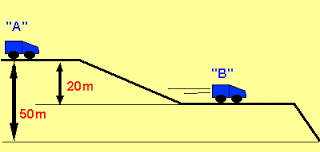
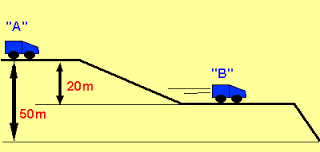
1. A ball has a 17 J of kinetic energy and its mechanical energy is 25 J. If the ball has a mass of 3.2 kg, what is its height above the ground?
0.26 m
0.52 m
5.2 m
25 m

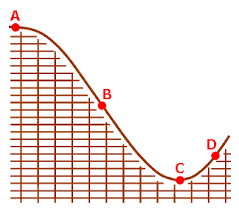
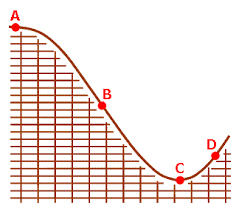
The given graph shows the relation between gravitational potential energy & height . If the total energy at height A= 0.49 J, what is the kinetic energy?
0.10 J
0.01 J
0.5 J
0.49 J

What is the GPE at point A
14 J
12 J
6 J
8 J

What is the KE at point B?
14 J
12 J
6 J
8 J

What is the Total Energy of the system?
14 J
12 J
6 J
8 J

What is the KE at point D?
14 J
12 J
6 J
8 J

What is the GPE at point E?
14 J
12 J
6 J
8 J

What is the Total Energy at the top?
15,000 J
3,750 J
7,500 J
11,250 J
What is the KE 1/4th of the way down?
15,000 J
3,750 J
7,500 J
11,250 J


A mass of 2.5 kg is released from rest at X and slides down a ramp, of height 3.0 m, to point Y as shown.
When the mass reaches Y at the bottom of the ramp it has a velocity of 5.0 m s–1.
What is the average frictional force between the mass and the ramp?
8.5 N
10.6 N
14.7 N
24.5 N

Two bodies of different masses undergo an elastic collision in the absence of any external force.
Which row gives the effect on the total kinetic energy of the masses and the magnitudes of the forces exerted on the masses during the collision?
A
B
C
D

Two unpowered toy cars, P and Q, are released from rest from X and travel down the track to Y. Car P has twice the mass of car Q. There is negligible friction.
What quantity is the same for car P and car Q?
The gravitational potential energy at X.
The accelerating force at X.
The velocity when they arrive at Y.
The momentum when they arrive at Y.
A roller coaster car is raised to a height of 65 m and released from rest
What is the maximum possible speed of the car?
11 m s−1
25 m s−1
36 m s−1
130 m s−1
The nucleus of a radioactive isotope X is at rest and decays by emitting an α particle so that a new nuclide Y is formed.
Which one of the following statements about the decay is correct?
The momentum of Y is equal and opposite to the momentum of the α particle.
The momentum of Y is equal to the momentum of X.
The kinetic energy of Y is equal to the kinetic energy of the α particle.
The total kinetic energy is the same before and after the decay.
A car of mass M travelling at speed V comes to rest using its brakes. Energy is dissipated in the brake discs of total mass m and specific heat capacity c. The rise in temperature of the brake discs can be estimated from


A stone is projected horizontally by a catapult consisting of two rubber cords. The cords, which obey Hooke’s law, are stretched and released. When each cord is extended by x, the stone is projected with a speed v. Assuming that all the strain energy in the rubber is transferred to the stone, what is the speed of the stone when each cord is extended by 2x?
v
2v
2v
4v

