wayground logo

Free Printable Worksheets

Font size

S
M
L
XL
Worksheets

EOC Review

Total questions: 170

Worksheet time: 2hrs 47mins

Name
Class
Date
1.
When measuring the volume of a small and irregularly shaped object, which of the following would be used to obtain the most accurate measurement?
a)
Fask
b)
Beaker 
c)
Graduated Cylinder 
d)
Triple Beam Balance
2.
An investigation is performed to determine how the angle of a ramp affects the speed of a ball as it rolls down the ramp. In addition to using the same ball and the same ramp, which of these should also remain constant?
a)
The height of the ramp
b)
releasing the ball from the same spot/height 
c)
keeping the ramp facing the same direction each trial 
d)
measuring the ramp each trial
3.
Some students used a hot plate to heat 1 L of water from 20°C to the boiling point of water. The students recorded the temperature of the water each minute until it began to boil. Which of the following provides the mostappropriate way to represent the data?
a)
a bar graph with temperature on the y-axis and time on the x-axis
b)
a bar graph with time on the y-axis and temperature on the x-axis
c)
a line graph with temperature on the y-axis and time on the x-axis
d)
a line graph with time on the y-axis and temperature on the x-axis
4.
Some students used a hot plate to heat 1 L of water from 20°C to the boiling point of water. The students recorded the temperature of the water each minute until it began to boil. Which of the following provides the mostappropriate way to represent the data?
a)
a bar graph with temperature on the y-axis and time on the x-axis
b)
a bar graph with time on the y-axis and temperature on the x-axis
c)
a line graph with temperature on the y-axis and time on the x-axis
d)
a line graph with time on the y-axis and temperature on the x-axis
5.
What precautions should be used in the lab when working with various chemicals?
a)
wear lab gloves and tie long hair back
b)
wear a cap and goggles, lab gloves, and protective shoes
c)
wear lab goggles, restrain loose clothing, and remove all rings
d)
wear a lab apron, use eye protection, and restrain loose clothing and hair
6.
Structural differences between different chemicals can be represented in models of the particles. Which drawingbest represents a compound?
a)
A
b)
B
c)
C
d)
D
7.
Ernest Rutherford was an important early researcher in nuclear physics. In one experiment, he observed that particles with a positive charge deflected when passing through a thin sheet of gold foil. What conclusion did Rutherford make in this observation?
a)
All atoms have electrons, protons, and neutrons.
b)
The positive part of the atom is small and dense.
c)
Protons and neutrons are located in the nucleus of an atom.
d)
Electrons have a negative charge, and protons have a positive charge.
8.
Sound travels as a
a)
A pattern of up and down vibrations
b)
A series of compressions and rarefactions
c)
A series of compressions only
d)
A wave without a medium
9.
When two nuclei are combined into one nucleus, there is a slight change in mass and the release of a large amount of energy. What is this process called?
a)
Fission 
b)
Fusion
c)
Reaction
d)
Conversion 
10.
When two nuclei are split and release of a large amount of energy. What is this process called?
a)
Fission 
b)
Fusion
c)
Reaction
d)
Conversion 
11.
Which statement best describes why the pencil looks bent in the picture?
a)
Light from the air is entering a different medium 
b)
Gravity affects the light more in a different medium 
c)
The farther light is from its source, the slower it moves.
d)
The pencil only looks bent at certain angles 
12.
Which type of radiation in the electromagnetic spectrum is associated with observable colors such as red, green, and blue?
a)
UV 
b)
X-ray
c)
Visible light 
d)
Gamma waves
13.
A metal ball has a constant velocity of zero. Which other quantity must also be zero?
a)
Weight of the ball
b)
Energy of the ball 
c)
Acceleration of the ball 
d)
Inertia of the ball
14.
A boy is walking a stops short. His orange on his lunch tray continues to move and falls off the tray. Which of Newtons Laws best explains why the orange continued to move?
a)
Newtons First Law
b)
Newtons Second Law
c)
Newtons Third Law 
d)
Newtons law of acceleration 
15.
Objects with greater _________ also have greater inertia.
a)
speed
b)
mass
c)
temperature
d)
friction
16.
If you were on the moon, there would be a change in your
a)
Weight and mass
b)
weight
c)
Mass
d)
volume
17.
How will this object move? 
a)
It won't move. 
b)
It will move to the right. 
c)
It will move to the left. 
d)
It will move
18.
What is the net force?
a)
30 N left
b)
25 N right
c)
5 N left
d)
55 N right
19.
What is Newton's First law about?
a)
The law of pie and cream
b)
Inertia
c)
Cheeseitz
d)
Speed & Velocity
20.
Two inclined planes put together creates which simple machine?
a)
Lever
b)
Pulley
c)
Wedge
d)
Screw
21.
Electric circuits provide energy for lightbulbs. Which of these prevents the flow of electrons?
a)
A series circuit
b)
A parallel circuit
c)
An open switch 
d)
A conductor 
22.
What is the function the part labeled z in the series circuit?
a)
provides an energy source for the circuit
b)
Allows a path for the electrons to flow
c)
Causes resistance 
d)
Opens and closes the circuit
23.
What is the function the part labeled X in the series circuit?
a)
provides an energy source for the circuit
b)
Allows a path for the electrons to flow
c)
Causes resistance 
d)
Opens and closes the circuit
24.
Which is an example of a physical property?
a)
rusting
b)
boiling point
c)
combustion
d)
reactivity with water
25.
This is an example of a
a)
physical change
b)
chemical change
26.
Which of the following properties is a physical property?
a)
magnetism
b)
reactivity with oxygen
c)
flammability
d)
non-reactive
27.
The positive particles of an atom are 
a)
electrons 
b)
positrons 
c)
neutrons 
d)
protons 
28.
Particles in an atom that are neutral and have no charge are 
a)
negatrons 
b)
electrons 
c)
neutrons 
d)
protons 
29.
Which of the following is an example of a physical change?
a)
Cooking an egg
b)
Boiling water
c)
A rusting bike
d)
A tarnished ring
30.
Chemical or Physical
a)
Chemical
b)
Physical
31.
__________ is stored energy. 
a)
Potential
b)
Kinetic
c)
None of the above 
d)
All of the above 
32.
Can energy be destroyed
a)
no
b)
yes
33.
Energy due to motion is ____________ energy. 
a)
Potential 
b)
Energy
c)
Kinetic
d)
Friction
34.
Which explains why the fork looks different under water?
a)
light can't pass through the glass
b)
the wavelength of light lengthens
c)
the amount of light increases when going through water
d)
light is refracted at an angle
35.
_____ is a lens that is thicker in the middle and makes an object appear bigger.
a)
prism
b)
convex lens
c)
concave lens
d)
mirror
36.
______ is a lens that is thicker on its edges and makes an object appear smaller?
a)
mirror
b)
convex lens
c)
concave lens
d)
prism
37.
Why does white light look like a rainbow when it exits a prism?
a)
The prism adds more kinds of light.
b)
The prism changes some white light into electricity.
c)
The prism is filled with many different colors.
d)
The prism separates white light into its component colors.
38.
Which window is opaque?
a)
Window 1
b)
Window 2
c)
Window 3
d)
None
39.
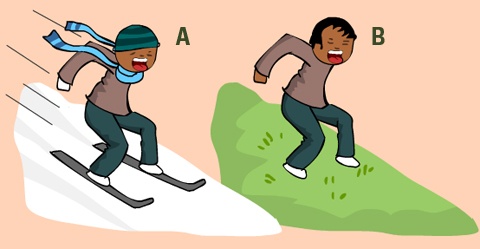
Why is it harder for the boy in Image B to get down the hill?
a)
Motion
b)
Friction
c)
Work
d)
Displacement
40.
What happens when one force PULLS an object toward another?
a)
Friction
b)
Motion
c)
Gravity
d)
Magnetism
41.
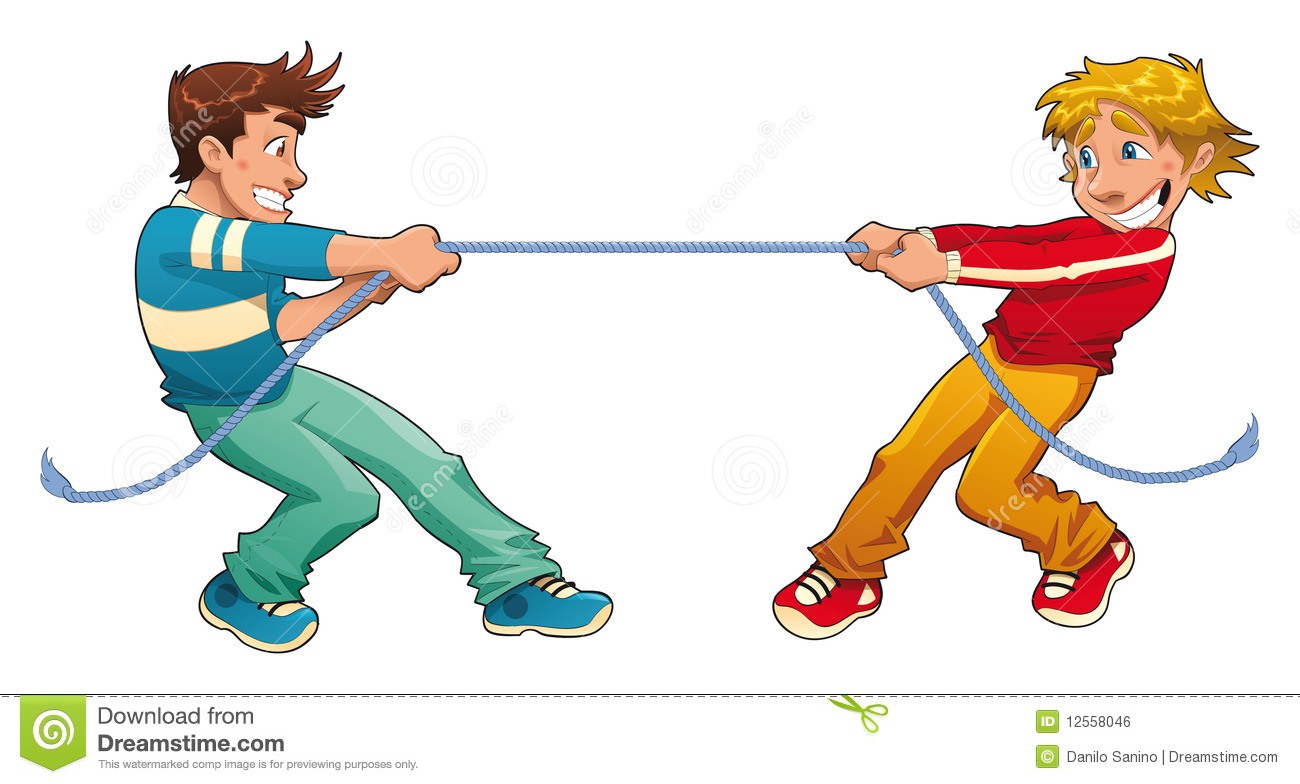
If these boys are pulling with the same amount of force.  What will happen?
a)
The boy in blue will win.
b)
They will not move at all.
c)
The boy in red will win.
d)
Both will fall down.
42.
What pulls a ball back to earth?
a)
Gas
b)
Gravity
c)
Friction
d)
Molecules
43.
When an object speeds up, slows down, stops, or starts is called?
a)
speed
b)
direction
c)
acceleration
d)
time
44.
What is speed?
a)
The rate at which an object changes position
b)
The direction an object is moving
c)
moving fast
d)
change in speed or direction
45.
Which of the following is an example of velocity?
a)
running 20 mph
b)
running 20 miles
c)
running 20 mph quickly
d)
running 20 mph south
46.
Which one of the following would you use to separate sand from iron filings?
a)
a bar magnet
b)
filter paper
c)
chromatography paper
d)
alum
47.
Two or more substances mingled together, but not chemically combined are known as a
a)
residue
b)
solution
c)
distillate
d)
mixture
48.
What type of mixture is this?
a)
heterogeneous 
b)
homogeneous
49.
What happens when you mix dirt and water?
a)
The dirt will float on top of the water.
b)
The dirt will settle to the bottom.
c)
The dirt will dissolve.
d)
The water will begin to bubble.
50.
What is NOT an example of an insulator in the kitchen?
a)
An oven mitt
b)
Pots and pans
c)
A wooden spoon
d)
A plastic measuring cup
51.
What object would best complete this circuit?
a)
A battery
b)
a peice of yarn
c)
an insulator
d)
a conductor
52.
A fur coat on a dog would be an example of:
a)
An insulator keeping thermal energy from passing.
b)
An insulator from keeping electrical energy from passing.
c)
A conductor allowing electrical energy to pass.
d)
A conductor allowing thermal energy to pass.
53.
A great conductor of energy is:
a)
wood
b)
plastic
c)
metal
d)
cloth
54.
Which box has a higher density?  
a)
Box A
b)
Box B
c)
cannot be determined
d)
they are the same
55.
Valence electrons are found by looking at what __________ the atom is located in on the periodic table.
a)
group
b)
column
c)
row
d)
box
56.
_________ are located to the right of the stair-step line.
a)
Metals
b)
Nonmetals
c)
Metalloids
57.
___________ are located to the left of the stair-step line.
a)
Metals
b)
Nonmetals
c)
Metalloids
58.
___________ are located on the stair step line
a)
Metals
b)
Nonmetals
c)
Metalloids
59.
Metals are _________ at room temperature with the exeception to Mecury and Bromine.
a)
solids
b)
gas
c)
liquid
60.
Nonmetals are ________ at room temperature.
a)
Solids
b)
Liquids
c)
gas
61.
Metalloids are _______ at room temperature.
a)
Solids
b)
liquids
c)
gas.
62.
Properties for Representive Elements:
__________________________
-Solids at room temperature
-Conduct electricity
-very reactive
-ductile (wires)
a)
Metals
b)
Nonmetals
c)
Metalloids
63.
Properties of Representative Elements:___________
- gases at room temperature
-poor conductors
-very reactive
-brittle (easy to break)
-good insulators
a)
Metals
b)
Nonmetals
c)
Metalloids
64.
Properties of Representative Elements: _________
-solids at room temperature
-properties of both
-semi-conducts
conduction varies on temperature
a)
Metals
b)
Nonmetals
c)
Metalloids
65.
In the periodic table elements are arranged by
a)
atomic mass
b)
atomic number
c)
valence electrons
d)
number of isotopes
66.
Each row in the periodic table is called a 
a)
group
b)
period
c)
cluster
d)
unit
67.
Each column in the periodic table is called a 
a)
period
b)
group/family
c)
cluster
d)
unit
68.
Particles in an atom's nucleus that are neutral and have no charge are 
a)
megatrons. 
b)
electrons.
c)
neutrons.
d)
protons. 
69.
A negatively charged particle that moves around the nucleus is a(n)
a)
proton
b)
neutron
c)
electron
d)
quark
70.
Which group/family of the periodic table is composed of inert (not reactive) gases? They are the ones boxed in in red in the picture.
a)
alkali metals
b)
alkaline earth metals
c)
halogens
d)
noble gases
71.
The atomic number of this pictured element is
a)
28
b)
58.6934
c)
Ni
d)
Nickel
72.
Elements which are shiny, conduct electricity and conduct heat are called
a)
metals
b)
nonmetals
c)
metalloids
d)
ions
73.
Two or more different elements chemically bonded form a(n)
a)
element
b)
compound
c)
mixture
d)
solution
74.
What does the H stand for?
a)
Hydrogen
b)
atomic number
c)
atomic mass
d)
atomic explosion
75.
What does the 1.00794 stand for?
a)
Hydrogen
b)
atomic number
c)
atomic mass
d)
atomic explosion
76.
The blue elements are called 
a)
metals
b)
nonmetals
c)
metalloids
d)
noble gases
77.
The atoms along the staircase are called 
a)
metals
b)
nonmetals
c)
metalloids
d)
noble gases
78.

An isotope is the same element with a different number of...?

a)

Protons

b)

Neutrons

c)

Electrons

79.
How many valence electrons does Iodine have?
a)
6
b)
16
c)
7
d)
17
80.
An element's identity is determined by the number of
a)
electrons
b)
protons
c)
neutrons
d)
valence
81.
Elements in the same ________ are more chemically similar.
a)
group/family
b)
period
c)
club
d)
table
82.
The majority of elements on the periodic table are
a)
man made
b)
nonmetals
c)
metals
d)
gases
83.
What does the number of electrons in the outer level indicate about the element?
a)
how brittle the element is
b)
how malleable the element is
c)
how reactive the element is
d)
how ductile the element is
84.
If a material can easily be drawn into the shape of a wire, it is
a)
Ductile
b)
Magnetic
c)
Malleable
d)
Reactive
85.
How many valence electrons does sodium have?
a)
1
b)
2
c)
3
d)
4
86.
How many valence electrons does Carbon have?
a)
4
b)
12
c)
6
d)
14
87.
How many valence electrons does Phosphorus have?
a)
31
b)
5
c)
15
d)
4
88.
How many valence electrons does Krypton have?
a)
36
b)
18
c)
8
d)
4
89.
What does the octet rule tell us?
a)
All ions need 8 electrons
b)
The maximum total number of electrons is 8
c)
The outer shell needs 8 electrons to be full (with the exception of the first shell which needs 2 to be full)
d)
Non-metals have a strong pull on their electrons
90.
What does electronegativity measure?
a)
The pull on electrons
b)
The size of an atom
c)
Number of valence electrons 
d)
The charge of an ion
91.
What is a mixture of two or more elements, at least one of which is a medal?
a)
ion
b)
gas
c)
nonmetal
d)
alloy
92.
What kind of force causes an object to move in a circle?
a)
kinetic energy
b)
potential energy
c)
circular force
d)
centripetal force
93.
The measurement of how much mass of a substance is contained in a given volume is ___.
a)
mass
b)
density
c)
weight
d)
energy
94.
Any substance that can flow is a ______.
a)
liquid
b)
gas
c)
fluid
d)
water
95.
The tendency of an object to resist a change in motion is called _______.
a)
static energy
b)
inerita
c)
momentum
d)
force
96.
The rule that energy cannot be created or destroyed is the ________.
a)
law of equal transfer of energy
b)
law of thermodynamics of tenegy
c)
law of conservation of mass
d)
law of conservation of energy
97.
What is the product of an object's mass and velocity?
a)
speed
b)
motion
c)
direction
d)
momentum
98.
What is a tiny particle or packet of light energy?
a)
a photon
b)
a lumen
c)
a ray
d)
a lens
99.
Which color below is a secondary color?
a)
red
b)
green
c)
yellow
d)
blue
100.
What is the force of gravity acting on an object?
a)
mass
b)
weight
c)
pressure
d)
inertia
101.
What happens when two atoms form a chemical bond?
a)
Like charges in the atoms cause them to stick together.
b)
The atoms fit together like two pieces of a puzzle.
c)
The atoms share or transfer electrons.
d)
The two atoms combine into a new, larger atom.
102.
Which substance is most likely classified as a colloid?
a)
A soft drink
b)
oxygen gas
c)
water
d)
fog
103.
Which answer is correct with respect to force? 
Force is equal to...
a)
mass x distance
b)
mass x acceleration
c)
acceleration / volume
d)
mass / acceration
104.
This diagram represents a neutral atom of fluorine-19.
Which best describes the structure of fluorine-19?
a)
2 electrons in the first energy level; 7 electrons in the second energy level
b)
2 electrons in the first energy level; 8 electrons in the second energy level
c)
9 protons and 9 neutrons in the nucleus
d)
10 protons and 9 neutrons in the nucleus
105.
What are the two branches or categories of Physical Science?
a)
Chemistry and Science
b)
Science and Technology
c)
Physics and Chemistry
d)
Chemical and Physical
106.

Which answer best describes Density?

a)

density = mass/volume

b)

density = cats x dogs

c)

density = mass x force

d)

density = mass x acceleration

107.
What is the fourth state of matter?
a)
dark matter
b)
Quintessence Idea 
c)
vapor
d)
plasma
108.

Sublimation - when a substance changes from a _______ to a _______.

a)

solid, gas

b)

gas, solid

c)

gas, liquid

d)

liquid, solid

109.

Water deposition - when a substance changes from a _______ to a _______.

a)

solid, gas

b)

gas, solid

c)

gas, liquid

d)

liquid, solid

110.
The amount of energy that a substance must absorb in order to change from a liquid to a gas is called _______.
a)
heat of vaporization
b)
heat of fusion
c)
heat of melting
d)
heat of freezing
111.
What are the two types of vaporization?
a)
condensation, vaporization
b)
condensation, boiling
c)
heat of fusion, vaporization
d)
evaporation, boiling
112.
A rotting apple is an example of a______.
a)
chemical change
b)
physical change
c)
thermal dynamic change
113.
Matter is divided into two categories - 
a)
homogeneous and heterogeneous
b)
mixtures and pure substances
c)
elements and compounds
114.
Which of the following is NOT a pure substance?
a)
rock
b)
salt
c)
sugar
d)
diamond
115.
Which one is made of single atoms, small molecules and ions
a)
Solution
b)
Colloid
c)
Suspension
116.

A mixture that contains some particles that are intermediate in size between the small particles in a solution and the larger particles in a suspension (unfortunately, ya'll don't know this one).

a)

Solution

b)

Colloid

c)

Suspension

117.
Which one is a heterogeneous mixture that separates into layers over time.
a)
Solution
b)
Colloid
c)
Suspension
118.
Energy possessed by an object in motion
a)
potential energy
b)
convection energy
c)
conduction energy
d)
Kinetic energy
119.
When heat is moving out of the system into the environment – it is an __________ reaction.
a)
Endothermic
b)
Exothermic
120.
Rusting is an example of an _________ reaction (where energy is released).
a)
Endothermic
b)
Exothermic
121.
Valence electrons are....
a)
the electrons in the outermost shell
b)
the electrons on the first layer of electrons
c)
the electrons that move back and forth from the first layer of electrons to other layers
122.
When valence electrons are lost... 
a)
The particle has a neutral charge.
b)
The particle has a negative charge.
c)
The particle has a positive charge.
123.

Gaining an electron is referred to as _________; losing an electron is referred to as _________. (Don't forget about Leo the lion)

a)

oxidation, reduction

b)

reduction, oxidation

124.
Subatomic particles are...
a)
neutrons, protons, electrons
b)
electrons and protons only
c)
neutrons, protons, leptons, & electrons
d)
neutrons and protons only
125.
A anion is a _______?
a)
negatively charged atom
b)
neutral atom
c)
positively charged atom
126.
A cation is a _______?
a)
negatively charged atom
b)
neutral atom
c)
positively charged atom
127.
What is an isotope?
a)
An atom with the same number of protons and neutrons, but a different number of electrons
b)
An atom with the same number of protons and electrons, but a different number of neutrons
c)
An atom with the same number of electrons and electrons, but a different number of protons
d)
An atom with a different number of protons, electrons & neutrons
128.

What phase of matter is the arrow pointing to?

a)

solid

b)

liquid

c)

gas

d)

plasma

129.

a principle stating that energy cannot be created or destroyed, but can be altered from one form to another.

a)

The law of energy

b)

The Law of Conservation of Mass

c)

The Law of Conservation of Energy

d)

The Conservation of Kinetic & Potential Energy

130.
magnitude means what?
a)
force
b)
size
c)
velocity
d)
acceleration
131.
Acceleration is the change in what?
a)
velocity
b)
speed
c)
direction
d)
none of the above
132.
motion is the change in what?
a)
speed
b)
velocity
c)
acceleration
d)
position
133.
What is a physical quantity that is specified by both a size and direction?
a)
scalar
b)
vector
c)
magnitude
d)
velocity
134.
What is the synonym for negative acceleration?
a)
speeding up
b)
accelerating
c)
deceleration
d)
velocity
135.
What is the equation to find speed?
a)
s=t/d
b)
s=d X t
c)
s=d/f
d)
s=d/t
136.
If someone travels in a complete circle around a high school track that is 400 meters, what distance did they travel?
a)
400 meters
b)
0 meters
c)
200 meters
d)
800 meters
137.
What is the SI unit for speed
a)
Kilogram
b)
Newton
c)
m/s
d)
m/s/s
138.
The formula:
 ? = D/T with direction 
is used to find
a)
Velocity
b)
Speed
c)
Force 
d)
Acceleration
139.
Final velocity minus Final velocity divided by time is the equation for what?
a)
speed
b)
acceleration
c)
distance
d)
velocity
140.
Acceleration of an object happens when things ________
a)
slow up
b)
go faster
c)
change direction (turn)
d)
All of the above
141.
What would the d-t graph look like for an object travelling at a constant velocity? 
a)
Horizontal line
b)
Straight line
c)
Curved line
142.
The difference between speed and velocity is
a)
Velocity involves time, speed does not
b)
Velocity has direction while speed does not
c)
Speed involves time while velocity does not
d)
 Speed involves direction while velocity does not
143.

Any substance that has mass and takes up space.

a)

Element

b)

Compound

c)

Matter

d)

Mixture

144.

A pure substance of one type of atom.

a)

Element

b)

Compound

c)

Matter

d)

Mixture

145.

A substance composed of atoms from more than one element held together by chemical bonds.

a)

Element

b)

Compound

c)

Matter

d)

Mixture

146.

Two or more substances which are mixed but not but not held together by chemical bonds.

a)

Element

b)

Solution

c)

Matter

d)

Mixture

147.

A mixture composed of two or more substances, where one substance is dissolved into another substance.

a)

Element

b)

Solution

c)

Matter

d)

Mixture

148.

Sodium is a

a)

Element

b)

Solution

c)

Compound

d)

Mixture

149.

Sodium chloride (NaCl) is a

a)

Element

b)

Solution

c)

Compound

d)

Mixture

150.

Sodium chloride (NaCl) dissolved in water is a

a)

Element

b)

Solution

c)

Compound

d)

Mixture

151.

Trail mix is an example of a

a)

Element

b)

Solution

c)

Compound

d)

Mixture

152.

Molecules are closely packed, rigid shape and volume.

a)

Solid

b)

Liquid

c)

Gas

d)

Plasma

153.

Definite volume, but conforms to the shape of its container.

a)

Solid

b)

Liquid

c)

Gas

d)

Plasma

154.

Molecules are widely separated, both shape and volume determined by its container.

a)

Solid

b)

Liquid

c)

Gas

d)

Plasma

155.

No definite shape or volume, electrically conductive, examples are lightning, neon lights, and the sun's corona.

a)

Solid

b)

Liquid

c)

Gas

d)

Plasma

156.

Phase change that occurs when a liquid turns into a solid.

a)

Freezing

b)

Boiling

c)

Melting

d)

Sublimation

157.

Phase change that occurs when a solid turns into a liquid.

a)

Freezing

b)

Condensation

c)

Melting

d)

Sublimation

158.

Phase change that occurs when a liquid turns into a gas.

a)

Freezing

b)

Evaporation

c)

Melting

d)

Sublimation

159.

Phase change that occurs when a liquid turns into a solid.

a)

Freezing

b)

Evaporation

c)

Melting

d)

Sublimation

160.

Phase change that occurs when a liquid turns into a solid.

a)

Freezing

b)

Evaporation

c)

Melting

d)

Sublimation

161.

Phase change that occurs when a gas turns into a liquid.

a)

Condensation

b)

Evaporation

c)

Deposition

d)

Sublimation

162.

Phase change that occurs when a gas turns into a solid.

a)

Condensation

b)

Evaporation

c)

Deposition

d)

Sublimation

163.

Process that occurs when reactants undergo a chemical change to yield products

a)

Chemical change

b)

Chemical reaction

c)

Physical property

d)

Chemical property

164.

A property that is measurable, such as color, mass, or length.

a)

Chemical change

b)

Chemical reaction

c)

Physical property

d)

Chemical property

165.

Occurs when one substance combines with another substance to create a new substance

a)

Chemical change

b)

Chemical reaction

c)

Physical property

d)

Chemical property

166.

Phase change that occurs when a solid turns into a gas.

a)

Condensation

b)

Evaporation

c)

Deposition

d)

Sublimation

167.

A property that can't be determined by viewing or touching a substance, such as flammability, toxicity, or heat of combustion.

a)

Chemical change

b)

Chemical reaction

c)

Physical property

d)

Chemical property

168.

A metric unit for length.

a)

Foot

b)

Yard

c)

Gram

d)

Meter

169.

A metric unit for mass.

a)

Liter

b)

Ounce

c)

Gram

d)

Gallon

170.

A metric unit for volume.

a)

Liter

b)

Gallon

c)

Kilogram

d)

Cup