
 Worksheets
AP Unit 3 Review
Total questions: 173
Worksheet time: 29hrs 50mins

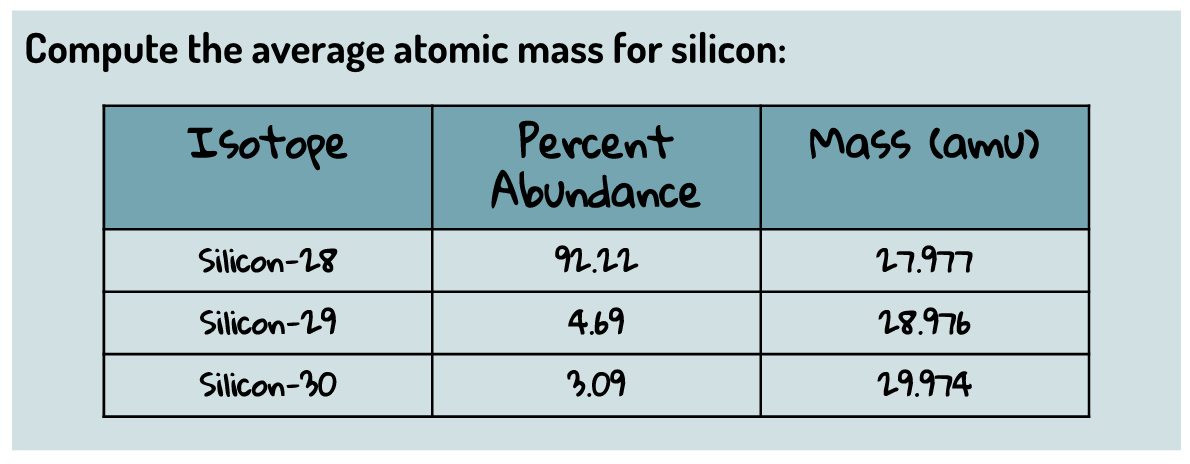
Calculate the average atomic mass of silver.
106.38649amu
111.91896amu
107.8677amu
121
Do the following atoms belong to the same element?
- Aluminum-27
- An atom with 14 protons and 13 neutrons
Yes because they have the same number of protons
Yes because they have the same mass
No because they have different number of protons
No because they have different number of neutrons
What do the heights of the peaks represent in the mass spectrum?
number of isotopes
relative abundance of each isotope
average atomic mass
charge:mass ratio

How many isotopes are shown in this mass spectrum?
1
84
86
4

Use your periodic table. There are two isotopes of rubidium: 85Rb and 87 Rb. Which is more abundant?
equally abundant
rubidium-85
rubidium-85.47
rubidium-87

What is the average atomic mass for this element?
10 amu
10.8 amu
19.9 amu
11 amu
Bromine has two major isotopes giving it an atomic mass of 79.904 amu. Based on this information, which of the following statements can explain the atomic mass value?
The isotope Bromine-81 is more common than Bromine-79
Bromine-79 and Bromine-81 exist in approximately equal proportions
Bromine-78 is about twice as abundant as Bromine-81
The two major isotopes of Bromine have 45 neutrons and 46 neutrons
Which is true of the 243Am3+ ion?
148 protons, 145 electrons, 243 neutrons
95 protons, 95 electrons, 148 neutrons
95 protons, 98 electrons, 243 neutrons
95 protons, 92 electrons, 148 neutrons

A pure sample of an element was vaporized and injected into a mass spectrometer and the data was plotted on the graph to the right. The mass values for the isotopes were found to be: A-56 (55.935 amu), A-54 (53.949 amu), A-57 (56.935 amu), and A-58 (57.933 amu). What is the most precise average atomic mass?
55.846 amu
54.916 amu
55.911 amu
54.140 amu


Which element does this mass spectrum most likely represent?
neon
scandium
boron
sodium

What do you expect the molar mass to be for this element?
91.4 g/mol
90.0 g/mol
4 g/mol
50. g/mol

How many isotopes of this element are shown in the mass spectrum?
98
7
100
95.9 g/mol
A gas phase atom with the electron configuration
1s2 2s2 2p6 3s2 3p6 4s2 3d6 loses three electrons. What is the electron configuration of the resulting gas phase ion?
1s2 2s2 2p6 3s2 3p6 3d5
1s2 2s2 2p6 3s2 3p6 4s1 3d4
1s2 2s2 2p6 3s2 3p6 4s2 3d3
1s2 2s2 2p6 3s2 3p5 4s1 3d5
Which element has atoms with four valence electrons in its ground state?
Ca
Cr
Si
S
Gas-phase atoms of which elements have an occupied 5d orbital in their ground state?
Ag (Z=47)
Ba (Z=56)
Eu (Z=63)
Ir (Z=77)
Which must represent an atom in an excited state?
1s22s22p1
1s22s22p3
1s22s22p33s1
1s22s22p5
Which pair consists of species that are isoelectronic?
Na+, K+
Cl, Cl-
Fe2+, Mn2+
Ar, Ca2+
Which is the electron configuration for an Fe(III) ion in its ground state? (notice it's an ion - what orbits would it lose electrons from?)
[Ar]3d5
[Ar]3d6
[Ar]4s23d3
[Ar]4s23d6
Atoms of element X have an electronic configuration of 1s22s22p63s23p3. The compound most likely formed with magnesium is:
MgX
MgX2
MgX3
Mg3X2

Which is an impossible electron configuration?
a
b
c
d
Which is the ground-state configuration for the atoms of a transition element?
b
c
d
e

Which represents an atom that has four valence electrons?
A
B
C
D
Which represents an atom of a transition metal?
A
C
D
E
Which of the following statements about quantum theory is INCORRECT?
The energy and position of an electron cannot be determined simultaneously.
Lower energy orbitals are filled before higher energy orbitals.
When filling orbitals of equal energy, two electrons will occupy the same orbital (box) before filling a new orbital (box).
No two electrons can have the same spin in the same orbital (box).
Which of the following statements is true?
The exact location of an electron can be determined if we know the energy.
An electron in a 2s orbital requires the same amount of energy to be removed as an electron in a 2p orbital.
Ni has two unpaired electrons in its 3d orbitals.
In the buildup of atoms, electrons occupy the 4f orbitals before the 6s orbitals.
Which existing element would the chemistry of element 119 most resemble?
Rn (Z=86)
Fr (Z=87)
Ra (Z=88)
Ac (Z=89)
Which atom has the highest electronegativity?
Na
P
Cl
Br
Of the elements listed, which has the highest first ionization energy?
Li
Be
Na
Mg
Properties of the alkaline earth metals that increase from Be to Ba include which of the following?
i. Atomic radius
ii. Ionization energy
iii. Ionic radius
i and ii only
i and iii only
ii and iii only
i, ii, and iii
In which lists are the ions arranged in order of decreasing size?
S2-, Br-, K+, Ca2+
Br-, S2-, K+, Ca2+
K+, Ca2+, Br-, S2-
Ca2+, K+, S2-, Br-
The removal of an electron from which gaseous atom requires the greatest amount of energy?
Na
Cl
K
Br
In which series are the species listed in order of increasing size?
N, O, F
Na, Mg, K
Cr, Cr2+, Cr3+
Cl, Cl-, S2-
Which equation represents the first ionization of calcium?
Ca(s) → Ca+(g) + e-
Ca(g) → Ca+(g) + e-
Ca+(g) → Ca2+(g) + e-
Ca2+(g) + e- → Ca+(g)
Electronegativities change both down a group and across a period. In general these changes are to:
increase down a group; increase across a period
increase down a group; decrease across a period
decrease down a group; increase across a period
decrease down a group; decrease across a period
When the atoms: Ba, Cs, Mg, Na are arranged in order of increasing size, what is the correct order?
Cs < Na < Mg < Ba
Mg < Na < Ba < Cs
Mg < Ba < Na < Cs
Ba < Mg < Na < Cs
Which element has the largest radius?
Br
K
Mg
Na
Which pair of symbols identifies two elements that are metalloids?
B and Ge
Mg and Si
P and As
Ti and V
Which of the following properties generally decreases across the periodic table from sodium to chlorine?
first ionization energy
atomic mass
electronegativity
atomic radius
Order the elements S, Cl, and F in terms of increasing atomic radii.
S, Cl, F
Cl, F, S
F, S, Cl
F, Cl, S
Which of the following would have the largest SECOND ionization energy?
Mg
Cl
S
Na
The first ionization energy of Mg is 735 kJ/mol. The second ionization energy is
735 kJ/mol
less than 735 kJ/mol
greater than 735 kJ/mol
more information is needed to answer the question
Which of the following concerning second ionization energies is true?
That of Al is higher than that of Mg because Mg wants to lose the 2nd electron, so it is easier to take the 2nd electron away.
That of Al is higher than that of Mg because the electrons are taken from the same energy level, but the Al atom has one more proton
That of Al is lower than that of Mg because Mg wants to lose the 2nd electron, thus the energy change is greater
That of Al is lower than that of Mg because the 2nd electron taken from Al is in a p orbital, thus it is easier to take
Which would have the largest radius?
Mg2+
P3-
P
Si
Which would have the smallest radius?
Na+
Mg2+
Al3+

As you move down a GROUP on the periodic table the atomic radius get bigger. This is because ____________.
The atoms have more neutrons in the nucleus.
The atoms have more protons in the nucleus.
The atoms have more energy levels for the electrons
The atoms have greater repulsion forces between the protons and electrons
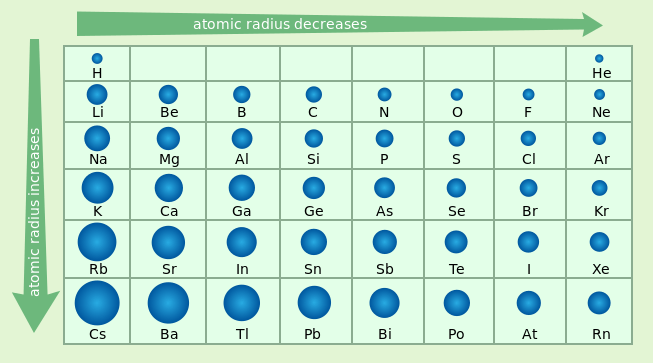
As you move across a period on the periodic table the atomic radius tend to get smaller because, ______________.
the atoms have more mass making them heavier.
more neutrons, making the nucleus bigger.
the atoms have more protons, pulling the electrons closer.
the atoms have less energy levels for the electrons to occupy.
The amount of energy released when an electron is added to a neutral atom to form a negative ion
Atomic Radii
Ionization Energy
Electronegativity
Electron Affinity
Electron affinity trends is . . . .
generally increases across a period, and a trend of decreasing electron affinity going down groups would be expected.
generally decreases across a period, and a trend of decreasing electron affinity going down groups would be expected.
generally increases across a period, and a trend of increasing electron affinity going down groups would be expected.
generally decreases across a period, and a trend of increasing electron affinity going down groups would be expected.
Which element has lower electron affinity?
Bromine is lower than Calcium
Chlorine is lower than Fluorine
Berylliumis lower than Magnesium
Aluminium is lower than Sodium

A chemical reaction has the equation 2A + B → C. In which case is B the limiting reactant?
I
II
III
IV

Which of the following reactions could be modeled using the following representation?
AgCl → Ag+ + Cl-
AgNO3 + NaCl → AgCl + NaNO3
AgCl + K → Ag + KCl
Ag+ + e- → Ag
A 64 g sample of NaCl (molar mass of 58.44 g/mol) reacts with 57 g of fluoride gas (molar mass of 38 g/mol) in the following equation: 2 NaCl(s) + F2(g) → 2 NaF(s) + Cl2(g)
Which particulate representation could be used to describe the species present in the reaction vessel after the process has gone to completion?


Choose the best description below for the image
physical change with no change in mass
physical change with a change in mass
chemical change with no change in mass
chemical change with a change in mass

Choose the best description below for the image
physical change with no change in mass
physical change with a change in mass
chemical change with no change in mass
chemical change with a change in mass

Hydrogen and oxygen react explosively to form water (write the balanced equation). If the explosion is louder when more water is formed, which balloon will make the loudest noise?
A
B
C
D
Consider the following reaction:
CH4(g) + 4Cl2(g) → CCl4(g) + 4HCl(g)
What mass of CCl4 is formed by the reaction of 2.00 g of methane with an excess of chlorine?
4.8 g
0.21 g
308 g
19.2 g
In the reaction of:
CH4 + 2 O2 → CO2 + 2 H2O
What is the ratio of moles CH4 to moles O2?
For every 1 mol CH4, there is 1 mol O2
For every 1 mol CH4, there are 2 mol O2
For every 4 mol CH4, there are 2 mol O2
With the equation given below, how many moles of oxygen are required to react with 8 moles of H2S?
2 H2S + 3 O2 → 2 SO2 + 2 H2O
3
8
12
20
With the equation given below, how many grams of Fe are required to react with 36 g of O2?
4 Fe + 3 O2 → 2 Fe2O3
1.50 g
83.78 g
18.02 g
1.125 g
In the reaction of sodium reacting with oxygen gas to form sodium oxide. The theoretical yield is calculated to be 2.5g, but 2.0 g of sodium oxide is actually recovered in the lab. Determine the % yield of sodium oxide.
.8%
77.4%
80%
125%
With the equation given below, how many atoms of zinc are required to produce 2 mol ZnCl2?
Zn + 2 HCl → ZnCl2 + H2
2
3.0 x 10²³
6.0 x 10²³
1.2 x 1024
With the equation given below, how many grams of hydrogen gas are produced when 100 g of hydrochloric acid (HCl) reacts.
Zn + 2 HCl → ZnCl2 + H2
2.8 g
1.4 g
50 g
35 g
For the Balanced Reaction: 3 Mg + 1 Fe2O3 → 3 MgO + 2 Fe; What is the Ratio of moles of MgO to moles Fe?
1:3
2:3
1:2
3:2
How many moles of oxygen are produced when 6.7 moles of KClO3 decompose completely?
What is the measured amount of a product obtained from a chemical reaction?
mole ratio
theoretical yield
percentage yield
experimental/actual yield

Which substance is the limiting reactant?
GaCl3
Rb2S
RbCl
Ga2S3
Which substance is the excess reactant?
GaCl3
Rb2S
RbCl
Ga2S3
Albert Einstein’s explanation of the photoelectric effect confirmed which of the following concepts?
Electrons can absorb energy and change levels in atoms.
Light energy can be converted into the mass of electrons.
Electrons have both particle and wave properties.
Light has both particle and wave properties.

What is the chemical symbol for the element depicted in the PES graph?
(a)

What is the chemical symbol for the element depicted in the PES graph?
(a)

Which of the following explains the differences in the position and intensity of the 2p peaks between carbon and nitrogen?
Nitrogen is larger in size making the electrons in the 2p orbit farther from the nucleus and thus easier to remove
Carbon experiences a larger effective nuclear charge on the 2p electrons and are thus harder to remove.
Nitrogen experiences a larger effective nuclear charge and has more electrons in the 2p orbital.
Carbon experiences a greater shielding effect from the 2s and 1s electrons making the 2p electrons easier to remove.

Refer to the photoelectron spectrum of neon shown below to answer the question.
Peaks A, B, and C represent the binding energies of electrons in which subshells of neon?
1s, 2s, 2p
2p, 2s, 1s
1s, 1s, 1s
2s, 2p, 2p

Which peak shows electrons closest to the nucleus
A
B
C
D
Refer to the photoelectron spectrum of neon shown below to answer the question.
Which of the following statements best accounts for peak A being to the left of peaks B and C?
The electron configuration of neon is 1s2 2s2 2p6.
Neon has 8 electrons located in its valence shell.
Core (not valence) electrons of an atom experience a much higher effective nuclear charge than valence electrons

What is the electron configuration for the photoelectron spectroscopy graph?
1s22s22p63s23p64s2
1s22s22p63s23p3
1s22s22p63s23p6
1s22s22p63s2

A sample containing atoms of C and F was analyzed using x-ray photoelectron spectroscopy. The portion of the spectrum showing the 1s peaks for atoms of the two elements is shown above. Which of the following correctly identifies the 1s peak for the F atoms and provides an appropriate explanation?
Peak X, because F has a smaller first ionization energy than C has.
Peak X, because F has a greater nuclear charge than C has.
Peak Y, because F is more electronegative than C is.
Peak Y, because F has a smaller atomic radius than C has.
How many peaks would be expected for a PES spectum for Calcium?
3
4
5
6
Which of these elements would have the same number of PES peaks as Fluorine?
Neon
Beryllium
Sodium
Chlorine

Which electrons would be ejected with the most kinetic energy according to the spectrum below?
The ones in the peak at 151
The ones in the peak at 7.9
The ones in the peak at 1.09
The ones in the peak at 0.58

How many valence electrons does the element pictured in the PES spectrum below have?
1
2
3
4
Refer to the photoelectron spectrum of neon shown below to answer the question.
Which of the following statements best accounts for peak C being three time the height of peak B?
The intensity of the photoelectron signal at a given energy is a measure of the number of electrons in that energy level.
Electrons represented by peak B have approximately triple the binding energy than those represented by peak C
In a photoelectron spectrum, as binding energy increases the relative number of electrons decreases.
The height of peaks in a photoelectron spectrum does not have any relation to the structure of the atom

Using the data in the two PES, what do you expect the binding energy of the 1s electrons in oxygen (atomic number 8) to be?
0 - 50 eV
50 - 400 eV
400 - 700 eV
700 - 1000 eV

Which of the following best explains the relative positioning and intensity of the 2s peaks in the following spectra?
Be has a greater nuclear charge than Li and more electrons in the 2s orbital
Be electrons experience greater electron-electron repulsions than Li electrons
Li has a greater pull from the nucleus on the 2s electrons, so they are harder to remove
Li has greater electron shielding by the 1s orbital, so the 2s electrons are easier toremove

Looking at the spectra for Na and K below, which of the following would best explain the difference in binding energy for the 3s electrons?
K has a greater nuclear charge than Na
K has more electron-electron repulsions than Na
Na has one valence electron in the 3s sublevel
Na has less electron shielding than K

Looking at the spectra for Na and K below, which of the following would best explain the difference in signal intensity for the 3s electrons?
K has a greater nuclear charge than Na
K has more electron-electron repulsions than Na
Na has one valence electron in the 3s sublevel
Na has less electron shielding than K
Which electronic transition in a hydrogen atom releases the greatest amount of energy?
n=3 → n=2
n=5 → n=3
n=6 → n=5
n=3 → n=6
What is the wavelength of a photon of red light (in nm) whose frequency is 4.64 x 10¹⁴ Hz.
646 nm
1.55 x 10⁶ nm
155 nm
464 nm
True/False: The SI unit for frequency is hertz (Hz)
True
False
Green light can have a wavelength of 512 nm. The energy of a photon of this light is:
1.02 x 10⁻³¹ J
5.12 x 10⁻⁷ J
3.88 x 10⁻¹⁹ J
5.86 x 10¹⁴ J
How many of the following is/are incorrect?
i. The main idea of the equation E=mc2 is that energy has mass
ii. Electromagnetic radiation can be thought of as a stream of particles called photons.
iii. Electromagnetic radiation exhibits wave properties
iv. Energy can only occur in discrete units called quanta.
0
1
2
3
In an investigation of the electronic absorption spectrum of a particular element, it is found that a photon having a λ = 500 nm provides just enough energy to promote an electron from the second quantum level to the third. From this information, we can deduce:
the energy of the n = 2 level
the energy of the n = 3 level
the sum of the energies of n = 2 and n = 3
the difference in energies between n = 2 and n = 3
An atom that has gained energy beyond normal is said to be ...
excited
grounded
naturalized
Light is emitted when electrons
move from one atom to another.
collide with one another, releasing energy.
move from a lower energy level to a higher energy level.
move from a higher energy level to a lower energy level.
Flame tests can be used to identify an element. Each element emits characteristic waves of light when it is heated in a flame. What describes how the light is produced?
Protons in the ground state lose energy and give off light.
Protons in the ground state gain energy and are emitted from the nucleus, giving off light.
Electrons in the ground state lose energy and move to an excited state, giving off light.
Electrons in the ground state gain energy, move to an excited state, and give off light when they return to the ground state.
When electrons are found in higher energy levels, further from the nucleus and are unstable we say that these electrons are in...
the ground state
the excited state
the valence state
the neutral state


All stars are composed of a mixture of elements. When these elements are heated they emit specific amounts of electromagnetic radiation, known as an emission spectrum. Each element emits a unique, identifiable, spectrum.
Using the Bright-line emission spectrum chart below, identify the elements present in this modeled star (found in the line labeled “mixture”).
Lithium and cadmium are in the mixture. Strontium is not in the mixture.
Lithium and strontium are in the mixture. Cadmium is not in the mixture
Cadmium and strontium are in the mixture. Lithium is not in the mixture
All of the shown elements are present in the mixture.

What subatomic particle is responsible for the spectral lines seen in emission spectra diagrams?
electrons
protons
neutrons

If an electron moves from n=4 to n=2 it ____
absorbs energy
releases energy


What is the order of VISIBLE light in increasing energy?
VIBGYOR
ROYGBIV

What are the type of spectra pictured called?
Continuous Spectrum
Emission Spectrum
Absorption spectrum


The diagram show
formation of continous spectrum
formation of line spectrum

the diagram show
the formation of continous spectrum
the formation of line spectrum
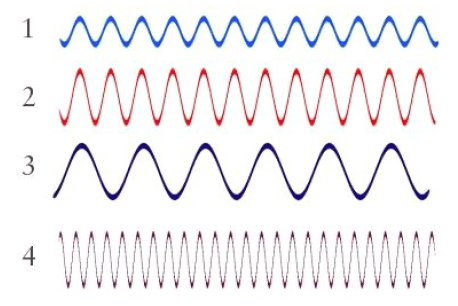
Electromagnetic waves vary in
the speed they travel in a vacuum.
wavelength and frequency.
the way they reflect.
the orientation of their electric and magnetic fields.

By passing starlight light through a ___the light is spread out into its component colors.
spectrograph or spectrometer
telescope
prism or diffraction grating
mirror

A ___ can be used in place of a prism in a spectroscope & is inexpensive.
plastic prism
diffraction grating
CCD
lens
You mixed two aqueous solutions together, expecting to see a precipitate form. Instead, after several minutes, you do not detect other visible changes. Which of the following is an observation for which you should have looked?
gas bubbling
heat evolving
color change
There are no other changes to look for because no reaction has occurred.
Aqueous solutions of sodium sulfate and barium chloride are combined. Which of the following setups would be appropriate to collect the product(s) of this reaction?


Which of the following is BEST described as a chemical change?
I2(s) → I2(g)

The absorbance of a sample of 0.885 M CuCO4 is studied at various wavelengths using a spectrophotometer.
Sn(s) → Sn2+(aq)

Which of the following best described what happens to C4H6 when a 5.00 g sample is heated from -10°C to 22°C?
Boiling point = 10.9°C
Melting point = -136.2°C
Insoluble in water
Soluble in C6H6
Density: 0.676 g/mL
A physical change occurs when the liquid boils at 10.9°C weakening the intermolecular forces between molecules.
A physical change occurs when the liquid boils at 10.9°C breaking the single and double bonds between C atoms in the molecule.
A chemical change occurs when the liquid boils at 10.9°C weakening the intermolecular forces between molecules.
A chemical change occurs when the liquid boils at 10.9°C breaking the single and double bonds between C atoms in the molecule.
A strong acid (HCl) is mixed with a strong base (NaOH) at room temperature. No indicator is used. Which of the following most accurately describes the process that occurs?
A physical change occurs because the acid and base create a mixture.
A physical change occurs, accompanied by the formation of gas and light.
A chemical change occurs due to the formation of hydrogen bonds between adjacent water molecules.
A chemical change occurs, due to the formation of O-H bonds in water.
What involves the breaking or forming of intramolecular bonds?
physical change
chemical change
boiling
condensing
What involves the change of intermolecular forces?
physical change
chemical change
burning
rusting
Which reaction could be classified as both a physical and chemical change?
CO2(s) → CO2(g)
NaCl(s) → Na+(aq) + Cl-(aq)
CO2(s) → C(s) + O2(g)
NH2F(l) → ½N2(g) + H2(g) + ½F2(g)
Which of the following processes represents a physical change?
C6H12O6(s) → C6H12O6(l)
SO3(g) + H2O(l) → H2SO4(aq)
HBr(g) + NH3(g) → NH4Br(s)
Na(s) + Cl(g) → NaCl(s)
Which of the following scenarios is an example of a chemical process?
A solution of H2O2 is heated, resulting in the evolution of oxygen gas.
A piece of copper metal is rolled and drawn out into a thin wire.
A mixture of plant pigments is separated using paper chromatography.
A sample of solid iodine is placed under vacuum, causing it to sublime.
The sublimation of CO2 is best classified as a:
physical change because only intermolecular forces between CO2 molecules are disrupted
physical change because only ionic bonds between C4+ and O2- ions are broken
chemical change because C-O bonds are broken and C-C and O-O bonds are formed
chemical change because covalent bonds between CO2 molecules are broken
Which of the following statements comparing chemical and physical processes is most accurate?
Chemical processes are characterized by changes in intramolecular forces, while physical processes are characterized by changes only in intermolecular forces.
Physical processes are characterized by changes in intramolecular forces, while chemical processes are characterized by changes only in intermolecular forces.
Both chemical and physical processes are characterized by changes in intramolecular forces.
Both chemical and physical processes are characterized by changes only in intermolecular forces.
Is this a chemical or physical process? CO2(g) → C(s) + O2(g)
chemical
physical
both chemical and physical
Is this a chemical or physical process? H2O(s) → H2O(l)
chemical
physical
both chemical and physical
Is this a chemical or physical process? MgCl2(s) → Mg+2(aq) + 2Cl-1(aq)
chemical
physical
both chemical and physical
Which substance is the precipitate in this reaction? FeCl3(aq) + NaOH(aq) → Fe(OH)3(s) + NaCl(aq)
FeCl3
NaOH
Fe(OH)3
NaCl
Boiling is an example of a __________
Physical change because bonds are broken
Physical change because IMFs are overcome
Chemical change because bonds are broken
Chemical change because IMFs are overcome
Which of the following statements BEST describes the differences between the two equations shown below?
Equation 1: H2O(l) → H2O(g)
Equation 2: 2H2O(l) → 2H2(g) + O2(g)
Equation 1 represents a physical change because intermolecular forces are broken during the process, whereas Equation 2 represents a chemical change because intramolecular forces are broken
Equation 1 represents a physical change because intramolecular forces are broken during the process, whereas Equation 2 represents a chemical change because intermolecular forces are broken
Equation 1 represents a chemical change because intermolecular forces are broken during the process, whereas Equation 2 represents a physical change because intramolecular forces are broken
Equation 1 represents a chemical change because intramolecular forces are broken during the process, whereas Equation 2 represents a physical change because intermolecular forces are broken
The dissolution of 80.0 g sodium hydroxide in a 2.00 L volumetric flask brought to volume with distilled water at room temperature can be classified by which of the following?
A physical change because only intermolecular forces are broken and the solution can be separated through evaporation, a physical process
A chemical change because only intramolecular forces are broken and energy is released by the solution, a chemical change
Both chemical and physical changes due to the breaking of ionic bonds, resulting in the interaction between the ions and the water molecules
This type of change cannot be classified as either chemical or physical due to the complexity of the process on a molecular level
Which of the following statements BEST explains why this reaction describes a CHEMICAL change, not a physical change?
7H2O(l) + 2Cr3+(aq) → Cr2O72-(aq) + 14H+(aq) + 6e-
The number of electrons in the reactants is not the same as the number of electrons in the products
The reactants include liquid and aqueous solutions, but all of the products are aqueous
O-H bonds are broken in H2O to form bonds between Cr and O in Cr2O72-
The reaction proceeds until the limiting reactant is depleted and then ceases rather than approaching equilibrium based on product and reactant concentrations

A student places a sample of a pure metal in a crucible and heats it strongly in air. Data from the experiment are given in the table. The final mass was determined after the sample was cooled to room temperature. Which of the following statements related to the experiment is correct?
The mass of the sample decreased, so physical changes occurred as the metal first melted and then boiled out of the crucible.
The mass of the sample increased, so a chemical change occurred when bonds formed between the metal and another substance.
There was nothing for the metal to react with, so only a physical change could have occurred.
The sample was only heated, so neither a physical nor a chemical change occurred.
A student mixes 20.0g of white KCl crystals with distilled water in a beaker. After the mixture was stirred, no crystals are visible and the solution is clear. After several days, all of the water evaporates and white crystals are found in the beaker. Which of following pieces of experimental evidence would best help the student to confirm that a new compound had not been made and that only a physical change occurred?
The solution does not change color after stirring.
The KCl crystals are no longer visible after mixing with water.
There is a temperature change in the solution during the dissolving process.
After the water has evaporated, the white crystals in the beaker have a mass of 20.0g.
Which of the following is the net ionic equation for the following reaction?
Ba(NO3)2(aq) + Na2SO4(aq) → BaSO4(s) + 2NaNO3(aq)
Na+(aq) + NO3-(aq) → NaNO3(s)
Ba2+(aq) + 2NO3-(aq) + 2Na+(aq) + SO42-(aq) → BaSO4(s) + Na+(aq) + NO3-(aq)
Ba2+(aq) + 2NO3-(aq) + 2Na+(aq) + SO42-(aq) → BaSO4(s) + 2Na+(aq) + 2NO3-(aq)
Ba2+(aq) + SO42-(aq) → BaSO4(s)
What is the net ionic equation for the reaction that occurs when solutions of sodium phosphate and zinc nitrate are mixed?
Na3PO4(aq) + Zn(NO3)2(aq) → Zn3(PO4)2(s) + NaNO3(aq)
2Na3PO4(aq) + 3Zn(NO3)2(aq) → Zn3(PO4)2(s) + 6NaNO3(aq)
3Zn2+(aq) + 2PO43-(aq) → Zn3(PO4)2(s)
Na+(aq) + NO3-(aq) → NaNO3(aq)
Which of the following is one of the spectator ions in the following reaction?
Pb(NO3)2(aq) + 2KI(aq) → PbI2(s) + 2KNO3(aq)
NO3-
I-
PbI2
Pb2+
When balanced using the smallest, whole-number coefficients, the correct coefficients for the following equation are:
__AlCl3 + __H2SO4 → __Al2(SO4)3 + __HCl
2, 1, 1, 2
2, 3, 1, 6
1, 3, 1, 3
2, 3, 1, 3
Which of the following represents the spectator ions in a reaction between solutions of calcium nitrate and potassium phosphate?
NO3-
K+ and NO3-
Ca2+
Ca2+ and PO43-
Reactions occurring in solution can be represented by 3 different types of reaction equations: (1) molecular equation, (2) a complete ionic equation, and (3) a net ionic equation. Sometimes two or more of these wind up looking exactly the same. Consider the reaction between dilute aqueous solutions of magnesium hydroxide and sulfurous acid, a weak acid. Given the molecular equation for the reaction, which of the following statements is TRUE concerning the molecular equation (shown), the complete ionic equation, and the net ionic equation for this reaction?
Mg(OH)2(aq) + H2SO3(aq) → MgSO3(s) + 2H2O(l)
all three equation types are the same
all three equation types are different
The molecular and complete ionic equations are the same, but the net ionic equation is different
The molecular equation is different from the other two, but the complete ionic and net ionic equations are the same.
If a solution of sodium bicarbonate is mixed with an equimolar solution of hydrochloric acid, aqueous sodium chloride, water, and carbon dioxide gas are produced. What is the net ionic equation for this reaction?
NaHCO3 + HCl → NaCl + H2O + CO2
HCO3- + H+ → H2O + CO2
Na+ + HCO3- + HCl → Na+ + Cl- + H2O + CO2
HCO3- + HCl → Cl- + H2O + CO2
What are the spectator ions in this reaction? Fe+3(aq) + 3Cl-1(aq) + Na+1(aq) + OH-1(aq) → Fe(OH)3(s) + Na+1(aq) + Cl-1(aq)
Fe+3 and Cl-1
Na+1 and Cl-1
Fe+3 and Na+
Na+1 and OH-1
What is the net ionic equation for this reaction? Fe+3(aq) + 3Cl-1(aq) + Na+1(aq) + OH-1(aq) → Fe(OH)3(s) + Na+1(aq) + Cl-1(aq)
Fe+3 (aq) + OH-1(aq) → Fe(OH)3(s)
Na+1(aq) + Cl-1(aq) → NaCl(aq)
Fe+3(aq) + 3Cl-1(aq) + Na+1(aq) + OH-1(aq) → Fe(OH)3(s) + Na+1(aq) + Cl-
Spectator ions _____________________________.
undergo chemical change during a chemical reaction.
do not undergo chemical change during a chemical reaction.
wear spectacles during a chemical reaction.
In this equation, CuCl2+ NaOH → Cu(OH)2 + NaCl, which product is insoluble?
copper(II) hydroxide
sodium chloride
sodium hydroxide
copper(II) chloride
Which of the following reactions does NOT have a net ionic equation?
C9H20 + O2 --> CO2 + H2O
AgNO3 + CaCl2 --> AgCl + Ca(NO3)2
NH4I + PbOH --> NH4OH + PbI2
Fe(NO3)2 + KOH --> KNO3 + FeOH
Define: Solubility
What is dissolved
What does the dissolving
A measure of how much solute can dissolve in solvent
a charged ion
Define: Net Ionic Equation
a balanced chemical equation in which all the reactants and products are given by their chemical formulae.
a chemical equation that shows all soluble species broken into their respective ions.
a chemical equation showing only the species which are actively involved in the reaction.
A neutralization (acid-base) reaction will (almost) always produce...
water & salt
water
salt
water & carbon
Identify the complete ionic reaction for products of this reaction: (final answer is not balanced)
HCl + Mg(OH)2 →
→ MgCl2 + H2O(l)
→ Mg2+ + Cl-1 + H2O(l)
→ Mg2+ + Cl-1 + H+1 + O2-
→ MgCl2 + H2O(l) + CO2(g)
What is the precipitate in the net ionic equation of CuClO4 + ZnI2
CuI
Zn(ClO4)2
ZnClO4
CuI2

