
 Worksheets
Chemical reactions and equations
Total questions: 176
Worksheet time: 4hrs 50mins

In which of the beakers does the scientist observe clear evidence of a chemical reaction?
Chemical formula of quick lime is :
CaO
Ca(OH)2
CaCO3
CO2
Silver article turns black when kept in open for a few days due to formation of
H2S
AgS
AgSO4
Ag2S
A chemical equation should be balanced to :
show conservation of energy
show conservation of mass
to make equation attractive
All of the above
Which of the following is not a chemical reaction ?
Formation of salt solution
Milk turns sour in hot weather
Burning of match stick
Contamination of food
The reaction in which two compound exchange their ions to form two new compounds is called
displacement reaction
combination reaction
redox reaction
double displacement reaction
Which of the following reactions involves the combination of two elements :-
CaO + CO2 -> CaCO3
4Na + O2 -> 2Na2O
SO2 +(1/2)O2 -> SO3
NH3 + HCI -> NH4CI
3.What happens when copper rod is dipped in iron sulphate solution :-
Copper displaces iron
Blue color of copper sulphate solution is obtained
No reaction takes place
Reaction is exothermic
7.The equation
Cu + xHNO3 -> Cu(NO3)2 + yNO2 + 2H2O
The values of x and y are
3 and 5
8 and 6
4 and 2
7 and 1
White silver chloride in sunlight turns to :
Grey
Yellow
Remain white
Red
Which of the following does not corrode when exposed to the atmosphere-
Fe
Cu
Au
Ag
Black and white photography uses
Decomposition of silver chloride
Decomposition of silver bromide
Both
None of these
Rusting of an iron is an example of :
Reduction
Ionization
Oxidation
Dissociation
Which of the following product is formed when calcium oxide reacts with water?
Slaked lime
Carbon dioxide
Calcium oxide
Oxygen gas
Heating of ferrous sulphate gives which of the following product?
Ferric oxide
Sulphur dioxide
Sulphur trioxide
All the above
Chemical formula of lime water is :
CaO
Ca(OH)2
CaCO3
CO2
Silver article turns black when kept in open for a few days due to formation of
H2S
AgS
AgSO4
Ag2S
The chemical formula of lead sulphate is :
Pb2SO4
Pb(SO4)2
PbSO4
Pb2(SO4)3
7.The equation
Cu + xHNO3 -> Cu(NO3)2 + yNO2 + 2H2O
The values of x and y are
3 and 5
8 and 6
4 and 2
7 and 1
Heating of ferrous sulphate gives which of the following product?
Ferric oxide
Sulphur dioxide
Sulphur trioxide
All the above

These are all models of the same molecule. What would this molecule look like in a chemical/molecular formula?
CH
C4H
CH4
4CH
Al + O2 --> 2Al2O3
Which of the following chemical equations follows the Law of Conservation of Mass? Hint: which is balanced?
CO2 + H2O --> C6H12O6 + O2
C6O + H12O --> C6H12O2
CO2 + H2O --> C6H12O6 + O2
CO2 +H2O --> C6H12O6 +O2

For an investigation a student poured a blue solution of CuSO4 into a beaker. The student placed a shiny, silver-colored strip of zinc metal in the solution and wrote down the changes. Which change shows that a CHEMICAL REACTION took place?
A dark solid (precipitate) formed on the zinc metal.
The zinc metal stayed silver-colored and shiny
The CuSO4 solution evaporated after the zinc metal was added.
None of these
What is matter?
Matter is made of atoms.
Matter is a measure of the amount of material in an object.
Matter may exist as a solid, liquid, or a gas.
Matter forms when particles chemically bond together.
Matter includes both elements and compounds.
What type of chemical reaction is burning paper?
Chemical
Physical
What breaks during a chemical reaction?
glass
bonds
molecules
atoms
Instead of using a chemical's long name, scientists use this instead when writing a chemical equation.
Shorthand
Braile
Elemental symbols
Elemental Code
How do you know a chemical reaction has occured?
Properties of the materials change.
Energy in the system changes.
Both A & B are correct.
Neither A nor B are correct
When I want to balance a chemical equation, this is the only number that I can change.
Subscript
Coefficient
Elemental Symbol
Yields
The subscript tells you how many of what there are in a chemical reaction?
atoms of that element
molecules of that compound
number of reactions
They don't tell you anything.
A coefficient tells you what about the chemical reaction?
Numbers of atoms in that element
Numbers of molecules for that compound.
How many reactions there are.
They don't tell you anything.
The following is an example of :
4NH3 + 5O2 -----> 4NO + 6H2O
(i) displacement reaction
(ii) combustion reaction
(iii) redox reaction
(iv) neutralization reaction
(i) and (iv)
(ii) and (iii)
(i) and (ii)
(iii) and (iv)
The electrolysis of water is a decomposition reaction. The mole ratio of hydrogen and oxygen gases liberated during electrolysis of water
1:1
2:1
4:1
1:2
Which of the following processes involve chemical reactions
Storing of oxygen gas under pressure in a gas cylinder
Liquification of air
Keeping petrol in a china dish in open
Heating copper wire in the presence of air at high temperature
Identify the type of reaction :
Iron nails when left dipped in blue copper sulphate solution become brownish in colour and the blue colour of copper sulphate fades away.
(a)
What is the formula of magnesium nitride?
MgN3
Mg2N3
Mg3N2
Mg2N
What are the products of decomposition of PbCO3
PbO + CO2
Pb + CO2 + O2
PbO + C
Pb + C + O2
A metal 'M' reacts with an acid according to the equation :
M + H+ --------> M3+ + H2
The metal can be
Potassium
Magnesium
Aluminium
Barium
When dil. sulphuric acid is added to pieces of iron sulphie, hydrogen sulphide gas is produced and soluble ferrous sulphate is produced. The type of chemical reaction involved is :
Decomposition reaction
Combination reaction
Displacement Reaction
Double displacement reaction
When ethane reacts with oxygen present in air it produces CO2 and water. In this reaction how many moles of oxygen is used?
3
5/2
2
7/2
Which of the following is not a type of reduction
Gain of hydrogen
loss of electron
loss of oxygen
gain of electron
A powdered salt X was heated in a dry test tube and evolution of brown fumes of nitrogen dioxide and a yellow residue of lead oxide is formed. The salt X is :
Magnesium Carbonate
Lead nitrate
Ammonium Sulphate
Calcium carbonate
Reaction of Na and H2O gives a very strong base , NaOH and another product, a gas. How do you test for this gas ?
Pass it through lime water, turns milky.
Rotten egg smell
Burns with a dazzling flame
Burns with a pop sound
Which of the following is endothermic reaction?
Dissolution of ammonium chloride in water
Dilution of sulphuric acid
Dissolution of sodium hydroxide in water
Reaction of zinc with HCl
In a chemical reaction between sulphuric acid and barium chloride solution, the white precipitate formed is ----
HCl
Chlorine
Sulphur
Barium sulphate
The respiration process in which glucose reacts with oxygen to produce energy is
Exothermic reaction
Endothermic reaction
Reversible reaction
Combination reaction
Neutralisation reaction between an acid and base is a type of----
Displacement reaction
Double displacement reaction
Addition reaction
Decomposition reaction
2 PbO + C = 2 Pb+ CO2
Redox reaction
Decomposition reaction
Oxidation reaction
Displacement reaction
Name the product formed when CaO reacts with water
Calcium hydroxide
CO2 + Ca
Ca+ H2O
Write balanced chemical reaction-
Sodium+ water = Sodium hydroxide + Hydrogen
Why does Silver chloride turn grey in sunlight ?
Due to corrosion
Due to the formation Ag and Cl
Due to the formation of silver hydroxide
Balance
BaCl2 +H2SO4 = BaSO4 +HCl
When CaCO2 is heated the products are
CaO + CO2
CaOH2
Ca+ H2O
2Cu +O2 =2 CuO when heated.
Name the reaction
Reduction
Oxidation
Redox reaction
Exothermic
three hydrogen (H)
one sulfur (S)
four oxygen (O)
How many elements are in C6H12O6?
1
2
3
4
In the equation, 2Mg + O2 ---> 2MgO, which are the reactants?
2Mg and O2
2MgO
Mg and MgO
O and MgO
Which is NOT an example of chemical change?
production of gas.
change in color.
change in size.
transfer of energy.
2H2O + 2N → 4H + 2NO
The chemical symbols on the RIGHT (at the end of the equation) are called:
products
reactants
yields/produces

How many atoms are represented in the reactants of this equation?
6
12
24
36
Which of the following could be an organic compound? Hint: organic means it contains Carbon!
NH3
H2O
CaCl2
CH4
Which of the following chemical equations follows the Law of Conservation of Mass? Hint: which is balanced?
CO2 + H2O --> C6H12O6 + O2
C6O + H12O --> C6H12O2
CO2 + H2O --> C6H12O6 + O2
CO2 +H2O --> C6H12O6 +O2

Which of the following pictures is an example of a chemical change?
Wood burning in a fireplace
ice melting in water in a beaker
a cracked rock
boiling water on a hotplate
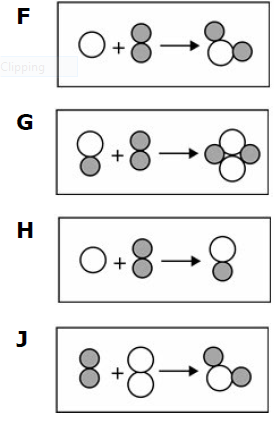
Which of the following models best demonstrates a balanced chemical equation?
F
G
H
J
Coal contains carbon and other elements. Carbon dioxide forms when coal burns in the presence of oxygen. Which of these is the best evidence that a chemical reaction occurs when coal burns?
The shape of the coal changes
Oxygen is present
A new substance is produced
Coal is made up of more than one element

A student listed how different parts of the body work to aid in the digestion of food.
Which of the following is a chemical change that occurs to the food?
The food particles break into smaller pieces as food is chewed
The movement of food to the stomach after food is swallowed
The breakdown of molecules of food by enzymes and acid in the stomach to form new substances
None of the above
Al2
A single atom
Elemental Molecule
Compound Molecule
None of these
How many Aluminum atoms are in Al2O3?
3
2
5
Does this follow the Law of Conservation of Mass? (Is it balanced?)
Na + H2O --> NaOH + H2
Yes
No
Example: H2
H2 + O --> H2O
H2 + Cl2 --> HCl
Fe + S --> FeS
Al + O2 --> 2Al2O3
2Mg + O2 ---> 2MgO
which are the reactants?
H2 + O2 --> H2O


In the equation what is the mass of the new substance FeS?
S + Fe = FeS
32g + 56g = ?
when does a chemical reaction take place ?
when a physical change occurs
when a chemical change occurs
both a and b
none of the above
What are the substances on the left side called and right side of the chemical equation called respectively ?
products and reactants
groups and electrons
nothing
reactants and products
Which of the following is not a physical change?
(a) Boiling of water to give water vapour
(b) Melting of ice to give water
(c) Dissolution of salt in water
(d) Combustion of Liquefied Petroleum Gas (LPG)
Which of the following statements about the given reaction are correct?
3Fe(s) + 4H2O(g) => Fe3O4(s) + 4H2(g)
(i) Iron metal is getting oxidised
(ii) Water is getting reduced
(iii) Water is acting as reducing agent
(iv) Water is acting as oxidising agent
(a) (i), (ii) and (iii)
(b) (iii) and (iv)
(c) (i), (ii) and (iv)
(d) (ii) and (iv)
which of the following observations helps to determine that a chemical reaction has taken place ?
change in state
change in color
change in temperature
all of the above
A solution of X is used for white washing walls. it reacts slowly with Y in air to form a thin layer of B on walls which gives walls a shiny finish. which of the following options correctly represents X,Y and B ?
X =slaked lime , Y = nitrogen , B=calcium oxide
X =Calcium Hydroxide, Y=Oxygen, B = Calcium carbonate
X= slaked lime, Y=Carbon oxide,B= calcium chloride
X= slaked lime,Y=Carbon dioxide,B=Calcium carbonate

What is the process that is happening in this image ? And also give the name of the two gas that are present in two test tubes and the ratio they(gases) are present in .
process= thermal decomposition,
gases present=hydrogen,carbon dioxide, ratio=2:1
process=corrosion,
gases present=oxygen,hydroxide, ratio=2:1
process=electrolysis of hydrogen polyoxide
gases present=hydrogen,oxygen, ratio=2:1
process=electrolysis of water
gases present=hydrogen,oxygen,ratio=4:2
Choose the correct balanced equation of barium chloride and aluminium sulphate.
3BaCl2+Al2(SO4)3→3BaSO4+2AlCl3
2BaCl2+Al2(SO4)3→2BaSO4+2AlCl3
6BaCl2+2Al2(SO4)3→6BaSO4+4AlCl3
none of the above
Choose the incorrect statement from the following options about saving foods from rancidity.
keep food items in air tight containers
flushing food items with carbon dioxide
flushing food items with nitrogen
keep food items in air loose containers
Silver article turns black when kept in open for a few days due to formation of
H2S
AgS
AgSO4
Ag2S
In which of the following process a chemical reaction has taken place?
Ice melts into water
A wet shirt got dried in sunlight
A brown layer is formed over iron rod kept in air
sugar getting dissolved in water
A chemical change is different than a physical change because in a chemical change
chemicals are used
molecules do not physically touch
a new substance is formed and in a physical no new substance is formed
the change can be seen but in a physical change it cannot
Which of the following 2 are chemical reactions?
sugar dissolving in water
water turning into steam
burning wood
mixing baking soda and vinegar
tearing paper

How many Carbons are present on the reactant side?
1
2
3
4

How many Hydrogens are on the product side of this chemical equation?
1
2
3
4

Why are chemical equations always balanced? Select ALL that apply.
Matter cannot be created.
Matter cannot be destroyed.
Matter can only be rearranged/conserved.
Matter doesn't matter.

In a chemical reaction, if the reactants are heated, the reaction usually happens
slower
faster
at the same rate
in a smaller volume

Some chemical reactions require a substance called a catalyst. The purpose of a catalyst is
to warm up the reaction
to speed up the reaction
to create more reactants
to stop the reaction
What does it mean for a reaction to be endothermic? Choose 2 of the following.
When two substances react, the temperature of the mixture decreases.
When two substances react, the temperature of the mixture increases.
There is less energy going into the reactant to break the bond than there is energy leaving the product.
There is more energy going into the reactant to break the bond than there is energy leaving the product.
The amount of energy entering and leaving is the same.
What does it mean for a reaction to be exothermic? Choose 2 of the following.
When two substances react, the temperature of the mixture decreases.
When two substances react, the temperature of the mixture increases.
There is less energy going into the reactant to break the bond than there is energy leaving the product.
There is more energy going into the reactant to break the bond than there is energy leaving the product.
The amount of energy entering and leaving is the same.

Is this chemical equation balanced? Why or why not? Choose the BEST answer.
Yes, the amount of atoms for each element are equal on both the reactant and product side.
No, the carbons are not the same number on both the reactant and product side.
No, neither the carbons or hydrogens are the same amount on both the reactant and product side.
No, none of the elements (carbon, hydrogen, or oxygen) are the same amount on both the reactant and product side.

Which is the correct word equation for photosynthesis?
water + glucose + oxygen ---> energy + carbon dioxide
energy + oxygen + carbon dioxide ---> water + glucose
water + carbon dioxide + energy ---> glucose + oxygen
glucose + oxygen ---> water + carbon dioxide + energy
Which of the following is the word equation for cellular respiration?
water + carbon dioxide + energy ---> glucose + oxygen
water + glucose ---> energy + carbon dioxide + oxygen
oxygen + carbon dioxide ---> water + energy + glucose
glucose + oxygen ---> water + carbon dioxide + energy

Photosynthesis takes place in the
mitochondria
chloroplast
nucleus
cytoplasm

cellular respiration takes place in the
mitochondria
chloroplast
nucleus
cytoplasm
What is the purpose of photosynthesis. Select all that apply.
to form glucose, food for the plant
to form carbon dioxide
to form oxygen
to form energy
to form water
What is the purpose of cellular respiration. Select all that apply.
to form glucose
to form oxygen
to form carbon dioxide
to form energy
to form water
Which of the following is a common sign that a chemical change has occurred?
A chemical has turned a different color, bubbled, and/or changed temperature.
A chemical has changed to a different state of matter, such as a liquid to a solid.
A chemical has changed size.
A chemical has become a different shape.
2H2 + O2 --> 2H2O
Al + O2 --> 2Al2O3
HgO --> Hg + O2
Mg + __HCl ---> MgCl2 + H2
_CF4 + _Br2 -- _CBr4 + _F2

