
 Worksheets
Chapter 3 &4 Quizizz
Total questions: 163
Worksheet time: 6hrs 4mins


f(x) = x2 to the graph of g(x) = (x + 4)2?
h = -5(t - 2)2.
Maria throws a ball with a path of
h = -5(t - 2)2 + 10.
Which description is reasonable for the difference in the two equations?

Reflected over the x-axis
Stretched by a factor of 2

Moves up 2
Moves left 4


Moves down 1
Moves right 1
y = 4x2
y = 2x2 - 2
y = 0.5 x2
y = x2
y = 2x2 - 2
y = 4x2
y = 2x2 - 2
y = x2
y = 0.5 x2
y = 4x2
y = 0.5x2
y = x2
f(x) = -2x2 + 4x - 6
f(x) = x2 - 8x + 15.
f(x) = -x2 - 4x + 12.
The standard form of a quadratic function is
ax2 + bx + c
a(x - h)2 + k
y - y1 = m(x - x1)
Ax + By = C
Identify A, B, and C if y=3x2-8+5x
A=3, B=5, C=-8
A=3, B=-8, C=5
A=3x2, B=5x, C=-8
A=3x2 , B=-8, C=5x
In the quadratic expression, f(x) = ax2 + bx + c , the values a, b, and c are
coefficients
variables
quadratic terms
none of the above
What are the values of a, b, and c in the following quadratic equation:
y = 4x2 – 8x + 3
a = -4, b = -8, c = +3
a = 4, b = -8, c = -3
a = 4, b = 8, c = 3
a = 4, b = -8, c = 3
In the quadratic expression, f(x) = ax2 + bx + c , the formula for the axis of symmetry is:
x = ax2
x = −2ab
x = f(x)
x = c
What is the axis of symmetry of the following expression?
f(x) = x2- 4x + 5.
x = 2
x = -2
x = 4
x = -4
Find the coordinates of the vertex (x, y) from the expression:
y = 2x2 + 4x + 6
(-1,-4)
(1,-4)
(-1,4)
(1,4)
Factor completely.
5x2−20x
5(x - 20)
5x(x - 20)
5x(x - 4)
5(x - 4)
Factor completely.
10x4y5+14x3y4−8x2y
2(5x4y5+7x3y4−4x2y)
2(8x4y5+12x3y4−6x2y)
2xy(5xy+7xy−4xy)
2x2y(5x2y4+7xy3−4)
Factor completely.
x2+10x+24
(x + 4)(x + 6)
(x + 3)(x + 8)
(x - 4)(x - 6)
(x - 3)(x - 8)
Factor completely.
x2−16
(x + 8)(x - 8)
(x + 4)(x - 4)
(x + 6)(x - 10)
(x + 4)(x + 4)
Factor completely.
4x2−49
(2x + 7)(2x + 7)
(2x + 7)(2x - 7)
(2x - 7)(2x - 7)
(4x + 7)(4x - 7)
Factor completely.
16x2−100
(4x + 10)(4x + 10)
4(4x2−25)
4(2x + 5)(2x - 5)
(4x + 10)(4x - 10)
Factor completely.
4x2−20x+25
(2x + 5)(2x - 5)
(2x + 5)(2x + 5)
(2x - 5)(2x - 5)
(4x - 5)(x - 5)
Factor completely.
x2+12x+36
(x + 6)(x + 6)
(x + 9)(x + 4)
(x - 6)(x - 6)
(x + 3)(x + 12)
Factor completely.
36x2−25
(6x + 5)(6x + 5)
(6x + 5)(6x - 5)
(6x - 5)(6x - 5)
(18x + 5)(18x - 5)
Factor completely.
49x2−42x+9
(7x + 3)(7x - 3)
(7x + 3)(7x + 3)
(7x - 6)(7x - 3)
(7x - 3)(7x - 3)
Factor completely.
36x4−100x2
(6x + 5)(6x + 5)
(6x + 5)(6x - 5)
4x2(3x+5)(3x−5)
4x2(9x2−25)
Factor completely.
x2−19x+48
(x + 24)(x + 2)
(x - 3)(x - 16)
(x + 3)(x + 16)
(x - 24)(x - 2)
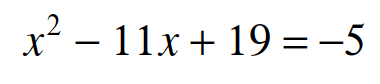
Solve the equation by factoring.
x = {3,8}
x = {-3,8}
x = {3,-8}
x = {-3,-8}
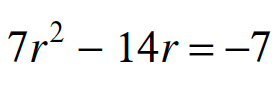
Solve the equation by factoring.
x = {1}
x = {-1}
x = { }
no solution
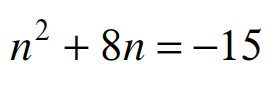
Solve the equation by factoring.
x = {-5,-3}
x = {5,-3}
x = {-5,3}
x = {5,3}
How many solutions can a quadratic have?
1 solution
3 solutions
0 solutions
2 solutions
What can the roots to a quadratic equation be called?
zeros
solutions
x-intercepts
none of the choices
What is the quadratic formula?


What is the axis of symmetry formula?
y = mx+b
y = ax2+bx+c
b2 - 4ac
x = -b/2a
Solve the equation using the quadratic formula.
x2 + 7x = x - 10
-6/2 + √4
-6/2 - √4
no solution
∅
Solve the equation using the quadratic formula.
4x2 +9x = 12x
x = {0, 3/4}
x = {0, -3/4}
x = {0, 4/3}
no solution
Use the discriminant to find the number of solutions for the following equation.
y = x2 +10x + 25
2 solutions
1 solution
0 solutions
Use the discriminant to find the number of solutions for the following equation.
y = -3x2 +5x - 8
2 solutions
1 solution
0 solutions
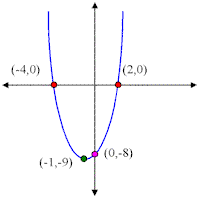
Which value is the vertex?
(-4, 0)
(-1, -9)
(0, -8)
(2, 0)
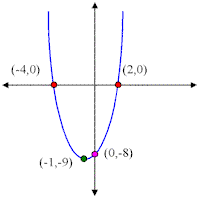
Which value is the y-intercept?
(-4, 0)
(-1, -9)
(0, -8)
(2, 0)

Does this graph have a maximum or a minimum?
maximum
minimum
I am not sure.
neither
What is the equation for standard form?
y = x2 + bx + c
y = ax2 + bx + c
y = mx + b
Ax + By = C
x2-5x+6=0 are
b2-4ac is called
4x2-5x-9=0 are
x2-7x+12=0 is
Solve the equation by factoring.
x = {3,8}
x = {-3,8}
x = {3,-8}
x = {-3,-8}

Solve by factoring
-4, 2
-2, 4
-16
-4
Solve the following quadratic equation: 4x2−9=0
x=23 & x=−23
x=32 & x=3−2
x=49
x=94
Find the value of "c" that completes the square.
x2+8x+c-4
4
8
16
Find the value of "c" that completes the square.
x2+28x+c28
14
196
56
Find the value of "c" that completes the square.
a2−22a+c-121
121
11
-11
Find the value of "c" that completes the square.
t2+7t+c27
3.5
449
249
Find the value of "c" that completes the square.
k2−18k+c
(a)
Find the value of "c" that completes the square. Then rewrite the trinomial as a perfect square.
n2−20n+c10; (n−10)2
100; (n−10)2
100; (n+10)2
10; (n+10)2
Find the value of "c" that completes the square. Then rewrite the trinomial as a perfect square.
x2−2x+c1; (x−2)2
4; (x−2)2
1; (x−1)2
4; (x−1)2
Find the value of "c" that completes the square. Then rewrite the trinomial as a perfect square.
p2+14p+c49; (p+7)2
7; (p+7)2
49; (p+14)2
7; (p+49)2
Find the value of "c" that completes the square. Then rewrite the trinomial as a perfect square.
m2+4m+c4; (m+4)2
2; (m+2)2
2; (m+4)2
4; (m+2)2
Find the value of "c" that completes the square. Then rewrite the trinomial as a perfect square.
b2−12b+c36; (b+6)2
36; (b−6)2
6; (b−36)2
6; (b−6)2
x2 = 9 - 4x
a2 + 10a + 21 = 0
x2 - 4x + 4 = 20,
what goes in the blank?
(x - __ )2 = 20
x2 +8x + c
x2 + 2x + c
x2 - 12x + c
x2 + 6x = 5
x2 + 26x + ___
a2 + 10a + 21 = 0
k2 − 12k + 23 = 0
x2 -4x = 5
y2 + 10y = -9
x2 +12x = 5
x2+ 6x - 4 = 36
x2 -4x = 5
Determine the values of a, b, and c for the quadratic equation:
4x2 – 8x = 3
a = 4, b = -8, c = 3
a = 4, b =-8, c =-3
a = 4, b = 8, c = 3
a = 4, b = 8, c = -3
Use the quadratic formula to find the solutions for
y = -x2 - 5x + 12
No Real Solution


What should you do first in solving this equation?
x2 + 6x - 13 = 3
Factor
Write down: a = 1, b = 6, c = -13
Subtract 3 from both sides.
Add 3 to both sides.
2x2 - 9x - 35 = 0

2r2+3r−1=0
Solve using the quadratic equation.
2m2=−2m+12
Solve using the quadratic formula.
x=2,−3
x=3,−2
x=1±13
No Solution
Solve using the quadratic formula...
9x2 = 4 + 7x


No solution
Solve using the quadratic formula:
4x2 + 4x + 1 = 0
x = -½
x = -2
x = 0
x = ½

What is this formula?
This is the standard formula.
This is the quadratic formula.
This is the square root formula.
This is the Pythagorean formula
Determine the values of a, b, and c for the quadratic equation:
4x2 – 8x = 3
a = 4, b = -8, c = 3
a = 4, b =-8, c =-3
a = 4, b = 8, c = 3
a = 4, b = 8, c = -3
Use the quadratic formula to find the solutions for
y = -x2 - 5x + 12
No Real Solution
x2 + 4x - 40 = -8


What does the discriminant determine?
Whether the graph goes up or down
The vertex
The number of Solutions
The y-intercept
If the discriminant is negative, how many solutions does the graph have?
2
1
0
If the discriminant is zero, how many solutions does the graph have?
2
1
0
Find the discriminant: 2a2 - 5a + 5 = 0
44
65
-15
-144
How many real solutions does 2a2 - 5a + 5 = 0 have?
2
1
0
Find the discriminant: 3k2 + k - 1 = 0
36
-11
13
-20
How many real solutions does 3k2 + k - 1 = 0 have?
2
1
0
Solve x2 - 2x - 8 = 0 using the quadratic formula
x = 2 , -3
x = 4 , -2
x = 2 , -4
x = 3 , -2
No Solution
Solve 4x2 - 2x + 4 = 0 using the quadratic formula
x = 2, -1
x = 3, -1
x = 1, -2
x = 1, -3
No Solution
Solve a2 - 4a + 4 = 0 using the quadratic formula
2
-2
4
-4
No Solution
Solve 2r2 - 3r -5 = 0 using the quadratic formula
x = 1/2, -2
x = 5/2, -1
x = 2, -1/2
x = 1, -5/2
No Solution
Solve 2p2 - 3a + 1 = 0 using the quadratic formula
x = 5, -4
x = 4, -5
x = 1, 1/2
x = -1/2, -1
No Solution
√-4
-2
-2i
2
2i


(4 – 3i)(-7 – 2i)

(1+3i)(2-i)
(10+ 15i) - (48 - 30i)
(-7+6i)2
49+36i
85
13-84i
13+84i
(6+i)(-3+6i)
3+7i
-18+6i
-24+6i
-18+12i
4+5i+6+6i
21i
20i+36
24+30i
10+11i
(3+4i)(-8-i)
-5+3i
-24-4i
-24-4i2
-20
-20-36i
(7 + 2i)(9 - 6i)
√-108
2i - 7i + 10
(2i)(3i)

