
 Worksheets
CHS Y7 Science - Skills
Total questions: 45
Worksheet time: 25mins

What does this symbol tell you?
Corrosive substances are present; protect your hands.
Wash your hands.
Extreme temperatures are present; wear appropriate gloves.
Bacteria are present.

What does this symbol tell you?
There are pirates around.
This chemical is toxic.
This chemical is flammable.
This chemical is corrosive.

This symbol tells us that a chemical is...
dangerous.
explosive.
toxic.
an Irritant or harmful in some way.

Which safety symbol is this?
Flammable
Oxidizing agent
No open flames
Explosive

This piece of equipment is called a (a) burner.

When you light this piece of equipment then the airhole must be...
open.
closed.
half open.
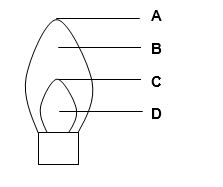
When the airhole of a lit burner is OPEN then the flame is...
blue and warm.
blue and very hot.
yellow and very hot.
yellow and warm.

This piece of equipment is called a...
beaker.
measuring cylinder.
test tube.
conical flask.

This piece of equipment is called a...
beaker.
measuring cylinder.
test tube.
conical flask.

This piece of equipment is used to measure the ___________ of liquids.
temperature
volume
amount
mass

Which is the best flame to use to heat up anything in science?
The yellow, safety flame
A roaring, blue flame
An invisible flame.

A thermometer is used to measure the _____________ of an object.
temperature
volume
mass
pH
A 'prediction' is...
what we think will happen.
what we know will happen.
what we saw happen.
what we want to happen.
The independent variable in an experiment is...
the variable that we are charge of.
the variable we keep the same.
the variable we measure to get results.
the variable that we cannot control.

This is a...
bar chart.
line graph.
pie chart.
scatter graph.
The dependent variable in an experiment is...
the variable that we are charge of.
the variable we keep the same.
the variable we measure to get results.
the variable that we cannot control.
Which of these symbols would you see on a bottle of concentrated acid?


Which of these symbols would you see on a bottle containing petrol?
Which of these symbols would you see on a bottle of dilute acid?
Variables that you keep the same in an experiment are called (a) variables.
Some chemicals are corrosive. What does this mean?
It can damage skin and other tissues
It can catch fire
It can explode
It is harmful to the environment
Why should the word 'Bunsen' always start with a capital 'B' burner?
It's named after Robert Bunsen.
It was invented in the German city of Bunsen.
It's named after Dr. Bunsen Honeydew.
It's the most important piece of equipment we have so we use a capital letter to show this.
Which of these are laboratory rules? (Hint: There may be more than one correct answer!)
Don't eat or drink in a laboratory
Tie your hair back when you are using a Bunsen.
Don't run in a laboratory
Don't taste any chemicals

What is the name of this piece of equipment?
Test tube
Beaker
Measuring cylinder
Conical flask
If an experiment tells you that you need to use 25cm3 of acid, which piece of equipment would you use to measure it out?
A measuring cylinder
A beaker
A test tube
A thermometer

True or False:
Test tubes must be more than half full if you heat things up in them.
True
False
True or False:
This piece of equipment is specially designed so you can swirl liquids around inside it without them spilling.
True
False

Opening the air-hole on a burner allows you to...
heat things up more quickly.
see the flame more easily.
do something else for five minutes.
make a nice coloured flame.

This piece of science equipment is known as a pair of...
(a)

If you ever accidentally spill a chemical in science lessons then you should...
clear it up yourself so you don't get told off.
tell your teacher immediately.
leave it for someone else to clean up.
taste it to see what it is.

Flammable substances...
can catch fire easily.
will explode on heating.
make other chemicals burn better.
are hot to the touch.

True or False:
Using a yellow flame will eventually cover and glass equipment in soot.
True
False
When heating a test tube, it should be...
pointed away from yourself and other students.
held with two fingers.
filled completely with the liquid being heated.
heated over a tripod and gauze mat.

If you break glassware in the lab, you should...
tell your teacher.
clean it up quickly before the teacher notices.
scream at the top of your lungs.
put the pieces in your pocket and take them home.
Which of these has the write-up of an experiment in the correct order?
Apparatus, Conclusion, Method, Results
Apparatus, Method, Results, Conclusion
Method, Results, Conclusion, Apparatus
Conclusion, Method, Apparatus, Results
True or False: When making a results table, the units should only go in the heading at the top.
True
False
Which of these graphs is best for plotting two sets of numbers against each other?
Bar chart
Line graph
Pie chart
You can't draw a graph for this information

This archer has been...
accurate and reliable.
accurate but unreliable.
inaccurate but reliable.
neither accurate nor reliable.

The best graph for this type of data is a...
line graph
bar chart
scatter graph

This measuring cylinder contains (a) cm3 of water.

This measuring cylinder contains (a) cm3 of water.

The best way to show this data is using a...
Bar chart
Line graph
Pie chart
You couldn't draw a graph of this data

True or False: Only a trained scientist should do the 'whoosh' bottle experiment.
True
False

