
 Worksheets
Quiz Chapter 3 & 4 Form 4 Mathematics KSSM
Total questions: 25
Worksheet time: 1hrs 15mins
Which of the following are statements.
3m ×2m=6m
A prime number has 2 factors.
x + y
Express 2300 in standard form.
x+2=3
Which statement is false?
Some quadratic function graphs intersect the x-axis.
Bougainvillea is the national flower of Malaysia and Kuching is the capital of Sarawak.
Hibiscus is the national flower of Malaysia or Rafflesia is the biggest flower in Malaysia.
If x > 3, then x > 1.
If p and q are both false statements respectively, then
not p and not q is a true statement.
p and q is a true statement.
not p and q is a true statement.
not p or q is a false statement.
Complete the premise in the following argument.
Premise 1 : If set P is a subset of set Q, then P ∩ Q = P.
Premise 2 : .........................................................................
Premise 3 : Set P is not a subset f set Q.
P ⋃ Q = Q
P ∩ Q = P
P ∩ Q ≠ P
P ⋃ Q ≠ P
State whether the following statement is true or false :
All polygons have five sides.
True
False
Determine the antecedent and consequent of the following implication :
If k = −4, then k³ = −64.
Antecedent : k ≠ −4
Consequent : k³ ≠ −64
Antecedent : k ≠ −64
Consequent : k³ ≠ −4
Antecedent : k = −64
Consequent : k³ = −4
Antecedent : k = −4
Consequent : k³ = −64
Which of the following implications is true?
If M ∩ N = { }, then M = { }.
If a > −3, then a² > 9.
If a < 0, then a² < 0.
If n = −2, then n² + 2n = 0.
Choose two implications based on the following statement.
y > 3 if and only if 2y > 6
If y > 3, then 2y > 6
If y < 6 , then 2y > 6
If 2y > 6, then y > 3
If 2y > 6, then y < 6
Refer to the following statement: "If a polygon is a quadrilateral, then it is a trapezoid."
What is the converse of this statement?
If a polygon is not a quadrilateral, then it is not a trapezoid.
If a polygon is not a trapezoid, then it is not a quadrilateral.
If a polygon is a trapezoid, then it is a quadrilateral.
A rectangle is also a quadrilateral.
Refer to the following statement: "If a polygon is a quadrilateral, then it is a trapezoid."
What is the inverse of this statement?
If the polygon is not a quadrilateral, then it is not a trapezoid.
If the polygon is not a trapezoid, then it is not a quadrilateral.
If the polygon is a trapezoid, then it is a quadrilateral.
A rectangle is also a quadrilateral.
Refer to the following statement: "If a polygon is a quadrilateral, then it is a trapezoid."
What is the contrapositive of this statement?
If a polygon is a trapezoid, then it is a quadrilateral.
If a polygon is not a quadrilateral, then it is not a trapezoid.
If a polygon is not a trapezoid, then it is not a quadrilateral.
A rectangle is also a quadrilateral.
Determine the validity and soundness of the following deductive arguments :
Premise 1 : All prime numbers are odd numbers.
Premise 2 : 5 is a prime number.
Conclusion : 5 is an odd number.
Valid and sound.
Valid but not sound.
Not valid but sound.
Not valid and not sound.
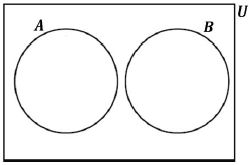
Which of the following statements are true for the Venn diagram shown?
A ∩ B = ⊘
A ⋃ B = ⊘
A ⋃ B = A
A ⋂ B = A
Let C = {2, 5, 7, 10} and B = {2, 4, 6, 8}. Find C U B.
{2, 4, 6, 8, 10}
{2, 4, 5, 6, 7, 8,10}
{2, 2, 4, 5, 6, 7, 8, 10}
Let C = {2, 5, 7, 10} and B = {1, 3, 5, 7, 9}. Find C ∩ B.
{1, 2, 3, 5, 7, 9, 10}
{2, 4, 5, 6, 7, 8, 10}
{5, 7}
If A = {1, 2, 3, 4, 5, 6}, B = {1, 2, 3, 5, 7, 9} and C = {3, 5, 6, 7, 8, 9}, what is (A ⋃ B) ⋂ C?
{3, 4, 5, 6, 7, 9}
{3, 4, 5, 6, 7, 8, 9}
{3, 5, 6, 7, 9}
{ }
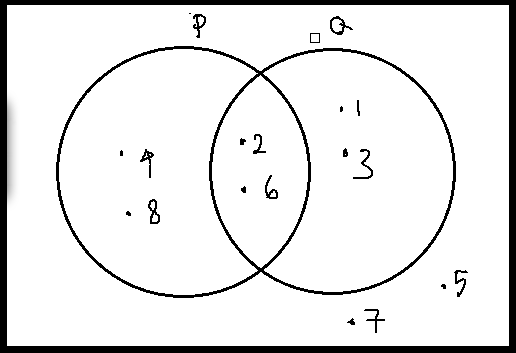
(A∩B)′
{2, 6}
{5, 7}
{1, 3, 4, 8}
{1, 3, 4, 5, 7, 8}
If P = {0, 1, 2, 3, 4}, Q = {4, 6, 8} and R = {6, 12, 18}, then what is (P ∩ Q) ∪ R?
{4}
{4, 6}
{4, 6, 8}
{4, 6, 12, 18}

Determine n(W ⋃ C)'.
6
15
21
44

Which of the following operations on sets describe the given Venn diagram?
A ∩ B
A ∩ B′
A′ ∪ B′
A ∪ B
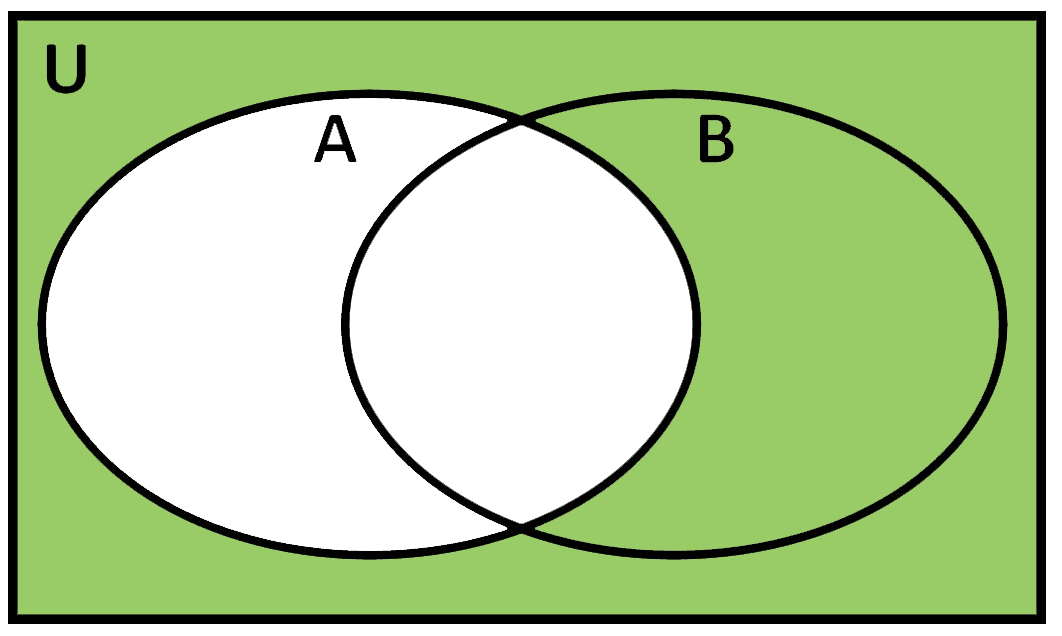
Which of the following operations on sets describe the given Venn diagram?
A′
B′
A − B
A ∩ B

The diagram shows a Venn diagram with the universal set, ξ=A∪B∪C.
List all the elements of set (A∩B) ′.
{r, s}
{q, r}
{p, t}
{p, q, t}
Given
ξ=A∪B∪C
A = {1, 2, 3, 4}
B = {4, 5}
C = {3, 4, 5, 6, 7}
Which of the following Venn diagram best describes the above information?


The diagram is a Venn diagram showing the number of elements in sets P, Q and R such that the universal set, ξ = P ∪ Q ∪ R.
2
3
4
5

The diagram is a Venn diagram showing the universal set, ξ, set L, set M and set N.
Which of the following sets represents the shaded region?
(M ∪ N') ∩ L'
(M ∪ N) ∩ L'
(M ∩ N') ∩ L'
(M ∩ N) ∩ L'

