
 Worksheets
electrolysis
Total questions: 55
Worksheet time: 45mins
It is essetial that the electrolyte is a liquid so that...
Charged ions can not migrate towards the electrodes.
Charged ions can migrate towards the electrodes.
The solution can move around.
The current can flow through it.
When NaCl solution is electrolysed what forms at the anode?
Hydrogen
Oxygen
Chlorine
Sodium
Choose the half-equation that shows the discharge of aluminium ion.
Al3+ - 3e- --> Al
Al2+ + 3e- --> Al
Al3+ + 3e- --> Al
Al3+ --> Al + 3e-
Ionic compounds do not conduct electricity when they are solid because,
their electrons are not free to move
their ions are free to move
their ions are not free to move
their electrons are free to move
What change is observed at cathode during electrolysis of aqueous copper(II) chloride using carbon electrode
Nothing
pink solid deposit
bubbles of green gas
colourless gas
What are the ions present in molten Al2O3?
Al2+ and O3-
Al2- and O3+
Al3+ and O2-
Al3- and O2+
Oxidation is loss of electron. Where does oxidation take place during electrolysis.
At anode
In the electrolyte
At the circuit
At cathode
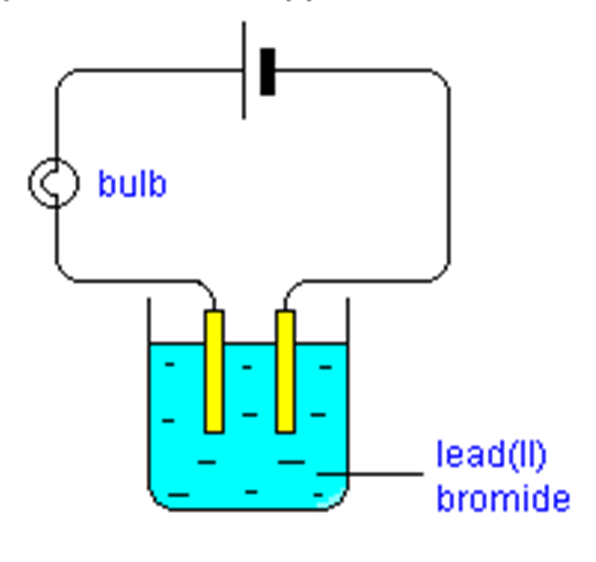
The diagram shows the electrolysis of lead(II) bromide using inert electrodes. Why does the bulb only light up when the lead(II) bromide is melted?
Bromine atoms in lead(II) bromide are converted to ions when it is melted
Electrons flow through the lead(II) bromide when it is melted
The ions in lead(II) bromide are mobile charge carriers in the molten state.
There are no ions in solid lead(II) bromide

What is the half-equation for the discharge of hydroxide ions?
2O2- --> O2 + 4e-
OH- --> OH + e
4OH- --> 2H2O + O2 + 4e-
2H2O + O2 + 4e- --> 4OH-

The picture shows electrolysis of copper(II) sulphate solution using graphite electrodes. Besides formation of brown solid on the cathode, what other observations can be made?
The mass of graphite anode decreases.
The blue colour solution becomes paler.
Bubbles of gas form at the anode.
The blue colour solution becomes darker.

What are the products at the electrodes when dilute sulfuric acid is electrolysed using inert electrodes?
A
B
C
D

Electricity is passed separately through concentrated hydrochloric acid, concentrated aqueous
sodium chloride and dilute sulfuric acid.
In which rows are the electrolysis products correctly named?
1, 2 and 3
1 and 2 only
1 and 3 only
2 and 3 only

Which row describes the electrolysis of molten potassium bromide?
A
B
C
D

What are the electrode products when molten silver iodide is electrolysed between inert electrodes?
A
B
C
D

Copper and hydrogen can each be formed by electrolysis.
At which electrodes are these elements formed?
A
B
C
D


Choose all the inert electrodes:
iron
nickel
graphite
platinum
The electrolytic deposition of a superior metal on a baser metal is:
electro-refining
electro-plating
electro-metallurgy
electrolysis
Which is the correct electrochemical series?
Na, Al, Fe, Mg, Zn
Mg, Fe, Zn, Na, Al
Na, Mg, Al, Zn, Fe
Fe, Zn, Na, Mg, Al
Choose all the correct reasons for electroplating:
Improves the electrical conductivity of the article.
Prevents corrosion or rusting of the base metal.
Makes the article dull.
Makes the article attractive.
During electroplating an article with silver, the electrolyte used is:
silver nitrate solution
silver cyanide solution
sodium argentocyanide solution
nickel sulphate solution
The blue colour of aq. Copper[II] sulphate solution ________ during electrolysis of aq. CuSO4 using copper electrodes, but ______ when platinum electrodes are used.
remains unchanged ; fades
remains unchanged; remains unchanged
fades ; fades
None of the above
The particles in weak electrolytes are:
molecules only
ions and unionised molecules
ions only
All of the above
The preferential discharge of the ions depends on its position in the (a) series.
When silver is being electroplated onto the cup,
the cup is at the anode.
silver is at the anode.
the electrolyte is aqueous gold nitrate


When NaCl solution is electrolysed what has forms at the cathode?
Hydrogen
Oxygen
Chlorine
Sodium

The diagram shows an electrolysis experiment.
During the electrolysis, sodium was formed at electrode P and chlorine at electrode Q.
Which choice correctly identifies P, Q and X?
P = anode; Q = cathode; X = concentrated solution of sodium chloride in water
P = anode; Q = cathode; X = molten sodium chloride
P = cathode; Q = anode; X = concentrated solution of sodium chloride in water
P = cathode; Q = anode; X = molten sodium chloride
The diagram shows the electrolysis of aqueous sodium chloride.
Which choice correctly identifies P, Q and X?
P = Hydrogen Q = Oxygen; X = sodium chloride solution
P = Sodium Q = Chlorine; X = water
P = Sodium; Q = Oxygen X = hydrochloric acid solution
P = Hydrogen Q = Chlorine X = sodium hydroxide solution

A
B
C
D
Identify the weak electrolyte
NaCl soln
dil HCl soln
dil H2SO4
aq acetic acid
Which of the following will act as non electrolyte?
Liq CCl4
CH3COOH
Aq. NaOH
Aq. KCl soln

Diagram shows an electrolytic cell.
Which of the substances cause the bulb to light up when electricity passes through it?
Ethanol
Dilute ethanoic acid
Solid lead(II) bromide
Tetrachloromethane
Molten X is electrolysed using carbon electrodes. After 10 minutes, a brown solid is deposited on the cathode and a brown gas is released at the anode. What is molten X?
Lead(II) chloride
Lead(II) bromide
Copper(II) chloride
Copper(II) bromide

