
 Worksheets
Honors Chemistry KSA Review
Total questions: 56
Worksheet time: 13hrs 10mins
What is the electron configuration of a sulfur atom in the ground state?
2–4
2–6
2–8–4
2–8–6
A neutral atom always has an equal number of
neutrons and electrons
neutrons and protons
protons and electrons
protons, electrons, and neutrons

Above is a Bohr-Rutherford diagram of an element.
Which element could be represented by this diagram?
calcium
cadmium
chlorine
no known element

Which choice above shows the correct electron dot structure for the atom whose electronic structure is 2–8–7 ?
1
2
3
4
What is the total number of electrons in the second principal energy level of a calcium atom in the ground state?
6
2
8
18

HS-PS1-7. Law of Conservation of Mass
The Haber process is an industrial process to produce ammonia from hydrogen and nitrogen. Balance the equation and sum the coefficients. Then select which of the images show the balanced equation? __N2 + __H2 → __NH3 *Hydrogen is white. Nitrogen is blue.
Sum of the Coefficients is 6
The correct image is C
Sum of the Coefficients is 8
The correct image is A
Sum of the Coefficients is 7
The correct image is B
Sum of the Coefficients is 3
The correct image is D
Sum of the Coefficients is 5
The correct image is C

HS-PS1-7. Law of Conservation of Mass
Hydrogen gas and oxygen gas synthesize to form water. Balance the equation and sum the coefficients. Then select which of the images show the balanced equation? *Oxygen is red. Hydrogen is white.
?H2(g) + ?O2(g) → ?H2O(l).
Sum of the Coefficients is 3
The correct image is Figure C.
Sum of the Coefficients is 6
The correct image is Figure A.
Sum of the Coefficients is 5
The correct image is Figure A.
Sum of the Coefficients is 5
The correct image is Figure D.
Sum of the Coefficients is 7
The correct image is Figure C.

HS-PS1-1. Use the periodic table as a model to predict the relative properties of elements based on the patterns of electrons in the outermost energy level of atoms.
Which Group 1 Element is the most reactive? and Why?
Lithium (Li) because its valence electron is farthest from the nucleus.
Lithium (Li) because its valence electron is closest to the nucleus.
Francium (Fr) because its valence electron is farthest from the nucleus.
Francium (Fr) because its valence electron is closest to the nucleus.
HS-PS1-1. Use the periodic table as a model to predict the relative properties of elements based on the patterns of electrons in the outermost energy level of atoms.
Which answer has the elements arranged in order of increasing atomic radius?
Li-Na-K-Rb-Cs-Fr
Fr-Na-K-Rb-Cs-Fr

HS-PS1-1. Use the periodic table as a model to predict the relative properties of elements based on the patterns of electrons in the outermost energy level of atoms.
Which group 17 element is the most reactive?
Astatine (At)
Fluorine (F)
Chlorine (Cl)
Bromine (Br)
Iodine (I)

HS-PS1-1. Use the periodic table as a model to predict the relative properties of elements based on the patterns of electrons in the outermost energy level of atoms.
Which Lewis Dot image, A-E, could represent the valence electrons for group 16?
A
B
C
D
E
HS-PS1-1. Use the periodic table as a model to predict the relative properties of elements based on the patterns of electrons in the outermost energy level of atoms.
Which Lewis Dot image, A-E, could represent a nitrogen atom?
A
B
C
D
E
HS-PS1-1. Use the periodic table as a model to predict the relative properties of elements based on the patterns of electrons in the outermost energy level of atoms.
Which Lewis Dot image, A-E, could represent a carbon atom?
A
B
C
D
E
HS-PS1-1. Use the periodic table as a model to predict the relative properties of elements based on the patterns of electrons in the outermost energy level of atoms.
Which Lewis Dot image, A-E, is the only one that can form up to 4 single bonds?
A
B
C
D
E
HS-PS1-1. Use the periodic table as a model to predict the relative properties of elements based on the patterns of electrons in the outermost energy level of atoms.
Which Lewis Dot image, A-E, could represent the valence electrons for group 18?
A
B
C
D
E
HS-PS1-1. Use the periodic table as a model to predict the relative properties of elements based on the patterns of electrons in the outermost energy level of atoms.
Which Lewis Dot image, A-E, could represent an oxygen atom
A
B
C
D
E

HS-PS1-1. Use the periodic table as a model to predict the relative properties of elements based on the patterns of electrons in the outermost energy level of atoms.
Refer to the image, which group can only form single bonds?
Group 14
Group 15
Group 16
Group 17
Group 18
HS-PS1-1. Use the periodic table as a model to predict the relative properties of elements based on the patterns of electrons in the outermost energy level of atoms.
Refer to the image, how many atoms can bond to elements in group 15?
1
2
3
4
5

HS-PS1-1. Use the periodic table as a model to predict the relative properties of elements based on the patterns of electrons in the outermost energy level of atoms.
Refer to the image, what it the correct Lewis structure for oxygen (O2). *Remember to always count the valance electrons and satisfy the octet rule.
1
2
3
4

HS-PS1-1. Use the periodic table as a model to predict the relative properties of elements based on the patterns of electrons in the outermost energy level of atoms.
When considering the organization of the periodic table, why is Fluorine in group 17?
Fluorine has 17 electrons.
Fluorine has 17 protons.
Fluorine has 9 electrons.
Fluorine has 7 valence electrons.
HS-PS1-1. Use the periodic table as a model to predict the relative properties of elements based on the patterns of electrons in the outermost energy level of atoms.
When considering the organization of the periodic table, why is Nitrogen in group 15?
Nitrogen has 15 electrons.
Nitrogen has 15 protons.
Nitrogen has 7 electrons.
Nitrogen has 5 valence electrons.
HS-PS1-1. Use the periodic table as a model to predict the relative properties of elements based on the patterns of electrons in the outermost energy level of atoms.
When considering the organization of the periodic table, why Potassium (K) in period 4? (row 4)
Potassium has 19 electrons.
Potassium has 1 valence electron.
Potassium has 4 energy shells/levels.
Potassium has 4 valence electrons.
HS-PS1-1. Use the periodic table as a model to predict the relative properties of elements based on the patterns of electrons in the outermost energy level of atoms.
When considering the organization of the periodic table, why is Radon (Rn), in period 6? (row 6)
Radon has 18 electrons.
Radon has 8 valence electrons.
Radon has 6 valence electrons.
Radon has 6 energy shells/levels.
HS-PS1-1. Use the periodic table as a model to predict the relative properties of elements based on the patterns of electrons in the outermost energy level of atoms.
What type of bond will form between Calcium and Chlorine?
Covalent
Ionic
Metallic
CLOSE
HS-PS1-1. Use the periodic table as a model to predict the relative properties of elements based on the patterns of electrons in the outermost energy level of atoms.
What type of bond will form Hydrogen and Oyxgen?
Covalent
Ionic
Metallic
CLOSE
HS-PS1-1. Use the periodic table as a model to predict the relative properties of elements based on the patterns of electrons in the outermost energy level of atoms.
What is the law of electrical attraction in atoms?
Like charges attract.
Opposite charges repel.
Like charges attract and opposites repel.
Opposite charges attract and like charges repel.
HS-PS1-1. Use the periodic table as a model to predict the relative properties of elements based on the patterns of electrons in the outermost energy level of atoms.
True or False: Attraction and repulsion between electric charges at the atomic scale explain the structure, properties, and transformations of matter, as well as the contact forces between material objects.
True
False
HS-PS1-1. Use the periodic table as a model to predict the relative properties of elements based on the patterns of electrons in the outermost energy level of atoms.
True or False: Attraction and repulsion between electric charges at the atomic scale explain the structure, properties, and transformations of matter, as well as the contact forces between material objects.
True
False
HS-PS1-1. Use the periodic table as a model to predict the relative properties of elements based on the patterns of electrons in the outermost energy level of atoms.
Where on the periodic table would you find an element that is shiny, malleable, ductile, and a good conductor of heat and electricity?
On the right side of the periodic table.
In Group 18.
On the left side of the periodic table.
In group 17.
HS-PS1-1. Use the periodic table as a model to predict the relative properties of elements based on the patterns of electrons in the outermost energy level of atoms.
Where on the periodic table would you find an element that is dull, brittle, and a poor conductor of heat and electricity?
A) On the right side of the periodic table.
B) In Group 18.
C) On the left side of the periodic table.
D) In group 17.
A, B, and D
HS-PS1-1. Use the periodic table as a model to predict the relative properties of elements based on the patterns of electrons in the outermost energy level of atoms.
Where on the periodic table would you find an element that is considered a semiconductor of heat and electricity?
On the right side of the periodic table.
In Group 18.
On the left side of the periodic table.
On the "stairstep."
HS-PS1-1. Use the periodic table as a model to predict the relative properties of elements based on the patterns of electrons in the outermost energy level of atoms.
How many protons, neutrons, and electrons are in an atom of Potassium (K)?
19 protons
19 electrons
19 neutrons
19 protons
1 electron
20 neutrons
19 protons
19 electrons
20 neutrons
39 protons
39 electrons
19 neutrons
HS-PS1-1. Use the periodic table as a model to predict the relative properties of elements based on the patterns of electrons in the outermost energy level of atoms.
How many protons, neutrons, and electrons are in an atom of Bromine?
80 protons
35 electrons
35 neutrons
35 protons
35 electrons
45 neutrons
35 protons
35 electrons
35 neutrons
45 protons
35 electrons
45 neutrons
HS-PS1-1. Use the periodic table as a model to predict the relative properties of elements based on the patterns of electrons in the outermost energy level of atoms.
What is an isotope?
Atoms of the same element, but they have a different number of protons.
Atoms of the same element, but they have a different number of electrons.
Atoms of the same element, but they have a different number of energy levels.
Atoms of the same element, but they have a different number of neutrons.
HS-PS1-1. Use the periodic table as a model to predict the relative properties of elements based on the patterns of electrons in the outermost energy level of atoms.
How many protons, neutrons, and electrons are in Carbon-14?
6 protons
6 electrons
14 neutrons
6 protons
6 electrons
6 neutrons
6 protons
6 electrons
8 neutrons
14 protons
6 electrons
8 neutrons
HS-PS1-1. Use the periodic table as a model to predict the relative properties of elements based on the patterns of electrons in the outermost energy level of atoms.
Why are the elements in group 18 non reactive?
They still need to get outer electrons.
They lost their outer electrons.
They already have 8 outer electrons.
HS-PS1-3. Plan and conduct an investigation to gather evidence to compare the structure of substances at the macro and micro scale to infer the strength of electrical forces between particles.
The melting point for silver is 962 degrees Celsius. The melting point for gold is 1064 degrees Celsius. Which of the following best explains this difference in melting point?
Silver has stronger intermolecular forces than gold.
Silver has more protons than gold to help hold it together.
Gold has weaker intermolecular forces than silver.
Gold has stronger intermolecular forces than silver.
HS-PS1-3. Plan and conduct an investigation to gather evidence to compare the structure of substances at the macro and micro scale to infer the strength of electrical forces between particles.
The melting point for table salt (NaCl) is 1479 degrees Celsius. The melting point for water (H2O) is 0 degrees Celsius. Which of the following best explains this difference in melting point?
Salt is held together by covalent bonds which are stronger than ionic bonds.
Salt is held together by ionic bonds which are stronger than covalent bonds.
Solid water (ice) is held together by ionic bonds which are weaker than ionic bonds.
HS-PS1-3. Plan and conduct an investigation to gather evidence to compare the structure of substances at the macro and micro scale to infer the strength of electrical forces between particles.
Why does water have such a high surface tension? (*Hint, when thinking of surface tension, think of what happens when someone does a belly flop in water.)
Water molecules have weak forces of attraction for other water molecules.
Water molecules repel other water molecules.
Water molecules are not polar and are not attracted to each other.
Water molecules are polar, meaning they are "sticky" and the molecules are attracted to each other.
HS-PS1-8. Develop models to illustrate the changes in the composition of the nucleus of the atom and the energy released during the processes of fission, fusion, and radioactive decay.
Gamma rays require the heaviest shielding of all the common types of nuclear radiation because gamma rays have the
highest energy
most intense color
lowest energy
heaviest particles
HS-PS1-8. Develop models to illustrate the changes in the composition of the nucleus of the atom and the energy released during the processes of fission, fusion, and radioactive decay.
Which type of radiation has the largest mass?
beta particle
0-1e
gamma rays
alpha particle
42He
neutron
01n
positron emission
0+1p

HS-PS1-8. Develop models to illustrate the changes in the composition of the nucleus of the atom and the energy released during the processes of fission, fusion, and radioactive decay.
Finish the equation for positron emission: *A proton turning into a neutron.
beta particle
0-1e
gamma rays
alpha particle
42He
neutron
01n
positron particle
0+1e

HS-PS1-8. Develop models to illustrate the changes in the composition of the nucleus of the atom and the energy released during the processes of fission, fusion, and radioactive decay.
HS-PS1-7. Use mathematical representations to support the claim that atoms, and therefore mass, are conserved during a chemical reaction.
What is missing in the nuclear reaction shown?
A
B
C
D
E
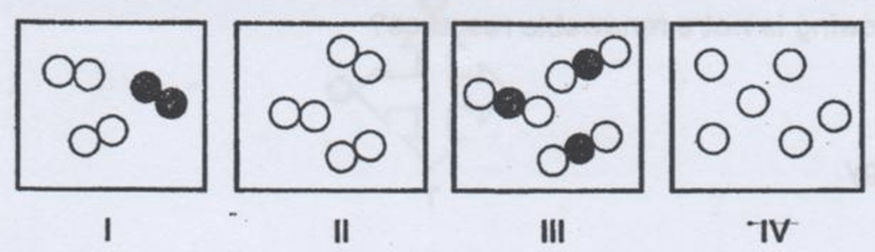
In the diagrams provided, the circles of different colors represent the atoms of different elements. Which diagram represents a mixture?
I
II
III
IV


A pure substance that cannot be broken down into any other substance.
Elements
Compounds
Mixtures
A(n) ______________ is formed when two or more elements chemically combine.
Compound
Element
Mixture
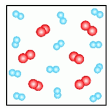
This diagram represents a _____.
HINT: Diatomic Elements like O2, H2, N2, Etc. exist in nature bonded together in pairs.
HS-PS1-3. Plan and conduct an investigation to gather evidence to compare the structure of substances at the macro and micro scale to infer the strength of electrical forces between particles.
When the vapor pressure of a liquid in an open container equals the atmospheric pressure, the liquid will
freeze
crystallize
melt
boil

PS1.C: Nuclear Processes Nuclear processes, including fusion, fission, and radioactive decays of unstable nuclei, involve release or absorption of energy. The total number of neutrons plus protons does not change in any nuclear process.
What type of nuclear reaction is taking place in the image?
Fusion
Alpha Decay
Beta Decay
Fission
PS1.C: Nuclear Processes Nuclear processes, including fusion, fission, and radioactive decays of unstable nuclei, involve release or absorption of energy. The total number of neutrons plus protons does not change in any nuclear process.
What are the atomic masses for the reactants and the products?
Reactants 92
Products 92
Reactants 235
Products 92
Reactants 236
Products 236
Reactants 327
Products Energy
PS1.C: Nuclear Processes Nuclear processes, including fusion, fission, and radioactive decays of unstable nuclei, involve release or absorption of energy. The total number of neutrons plus protons does not change in any nuclear process.
In the image, the mass of the reactants and the products are equal. What law does this illustrate with regards to matter and mass?
That matter can always be destroyed.
That matter is never created or destroyed.
That energy is always used and destroyed.
That the mass you started with, will never equal the mass you ended with.
PS2.B: Types of Interactions Attraction and repulsion between electric charges at the atomic scale explain the structure, properties, and transformations of matter, as well as the contact forces between material objects.
Ionic bonding involves...
Select all that apply.
A cation (+ ion) bonded to an anion (-ion)
A nonmetal bonded to another nonmetal.
A metal bonded to a nonmetal.
A transfer of electrons between a metal and nonmetal.
PS2.B: Types of Interactions Attraction and repulsion between electric charges at the atomic scale explain the structure, properties, and transformations of matter, as well as the contact forces between material objects.
Covalent bonding involves...
Select all that apply.
A cation (+ ion) bonded to an anion (-ion)
A nonmetal bonded to another nonmetal.
A metal bonded to a nonmetal.
A sharing of electrons between a nonmetal and nonmetal

