
 Worksheets
Final-Physics
Total questions: 157
Worksheet time: 3hrs 15mins


The clown walked 27 feet in 9 seconds. what was his velocity?
18 feet/sec
243 feet/sec
36 feet/sec
3 feet/sec

A unicyclist pedals 40 hours at 5 miles per hour without making any stops. How far does she get?
200 miles
8 miles
35 miles
45 miles
Convert 1800g to kg.
18 kg
1.8 kg
180 kg
0.18 kg
1 minute =
60 minutes
24 hours
60 seconds
30 seconds
conclusion


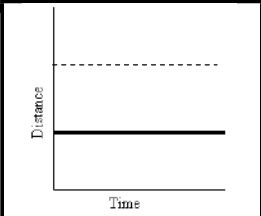
This position vs. time graph shows an object...
not moving
moving with constant velocity
moving with changing velocity

This position vs. time graph shows an object...
not moving
moving with constant velocity
moving with changing velocity

This position vs. time graph shows an object...
not moving
moving with constant velocity
moving with changing velocity

This position vs. time graph shows an object...
not moving
moving with constant velocity
moving with changing velocity

This position vs. time graph shows an object...
not moving
moving with constant velocity
moving with changing velocity
Which of these position vs. time graphs shows an object changing direction?


This motion map shows an object...
not moving
moving with constant velocity
moving with changing velocity

This motion map shows an object...
not moving
moving with constant velocity
moving with changing velocity

Describe the motion:
constant velocity to the right
not moving
constant velocity to the left

Describe the motion:
constant velocity to the right
not moving
constant velocity to the left

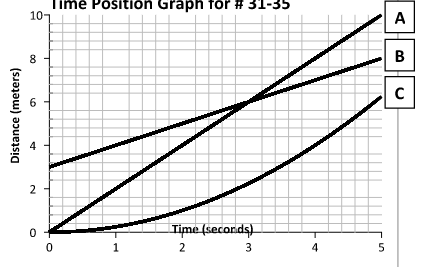
Which line shows an object moving to the left?
A
B
C
D
Which line shows an object that is stopped?
A
B
C
D
What is the difference between the motion of object B and object D?
B is moving faster than D
D is moving faster than B
B is moving to the right, D is moving to the left
D is moving to the right, B is moving to the left

What is the object's starting position?
20 m to the right
20 m to the left
60 m to the right
60 m to the left
What is the object's ending position?
20 m to the right
20 m to the left
60 m to the right
60 m to the left
What is the object's motion between 0-1 seconds?
not moving
medium speed to the right
medium speed to the left

When is the object moving to the left?
0-10 seconds
10-15 seconds
15-40 seconds
40-60 seconds
When is the object stopped?
0-10 seconds
10-15 seconds
15-40 seconds
40-60 seconds
What is the object's initial position?
0 m
60 meters to the right
40 meters to the left

A push or a pull on an object
Force
Gravity
Inertia
Friction
A force exerted by a surface perpendicular to the surface.
Normal
Friction
Gravity
Tension
A force that resists an object's motion
Friction
Gravity
Normal
Tension
A pulling force exerted along a rope, string, wire, cable...
Friction
Gravity
Normal
Tension
The gravitational attraction between an object and the Earth.
Friction
Weight
Normal
Tension
Which of Newton's Laws describes the relationships between Force, mass and acceleration.
1st
2nd
3rd
A shopping cart accelerates more slowly when full. This is an example of Newton's ________ Law.
1st
2nd
3rd
According to Newton's first law, an object in motion will stay in motion unless:
a. An opposing force acts on it.
b. It's in outer space.
c. It stops.
d. It remains at rest.
A rollercoaster heading down a hill is _____________.
at rest
slowing down
accelerating
velocity
if an object stays still or continues moving at the same speed and in the same direction, it is a _______ force.
weak
strong
balanced
unbalanced
According to Newton’s second law of motion, force is equal to mass times ______________________.
inertia
weight
acceleration
direction
True or False. 800 N = 800 kg ⋅ m/s2
True
False
If the net force is equal to zero, the forces acting on the object are
balanced
unbalanced

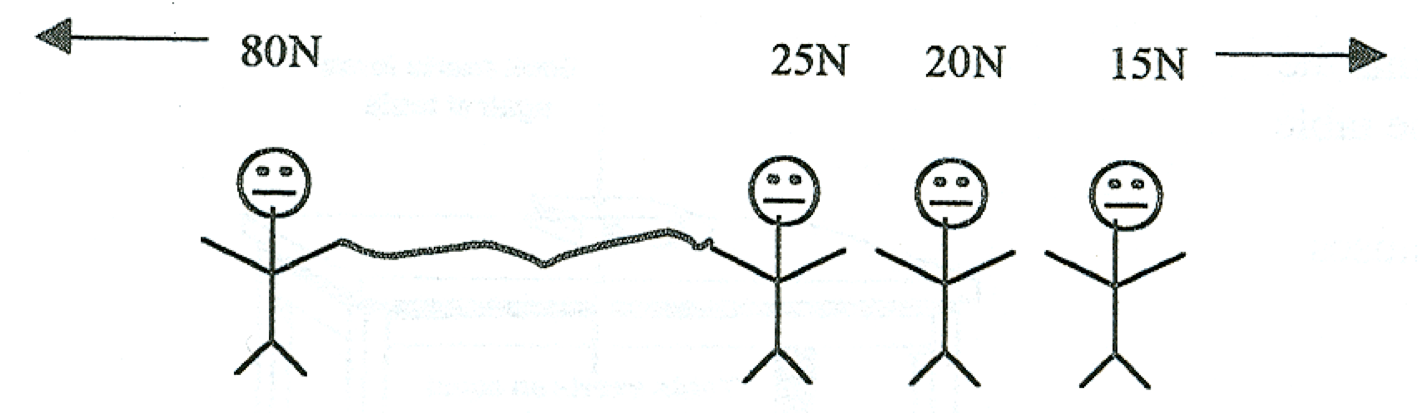
What is the net force?
40 N left
400 N right
0 N Balanced
40 N right

If the man pushes with an equal amount of force, which object will accelerate more?
Car because it has more mass
Lawnmower because it has less mass
Car because it has less mass
Lawnmower because it has more mass
A 25 kg bike accelerates at 10 m/s2. What was the force?
250 N
2.5 N
25 N
15 N
The mass of a wagon is 40 kg. The wagon accelerates at 8 m/s2 . What is the force?
38.25 Kg
320N
5N
3.825Kg
A cat has a mass of 200 kg and accelerates at 3 m/s2 to catch a mouse. How much force would be needed to stop the cat?
200 N
300 N
500 N
600 N
What force is required to accelerate a car at a rate of 2 m/s2 if the car has a mass of 3000 kg?
1500 N
3002 N
6000 N
0.00067 N
A 10 kg bowling ball would require what force to accelerate down an alleyway at a rate of 3 m/s2?
30 N
3.34 N
0.3 N
13 N


130 N 150 N
<------ --------->
100 N 230 N
<------ --------->


True or False. Acceleration of an object is directly proportional to the net force acting on it
True
False
Your car has a mass of 2500 kg and a force of 5000 N. How fast will it accelerate?
20 m/s2
0.5 m/s2
2 m/s2
120 N
If an object was accelerating at 5 m/s2, and a force of 10 newtons was required to accelerate it, what was the object's mass?
50 kg
2 kg
0.5 kg
5 kg
A change in speed or direction; a change in velocity
Acceleration
Force
Inertia
Net force
The sum (total) of all forces acting on an object:
Unbalanced Force
Balanced Force
Newtons
Net Force
A force must be physically touching an object in order to act on it.
True
False
A 50-kg crate is pushed with a horizontal acceleration of 20 m/s2. What net force is acting on the crate?
2.5 N
0.4 N
1000 N
30 N
A 20-N net force acts on an object with a mass of 2.0 kg. What is the object's acceleration?
10 m/s2
0.1 m/s2
40 m/s2
22 m/s2
What is the mass of a motorcycle that accelerates at 4 m/s2 when a net force of 400 N is applied to it?
1600 kg
100 kg
0.01 kg
396 kg
A 20-kg crate is being pushed across a floor with a force of sliding friction of 20 N. If the pushing force is also 20 N, what is the acceleration of the crate?
0 m/s2
2 m/s2
0.5 m/s2
40 m/s2
A winch is supplying a force of 100 N on a large 50-kg crate to move it along a trailer bed with a friction force of 50 N. What is the acceleration of the crate?
0 m/s2
10 m/s2
1 m/s2
2 m/s2
A 75-kg skydiver who has not yet opened his parachute is falling at terminal velocity. What is the magnitude of air resistance force that is acting on him?
about 75 N
0 N ... air is too light to exert any forces
750 N
10 N
What is the weight on Earth of a labrador retriever that has a mass of 30 kg?
30 N
30 lbs
about 300 lbs
about 300 N
Football A has a greater mass than football B. Which football will have greater acceleration when both are thrown with the same force in the same direction?
Football A
Football B
They will have the same acceleration
Mass has no effect on acceleration
In Newton's 2nd Law the M stands for
meters
metric
mass
In Newton's 2nd Law the variables are
F, N, A
F, M, A
D, V, A
S, D, T

We receive ________ and heat energy from the Sun.
sound
mechanical
light
kinetic
Vibrations produce _______ energy.
chemical
sound
potential
light
Which of the following is an example of kinetic energy?
A rock at the top of a hill.
Water falling down a waterfall.
A pencil sitting on a desk.
A backpack on the ground.
Objects with a higher temperature have particles that are vibrating _______.
faster
slower
Pushing a filing cabinet across the room is an example of ________ energy.
light
thermal
chemical
mechanical
_________ energy is the energy of motion.
Potential
Kinetic
Thermal
Sound
______ energy is a type of potential energy that is stored in links between molecules of food and fuel.
Mechanical
Light
Chemical
Sound
_____ is the flow of thermal energy from one substance to another.
Heat
Light
Sound
Movement
Heat is another name for
thermal energy
electrical energy
mechanical energy
gravitational energy
When a firecracker explodes, stored chemical energy turns into sound and light energy. What other type of energy is also released?
mechanical
potential
electrical
thermal
If an item has mass and height ABOVE the surface of the Earth, then the item has ____________________
elastic potential energy
gravitational potential energy
Fuel
radiant
chemical
potential
kinetic
sound

batteries
Kinetic
Thermal
Sound
Chemical
True or False. Energy cannot be created or destroyed, rather it is transformed from one energy type to another.
True
False



What situation describes the initial (i) and final (f) state shown by the energy bar graph.
A phone falls from a table (i) to the floor (f)
A ball is thrown straight up (i) into the air (f)
A car driving on a flat road (i) accelerates (f)



